
Catching up on news from earlier this week, I’m astounded to read the real reason the US stock market rallied: “The US Taxpayers just lent the Biggest Banks and Hedge Funds in New York $400 Billion in exchange for ‘mark to market valued’ sub prime mortgage securities that are probably nearly worthless (being so far down on the claims chart in a bankruptcy). This is a ’silent bailout’ of the Republican’s biggest contributors that is going to be much more expensive than the S&L Rescue package of the early 90s. At least Bush Sr proposed the S&L bailout in the sunlight. Bush Jr, Paulson and the Fed are doing the bailout without asking our permission. What does ‘pork barrel’ John McCain think of this corporate welfare?”
You are currently browsing the archive for the Transparency category.

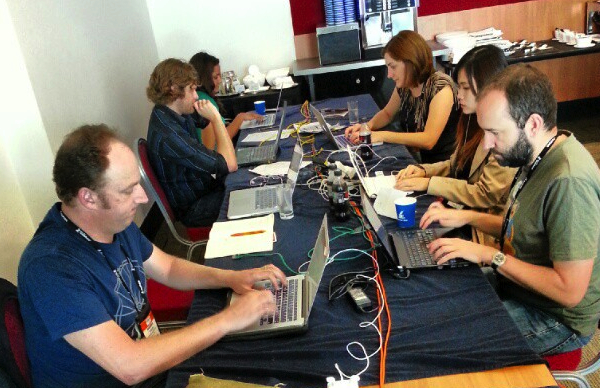
“I supposed at least he was honest,” said Duncan Riley when he passed on this story (pictured).
I’ll reproduce the text here so the search engines find it — which may or may not be a Good Thing. My website ends up in enough weird searches as it is.
Burglary
A 38-year-old Cole Avenue man reported that his home was invaded on Sept. 9. The man said that he was sitting home alone masturbating and watching a pornographic movie when a man came down into the basement, holding a gun, and started to videotape him. The man said that before he left, the intruder fed his dog some mushrooms and the dog died.
The story is supposedly from The Beacon Journal, Sunday 21 September 2003. If it’s a fake, someone’s gone to a lot of trouble.
Now, is this the weirdest crime story you’ve heard recently? Please, links to even weirder ones!
OK, that’s set the tone for the day…

When Chairman Rudd announced the Australia 2020 Summit the euphoria kicked in like a clean hit of a fresh new political drug. After 11 drab years of John Winston Howard, Change! Big, bright colourful change with sparkly bits and the sound of a thousand sitars! But now the euphoria’s wearing off. We’re coming down — and the Main Event is still a month away.
Kevin still looks pretty cheerful, though, doesn’t he. Why is that?
Look back through everything I’ve written so far and you can see the moodswing. “Chairman Rudd’s got a clever strategy going,” my first post began. Another post was headlined Australia, let the Enlightenment begin!, quoting Maxine “Toadslayer” McKew and agreeing that the nation was ready to start a new conversation about its destiny. At the end of February I even nominated myself.
Given Rudd’s claim that his government would be open and transparent, and develop policies based on evidence, it all sounded pretty good.
As days go by, however, it’s become increasingly clear that the potential of the event will be stifled by the political “need” to placate the same old whinging lobby groups, the same old middle-class middle-aged white men in dark suits (just flick through the Steering Committee) and, it seems, the “need” to pre-load the agenda with specific topics to… well, let’s explore that.
So last week Apple announced new products. Yawn. The Cult of Apple worshipped their God, and millions of words were written praising His Wisdom. However the most interesting comment I’ve read so far was about the political content of Steve Jobs’ presentation.
Alastair Rankine writes that the Macworld Keynote has moved from slick-but-reality-distorted marketing into the realms of straight-out entertainment, and then criticises Randy Newman’s performance. Not because it was crap (which, being Randy Newman, is inevitable), but because it was political.
Criticism of the Bush administration is something I obviously have a lot of time for. But is it suitable for a consumer product launch? …
Mix politics with business and you take a risk with a relatively small upside but a big downside. If your politics match mine, we are no more likely to do business together than before we knew each other’s positions. But if our politics disagree, this difference becomes a barrier that we each have to overcome in order to do business together.
I’m not arguing for censorship or anything. I’m just saying that the separation of politics and business is crucial for the success of both.
I disagree.
Business is about making money, yes, but sometimes I think it’s wrong to “leave politics at the door”. In fact, is it even possible?
Maybe those annoying socialists on King Street will finally achieve something with their endless petition-signing. Chairman Rudd will require parliament to formally consider and report on all petitions.
More than a million Australians signed 900+ petitions during Howard’s final three-year term. A grand total of 2 were responded to in some way. The other 99.8% were tabled and ignored.
My local MP Anthony Albanese, the “manager of government business” in parliament, says petitions won’t need to be sponsored by an MP any more. He reckons citizens have a basic right to petition parliament. And they’ll look into electronic petitions too.
That, and Julia Gillard’s announcement that NGOs receiving government funds would no longer be prevented from making political statements, are clear sings that maybe Kevin Rudd actually means what he says about strengthening the parliamentary system.
Well surprise surprise! The (former) government’s campaign to promote their dodgy NetAlert filter — it was cracked by a teenager, after all — over-stated the risk to kids on the Internet. And Senator Helen Coonan seems to have fibbed about what was in the government-commissioned report.
One advertisement said a survey had shown that more than half of 11-15-year-olds who chatted online were contacted by strangers…
[Coonan] refused to make the research public, saying it contained personal information. The Age has obtained the research, a survey prepared by the Wallis Consulting Group, under freedom of information laws. It does not contain any personal information…
[The claim] regarding stranger contact does not appear in the government-commissioned research. The question was not posed in this form. Participants were asked: “When chatting online, have you ever been contacted by someone you haven’t met in real life?” More than half answered “yes”.
So, a “stranger” is anyone you chatted with online, even a friend of a friend, who you just haven’t met physically. A “contact” could have been spam. Gee, we all have them, don’t we?
Human rights lawyer Geoffrey Robertson reckons Australia needs a Bill of Rights. I reckon he’s right about rights. And that’s because the central issue reminds me of when we were running The Core magazine…
The Core’s sole source of income was advertising, and most of it came from nightclubs. Nightclub managers are [coughs] the most honourable and [chokes] reliable [gargles] businessmen and women who can be found. Their integ… [coughs] [chokes] … sorry, I seem to have something caught in my throat.
They’d brag about how their new club night would be the biggest, brightest thing ever. “It’ll be huge,” they’d say. They’d want to book a heap of advertising — on credit, of course — and wanted discount.
“Sure,” I’d say, showing them our rate card and the discounts on offer.
“We’ll book a full page for 8 weeks then, for that 25% discount,” or whatever it was.
“Sure,” I’d say again. “Just sign here.”
And then they’d freeze.
Information Architects Japan have published a great guide to What Works on the Web — a good read for anyone wanting to do business online.
One section touches upon what I’ve been calling radical transparency — something which can shock clients more used to their suppliers spinning bull.
The openness with which we communicate here is not common. It has gotten some people suspicious and angry. We talk about clients that screwed us over (without mentioning their name, or even giving hints of course), contracts we didn’t get because we were not good enough, we shoot against people that are potential clients, we mess with one of the lungs of the blogosphere and one of the biggest marketing agency in the world started to get nervous after we opened fire against them and their unprofessional dubious practices.
This openness is to a certain degree an experiment, to a certain degree unavoidable, as it goes back to the character of iA’s peculiar owner. iA’s openness is based on the assumption: That being real works better that being virtual. In the so called virtual world as well as in the real world. Yes, in the business world as well: Because if you show your clients who you are, you are more likely to get the ones that understand you.
The definite reality check on that one is yet to come. But we are pretty optimistic.
I’ve written about transparency before, but it’s great to find a like-minded firm. Hat tip to Zern Liew.
It was Oscar Wilde or G B Shaw or — oh, somebody interesting — who, when accused of shocking people, replied to the effect that people should be shocked a good deal more often. Or offended. Anyway, I can’t find the right quote so here’s a different one.
I never travel without my diary. One should always have something sensational to read in the train.
That’s Wilde.
Yesterday we ruffled a client’s feathers. We were invited to tender for a web development project. Our response was, in essence, “Yeah we’re interested — but not if you’re going to do it that way. We don’t think that’ll work because [reasons]. We strongly recommend doing it [some other way]. Before we go any further, is it cool for us to tender that way, knowing that’s not what you asked for? Oh, and here’s the keys to our intranet, so you can see the dialog which led to this conclusion.”
Bang!
Someone’s worldview was gunned down ruthlessly! Politely, but we did use phrases like “high-risk death march”.
Now I should say that one of us worked with this client for almost a decade and the other has worked with them on two projects in the last year. So our comments were based on some knowledge of the organisation and its needs as well as our own professional opinions. Nevertheless, what we said was shocking.
I’ve always wondered why clear, direct communication is so rare in business. People seem almost afraid to say what they mean. “Don’t upset the client!” So a recommendation like “Process A is dangerous and you should change that immediately or risk almost certain failure” becomes a mealy-mouthed “Is everyone happy with the assumptions relating to Process A?”
All urgency is drained away. The project continues flying serenely towards the looming mountain.
But don’t upset the client.
If your recommendation is for major change, when do you broach the subject? Sign up to the “wrong” concept of the project and then try to change it? Leave it until people have spent more time going down the wrong path, and the deadline is closer? No, something so important should be communicated as soon as possible.
Organisations aren’t used to people speaking quite so directly. When it happens, it’s like a splash of iced water into the face. And sometimes, that splash into alertness is precisely what’s needed.
An open letter to family and friends of those who died in the crash of the Black Hawk helicopter on HMAS Kanimbla, and to those who survived.
I understand why you didn’t want the crash video made public. Every time you see it, you’ll re-live that crash. And every time, you’ll feel that black void of horror creeping back up into your mind. The horror may stay with you for years. It’s pretty fucked, I know.
But despite the on-going pain it inevitably causes, I think it’s not only reasonable that such videos be made public, I think it’s essential.
In 1992, there was another accident. During an army live-fire exercise, an assault rifle accidentally discharged and a soldier died. A very good friend of mine was holding that rifle. And while both a military inquiry and a civilian coronial inquest agreed it was an accident and found my friend blameless, the post-traumatic stress and guilt stayed with him for years — to the point where it became unbearable and he hanged himself at the end of 1996.
His parents were devastated. I wasn’t too thrilled either, having cut him down from the tree in my back yard and, later, helped carry him to his grave.
Some of us reckon the army hadn’t taken proper care of one of their own. The 2005 Senate inquiry into the The effectiveness of Australia’s military justice system agreed.
As a direct result of Senate recommendations, the inquiry into the Black Hawk crash was headed by a civilian judge — the first time that’d happened. And that judge declared the video should be released. It was right and proper that he do so.
Secrecy provides a breeding-ground for corruption.
Secrecy can be used to cover up incompetence.
Secrecy is, of course, essential in many military operations. But when it comes to finding out why a perfectly good helicopter slammed into the deck of a ship and then dragged two fine men to their deaths, secrecy has no place. Justice needs to be done — out of respect to those men, and out of respect to every man and woman who chooses to serve the Australian people in the armed forces.
Justice not only needs to be done, we need to see that it’s being done — and that means putting the evidence on the public record.
I’m sorry you’ve had to re-live the disaster. I know even reading this letter will hurt. I’ll have trouble sleeping tonight too, having re-lived my own story. That’s the price of Justice. It’s worth paying.
This morning’s Sydney Morning Herald has a story about how the Sydney Opera House website was hacked. It’s a nice explanation for the masses about how these things work.
But I think the SOH’s Claire Swaffield is disingenuous when she says that no customer data was disclosed.
Sure, the SOH customer database wasn’t affected. But if trojans were installed on visitors’ computers, then their data could well have been compromised — and the SOH doesn’t know how long that was happening.
Ms Swaffield’s comment is good for the SOH’s PR spin, maybe, but it isn’t the reality. A far more useful and, dare I say it, responsible statement would have been to say that while the SOH data wasn’t compromised, users should check their computers for infection — particularly if they’re not 100% sure their maintenance is up to date.

Some Australian airlines announced record-low $3 airfares this month. But do you really want to travel on an airline where you contribute so little money to pre-flight checks and other maintenance tasks…?


Recent Comments