
I saw these books sitting in a shop window the other day and the first thing I did was laugh. Why? Well, seeing the four lined up like this seemed like a list of clichés.
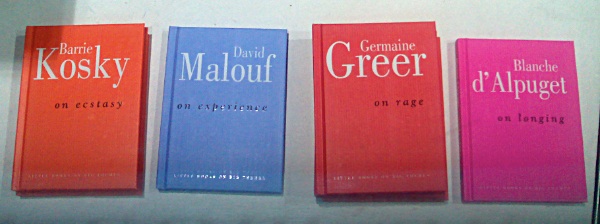
Germaine Greer On Rage? Well, yes, she does get more than a little grumpy, wink wink, eh? (Although as someone asked me, “Greer on Rage? What would she guest program?”) David Malouf On Experience? Yeah, he’s getting a bit long in the tooth, sure… and need I mention the probable subject of Blanche d’Alpuget’s longing in On Longing?
Yeah, time for another nudge-nudge wink-wink there too.
Now Mark Pesce tells me that Greer’s book is written in the context of the NT Intervention — something worth getting angry about. “A cogent book about rage,” he says. “Perhaps an important one. Time will tell.”
Sure, he’s a fan. Greer is an important public intellectual, though, and today’s First Dog on the Moon cartoon explains very well why everyone hates Germaine Greer. But for me the line-up of little pastel covers and the gift-set option tells me this is for people who want to look like they’re intellectuals.
If Greer’s book is indeed important, then it needs to be more than a fetish for someone’s mantlepiece, along with that unread (and unreadable) hardback of Umberto Eco’s The Name of the Rose. And maybe that means more descriptive covers?
I’m a little surprised that something so apparently important as Germaine Greer’s commentary on the NT intervention is published in a ‘collectable’ edition with such dubious company — her last rant on indigenous affairs was in Quarterly Essay which seems a better place for it.
I like GG — she’s a ratbag, and you can’t get much more Australian than that. If ratbaggery were an Olympic event we’d win lots of gold. Then again, I have read The Name of the Rose many times and it’s in the all-time favourite box. Foucault’s Pendulum on the other hand…
People should lay off Foucault’s Pendulum. It’s a lot more coherent and easier to read than a fair few blogs I can think of (not this one, obviously).
Oh don’t tell me that. I just started on The Name of the Rose the other night! I was hoping it just seemed obtuse because I was missing some backstory or historical reference or somesuch.
To bail out of a fight really quickly, I’ve not read Foucault’s Pendulum or indeed any Thomas Pynchon. I read very few novels these days, so something has to really grab me to get one of the limited spots.
@Quatrefoil: There’s a lovely commentary on last week’s Germaine Greer Tour of Australia over atLavarti Prodeo , entitled On Rage: Raging against Germaine:
Well, the answer to the commenter’s question is easy: In the increasingly-busy lives of producers and editors, Germaine Greer’s semi-regular visits, where she parachutes into Australia and says something that will almost inevitably sound controversial, it’s an easy way to fill your program or publication. Too easy, in fact. I think I’d brand it “lazy”.
(Yes, when I worked for ABC Radio I, too, relied on the “author tour” to fill airtime.)
The implication of that answer is that if you want an issue to be taken seriously, then Germaine Greer should not be your spokesperson. Any discussion will always descend into a battle about GG’s relevance, and the original point will be lost. Still, GG will have gotten her airtime, her reputation as an enfente terrible (or mad old cow) will be reinforced, and her book will sell.
Similarly, Melbourne University Press presumably knows that the gift-set market is another niche to exploit, and the aim is to provide names that the buyer recognises, not the eventual reader. Putting GG in there means that at least one of the authors will have been seen the Daily Telegraph — perhaps quoted well out of context, but that doesn’t matter.
The Lavartus Prodeo piece makes another interesting point:
@Giania: The “back story” of The Name of the Rose is, perhaps, Umberto Eco’s entire brain, filled as it is with obscure observations about the cross-linkages of signs and symbols throughout history. That’s his gig. I much prefer his witty and far more accessible essays and newspaper columns.
I do think The Name of the Rose will reward the persistent. But in the competition for my attention, in 2008 it would fail.
The first few pages, though somewhat perplexing in their unexplained depth, were definitely enough to goad me into reading further. Come to think of it, that’s what I’ll do while all these laptop backups are burning! Hell yeah multitasking!
I found Foucault’s Pendulum to be incredibly intimidating, it demands a notebook or a constantly open browser to be able to penetrate the extremely thick layer of specific references. It simply can’t be puzzled out from context alone, at least not at the beginning. That is one I set aside for another time. (Honestly, that might be a good bench test of the Kindle’s lookup capabilities, if I had the opportunity to play with one.)
Wait a minute – I *read* “The Name of the Rose”. He almost lost me when he wandered off into a page of Vulgate text, but I hung on through.
That is probably the most pretentious pop fiction I’ve ever read, or ever will read.
@Giania: Having a browser open to research what the author is talking about makes reading a novel a very different experience. It a Karin Slaughter thriller is a brisk stroll, then Pynchon or Eco is like an expedition to climb K2. Not for the faint-hearted, and not to be begun without preparation — but seriously rewarding. If you make it.
@mpesce: Yes, “pretentious” is the word. I just skipped over the Latin, Greek etc with the thought that a good writer makes thing clear to the reader. But then Eco is a good writer. Paradox!
No one reads books anymore video is King and VR is soon to be Queen
Ah, but if you dumbed down Foucault’s Pendulum you’d basically end up with The Da Vinci Code.
I agree that Germaine Greer both suffers from and exploits her media status, and frequently says something outrageous for shock value and attention. But she is, nonetheless, a good scholar and commentator. I recently read her latest book, Shakespeare’s Wife, and it’s a great piece of scholarship. I also went to hear her speak about it — that was more of a PR exercise with plenty to keep the punters happy, but it also contained some thought-provoking substance.
Re: The Name of the Rose — the book probably worked for me because it’s my own field of study and I did get a fair bit of the back reference, though by no means all of it, and certainly not the Greek. If you know something about the monastic debates in the thirteenth-century, it’s actually very funny (and yes, I realise that’s a limited audience). But Eco didn’t write it for a mass-market audience — it was picked up and marketed by the publisher and received a fair amount of success from word-of-mouth recommendations. It isn’t, and was never intended to be, pop fiction. Clearly enough people outside the medievalist academy liked it that it went on to be an international phenomenon. I didn’t get very far with Foucault’s Pendulum, partly because I think it lacked the playfulness of the The Name of the Rose, and perhaps because I know less about its background. So, I suggest that the issue about these books is one of audience.
The movie of The Name of the Rose is also one of my favourites. I don’t think it was a dumbing-down of the book at all, rather exactly what it says it is — a palimpsest, that is a text which has been written over another text so that you can glimpse the first text beneath it. And I also think the movie is very funny too. A friend of mine described it as ‘containing the largest concentration of ugly men in once place outside of the SCA’.
@Quatrefoil: I agree that the film of The Name of the Rose is a fine adaptation. And there’s Sean Connery, of course…