I’ve decided that each weekend I’ll dig out an object or two from my more distant past and write about it. To kick things off, here’s a challenge which was originally created by the same chap who coined my name.
The text you can see in the image below (at least if you happen to be sighted) is in an unknown script. Your task is obvious, I think.
The only clues you have are that it’s a quote from a book by Ursula LeGuin and it’s nothing whatsoever to do with Tolkein.
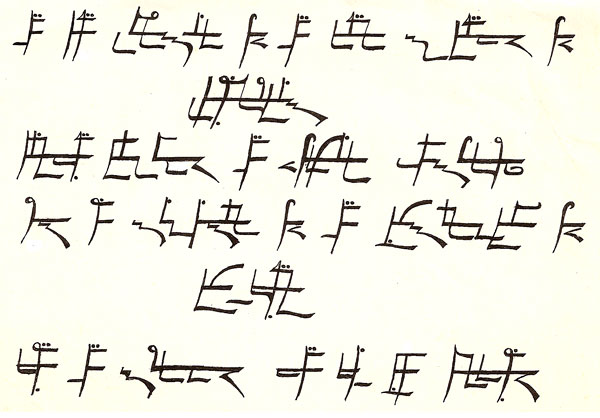
Now originally I solved this in under 2 days, without the aid of computers or amphetamines. I reckon that in The Age of the Internet you can do better. I’ll negotiate a suitable prize for the first person who posts the solution.
It’s been 14 months, Stil. No takers.
That tells me that the other 99.96-ish per cent of the population (like me) who aren’t cryptography geeks, will need the help of our protocol droids if we’re to solve this without shelving all our commitments for a month or whatever.
*our own, dammit.
Stephen Stockwell: I find looking at the preview of your post and correcting problems before posting to be invaluable. 🙂 OTOH, I could register you so you can edit your comments? Editing the past is quite popular now that everything is digital.
As far as cryptanalysis goes, this puzzle is real beginner-grade material. I’m quite surprised no-one’s even had a go.
Cryptanalysis personally = Could. Not. Be. Arsed. Ball-tearer of an interesting subject, though.
I’ve had a brief look at this following your tweet about nobody solving it.
Observation 1. It could be a simple character substitution code given that at least two “scribbles” are repeated throughout the script – the first “scribble” and last “scribble” on the first line for instance. If this is the case the commonly used English character frequency of letters table starting ETANOISH… could be of use.
Observation 2. Although you state it has absolutely nothing to do with “Tolkien” clearly this is a clue in itself and research into Tolkien is clearly in order. I note the the “Tolkien logo” bears a resemblance to the strokes (scribbles) in the script.
Observation 3. If this is a character substitution code and if each line is a word then the second line could only be the “word” a or i.
Observation 4. If the second character is an a or an i and if each line is a word then the penultimate line would be a two character word that could only start with an a e i o or u. If the second letter is an a or an i this reduces the number of permutations to words such as it or of etc.
Observation 5. I had never heard of Ursula LeGuin but Google research into “quotes Ursula LeGuin” results in quite a few interesting observations about life the universe and everything but none quite match my deliberations although “if you light a candle you also cast a shadow” has an appropriate place given that it has an “a” where I might expect to find an “a”.
@Bob Bain: Your approach to cryptanalysis is taking the right path, mostly. My Tolkien comment was originally because his Tengwar script, also known as Feanorian letters, is the one which appears most frequently in his work — and the first wrong path which some people have taken when trying to solve the puzzle.
This sample reads “Ennyn Durin Aran Moria: pedo mellon a minno”, which is Sindarin, an elvish language, for “The Doors of Durin, Lord of Moria. Speak, friend, and enter.” I could once read and write those letters, some decades ago, but I never went as far as to learn the languages themselves. I could pronounce the words, but not understand them.
That LeGuin quote you found is indeed beautiful, but it is not the one. The full context, from the first of her Earthsea trilogy, A Wizard of Earthsea, is some advice to the young wizard Sparrowhawk:
Now as I say, Bob, your approach is mostly the right path. The language is English, just written in a different alphabet. A letter-frequency attack is the right first step for a letter-substitution cypher. But this is not strictly a letter-substitution cypher.
One more clue: Not all alphabets have the same number of letters. Why is that?
Right the greek alpahbet has 24 letters alpha beta though to omega
http://en.wikipedia.org/wiki/Greek_alphabet
The Phoenician alphabet (linked to above) offers some promise but there is no clear relation between the symbols in either the Greek or Phoenician alphabets to the script above.
Wikipedia informs me in their article on Egyptian hieroglyphs that there are logographic and alphabetic representations. The Japanese I seem to recall tend to mix their logographic symbols with English and/or European characters which makes travelling in Tokyo quite interesting as the English bits give an idea of what’s going on.
(working on it.. working on it… It’ll take longer than two days !)
It seems to me that some of the letters have an inordinate amount of strokes. So, I’ll offer the hypothesis that the number of strokes and dots in each letter has some relationship to the plain-text. With the number of dots in parentheses, my count of the strokes are
4(2) 5(2) 13(1) 4(0) 4(2) 6(2) 12(2) 4(0)
14(3)
9(4) 12(0) 4(2) 9(1) 14(0)
6(0) 2(1) 17(2) 4(0) 4(2) 19(1) 4(0)
12(3)
3(3) 4(2) 12(0) 4(2) 5(1) 5(1) 10(2)
Now, this all looks good up until the last line, where two sets of different letters have the same number of strokes and dots – which may be intentional, as a coding device to represent an English (or more correctly, Latin) letter with two or more coded letters, or it may not be, in which case the substitution breaks.
Perhaps there is meaning as to whether the dot is above or below the central horizontal axis of the script, which would allow the two 5(1)’s to be different letters, but the similarity of the two 4(2)’s on the final line would tend to disprove the hypothesis.
That’s about as far as my reasoning takes me, pre-coffee on a Sunday morning.
@Jason Langenauer: Welcome to the Game, Sir! Now, what is a letter and what is a word? Inordinate numbers indeed — or perhaps not.
I have often found it useful in many problem domains to list out the assumptions one is making, so that they may be validated. So, what are the assumptions in play here? And how can we validate them?
1. That each grapheme in the script is separated from other graphemes by a continuous section of space. This means, that the fifth line is one character, not two as @bob_bain has suggested. Can we prove or disprove this? Not really, so lets keep it as a working assumption.
2. That there is a one-to-one correspondence between a grapheme in the script, and a letter in the Latin alphabet – i.e. each grapheme maps to exactly one Latin letter, and each Latin letter maps to exactly one grapheme. Can we prove or disprove this? Yes, because Stilgherrian confirmed it when he said the “The language is English, just written in a different alphabet”.
3. That the different lines represent new words – i.e, based on the first assumption, the English quote is of the form “xxxxxxxx x xxxxx xxxxxxx x xxxxxxx”. Hmm, that’s a problem that could be solved rather quickly with a Regex and the text of Ursula LeGuin’s works. But that would hardly be sporting. Can we prove or disprove this? Not really, but it’s worthwhile to keep in mind other possibilities: that no word breaks are used, ASENGLISHCANBEWRITTENLIKETHISWITHOUTLOSINGMUCHMEANING, or another grapheme is used as a “word-break” character – the last character of the first line is a possibility.
More thought required here…. but at least I learnt a new word (“grapheme”).
@Jason Langenauer: “Grapheme” is indeed a wond’rous word. “Alphabet” is an interesting word too, and one which deserves further consideration.
Ah hah
Currently considering FONTS !
e.g.
http://www.searchfreefonts.com/free/bisaya-1880.htm
Type Stilgherrian into the box and you get symbols with dots and lines BUT if the solution is a FONT then this isn’t the font that may be being used as it doesn’t produce the required graphemes.
Microsoft Wingdings doesn’t work either !
Some of these non-latin fonts approach the type of grapheme being considered.
(working on it.. working on it… )
Stilgherrian’s comment that “grapheme” is indeed a wond’rous word…
reference http://en.wikipedia.org/wiki/Grapheme
“A grapheme (from the Greek: γÏάφω, gráphÅ, “write”) is the fundamental unit in written language. Examples of graphemes include alphabetic letters, Chinese characters, numerical digits, punctuation marks, and all the individual symbols of any of the world’s writing systems.”
noting that “Alphabet” is an interesting word too, and ONE WHICH DESERVES FURTHER CONSIDERATION” appears to indicate that we can ignore Chinese characters, numerical digits, punctuation marks, and the odd assortment of individual symbols of any of the word’s writing sytems.
This rules out such things as Ideograms http://en.wikipedia.org/wiki/Ideogram
“An ideogram or ideograph (from Greek ἰδÎα idea “idea” + γÏάφω grafo “to write”) is a graphic symbol that represents an idea or concept. Some ideograms are comprehensible only by familiarity with prior convention; others convey their meaning through pictorial resemblance to a physical object, and thus may also be referred to as pictograms”
Over the coming weeks I’m concentrating on fonts ! 🙂
@Bob Bain: It’s good that you’re clarifying all the terms — “alphabet”, “grapheme”, “ideogram”, “font”… but pursuing fonts as such is the wrong path. This is a new, unique script, and I reckon the picture in this page would be the only example on the entire Internet.
I won’t say any more just now, because someone’s high school English class will be having a go at this soon. Not too many clues!
Fonts are interesting in their own right and I am delving into aspects of Microsoft Word at Penrith Valley Seniors Computing Club – so even though fonts may not have any direct relevance to this puzzle I will be looking at fonts in the ensuing weeks.
With regards to an aspect of alphabets we the puzzle solvers are overlooking I digged this out from the Interernet last night.
http://www.answers.com/topic/history-of-the-alphabet
No doubt the English class mentioned in your entry this morning can find the aspect of alphabets we seem to be overlooking noting that alp = “ox” and bet = “house” in the Proto-Canaanite invocation of this phenomena.
I await insight from those much younger than myself !
Ok, I think I understand the principle, but then I should.
I wonder whether you had to go to the library to sort this out back when it was first set?
I’m up for the challenge.
@Quatrefoil: Glad you’re joining the fray. No, I didn’t need to go to the library.
Interesting: the Tolkien script uses those accent-like dots and squiggles for vowels, so for example the first word, transliterated as Ennyn, is really [n][n] with an [underlined acute] meaning [e], and a [pair of dots] meaning [y]. I speculated there was something similar in your example: the first symbol (top left), looking like an F with two dots, recurs in a bunch of places, and there are also similar ones with different dots and frou-frou, like the second symbol on the fourth row. I’m dividing the larger symbols into what I think are letters — for example, the first one on the bottom line may be one of those F things with one dot and a loop, preceded by a smaller L shape. Two letters? Three, counting the loop+dot as a vowel? Perhaps. I should really be working…
Argh. I used to have a key to this. Possibly still do, probably in the back of some old mathematics notes. From 1978. My goodness this brings back very old memories. I wonder if I can remember the logic behind the script. As I look at it some of it comes back to me. I remember when Danny was creating it.
Stilgherrian may not have found it necessary to go to a library to solve this as I get the impression that he is a fan of this type of fiction and so has a head-start over those of us who haven’t quite got the hang of it. I have therefore been delving into the works of Ursula Le Guin and have discovered that in the Wizard of Earthsea Le Guin introduced a “special language”
http://stuffedhead.wordpress.com/2009/03/21/88/
Part I: Magic Controlled by Speech
One of the most well known aspects of the Earthsea series is the magic system. Le Guin created a system where wizards use a special language called the Old Speech to work magic. As a passage from A Wizard of Earthsea explains,
“In the world under the sun, and in the other world that has no sun, there is much that has nothing to do with men and men’s speech, and there are powers beyond our power. But magic, true magic, is worked only by those beings who speak the Hardic tongue of Earthsea, or the Old Speech from which it grew.â€
Now if a person has read Le Guin’s works then he or she would have a head start over the rest of us methinks…
Update.. checked out Le Guin in the Galaxy Bookshop. She wrote verse about hexagrams which leads me to the I Ching.
http://en.wikipedia.org/wiki/I_Ching
The text of the I Ching is a set of oracular statements represented by 64 sets of six lines each called hexagrams (å¦ guà ). Each hexagram is a figure composed of six stacked horizontal lines (爻 yáo), each line is either Yang (an unbroken, or solid line), or Yin (broken, an open line with a gap in the center). With six such lines stacked from bottom to top there are 26 or 64 possible combinations, and thus 64 hexagrams represented.
The oracular interpretation of the symbolic language based on trigram symbols formed from yang and yin components is well known. However, the inherent numerical language of line change and non-change is relatively unknown.
==================
ah hah ! Progress !!
I’m making a very different set of assumptions to yours Bob – I think it’s a whole lot simpler than that. I don’t think it’s a numerically based script – I did think about twig runes which work as a counting code, but I don’t think it’s that.
I have now eliminated quite a few possibilities for words, but haven’t found any definite combinations.
I’m proceding on a largely grammatical/linguistic basis.
And it would be very useful to know a tense, but that would feel like cheating.