
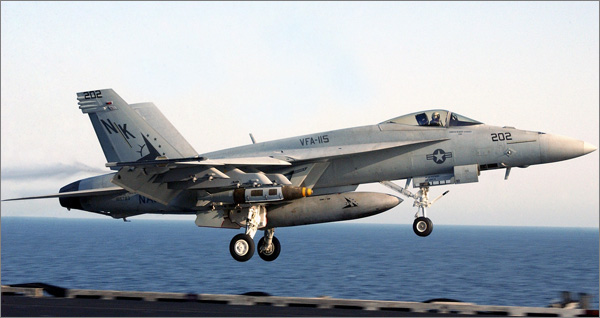
Defence minister Joel Fitzgibbon has announced that the controversial purchase of 24 Super Hornet aircraft will go ahead.
The review of the Howard government’s decision to buy the aircraft — at a total cost of $6 billion even though the RAAF hadn’t wanted them — reached some damaging conclusions, including:
- There has been a lack of sound, long-term air combat capability planning decisions by the former Government over the course of the last decade.
- The retirement of the F-111 was made in haste but is not irreversible. The cost of turning the F-111 back on would be enormous and crews and skills have already moved on.
- The former Government’s decision to leave Australia’s air defences in the hands of the Joint Strike Fighter project was a flawed leap of faith in scheduling terms and combined with the quick decision to retire the F-111 early, allowed an air combat capability gap to emerge.
- The subsequent timetable the former Government put on the acquisition of an interim fighter left Defence planners with no choice but to recommend the Super Hornet. No other suitable aircraft could be produced to meet the 2010 deadline the former Government had set. One year on, that is now even more so the case.
Cancelling the order would still incur a financial penalty and create “undesirable tensions”, and the final conclusions is that “the Super Hornet is an excellent aircraft… and is the only aircraft which can meet the small delivery window created by the former Government’s poor planning processes and politically-driven responses.”
As a shareholder in Australia Inc, I’d like to know why the former “board members” allowed this to happen. When company directors are negligent they become personally liable so why, given the report’s damning conclusions, does Brendan Nelson not become personally liable?
Why were established evaluation and purchasing processes ignored? What is the connection between former defence minister Brendan Nelson (a member of the Liberal Party), and the then chairman of Boeing Australia, Andrew Peacock, a former leader of the Liberal Party?
Hat-tip to Tim Dunlop, who also notes:
[D]o you make procurement decisions on the basis of strategy or is it on occasion necessary to build strategy around procurements that have already been made? I mean, the White Paper may be still six months away but it is hardly as if it is being written from scratch. It looks like Fitzgibbon has decided that getting the Super Hornet decision locked away was the more important factor and is happy enough to make strategy decisions with the Super Hornets in the mix. To paraphrase another Defence Minister/Secretary, sometimes you do strategy on the basis on the equipment you have.
As in this case. We’re buying the Super Hornets because, essentially, it’s the only choice left.
[Photo: A US Navy (USN) F/A-18E Super Hornet aircraft, Strike Fighter Squadron 115 (VFA-115), Naval Air Station (NAS) Lemoore, California (CA), launches from catapult three during flight operations on board the USN Nimitz Class Aircraft Carrier USS Abraham Lincoln. US Navy via Wikipedia.]

A fascinating comment at Aviation Week. Apparently if the aircraft doesn’t meet the requirements, you just say the requirements don’t matter!
I’ll have to see if the Australian review just completed published what the criteria were for rating the aircraft as “excellent”…
Yup fancy avionics alone in the form of the Block II variant of the Super Hornet do not a combat jet make.
What is worse though is that 4 senior defence officials have come out and said that the Super Hornet can take on all known threats ( this btw is highly questionable and ignores some basic facts about modern air combat.)
In any event, where it gets interesting is that since the senior defence officials have stated Super Hornet can handle known threats. There is now… no justification for the Australian taxpayer to hand out 14,… 15… up to $16 billion or more for the unproven and yet to be complete Joint Strike Fighter.
Reading that article it often makes you wonder,why Australia has to buy such a inferior aircraft,as it is not even close to the performance of the Russian fighters such as the MIG 29 Fulcrum or the SUKHOI su 33 Flanker-D as they both have a better speed than the Hornet and a much higher service ceiling the facts speak for themselves.
MIG 29
General characteristics
* Crew: On
* Length: 17.37 m (57 ft)
* Wingspan: 11.4 m (37 ft 3 in)
* Height: 4.73 m (15 ft 6 in)
* Wing area: 38 m² (409 ft²)
* Empty weight: 11,000 kg (24,250 lb)
* Loaded weight: 16,800 kg (37,000 lb)
* Max takeoff weight: 21,000 kg (46,300 lb)
* Powerplant: 2× Klimov RD-33 afterburning turbofans, 8,300 kgf (81.4 kN) each
Performance
* Maximum speed: Mach 2.25 (2,445 km/h, 1,518 mp
* Range: 700 km (430 mi)
* Ferry range: 2,100 km (1,800 mi) with 1 drop tank
* Service ceiling: 18,013 m (59,100 ft)
* Rate of climb: initial 330 m/s average 109 m/s 0-6000 m [78] (65,000 ft/min)
* Wing loading: 442 kg/m² (90.5 lb/ft²)
* Thrust/weight: 1.13
THE F/A 18E SUPER HORNET
General characteristics
* Crew: F/A-18E: 1, F/A-18F: 2
* Length: 60 ft 1¼ in (18.31 m)
* Wingspan: 44 ft 8½ in (13.62 m)
* Height: 16 ft (4.88 m)
* Wing area: 500 ft² (46.45 m²)
* Empty weight: 30,600 lb (13,900 kg)
* Loaded weight: 47,000 lb (21,320 kg) (in fighter configuration)
* Max takeoff weight: 66,000 lb (29,900 kg)
* Powerplant: 2× General Electric F414-GE-400 turbofans
o Dry thrust: 14,000 lbf (62.3 kN) each
o Thrust with afterburner: 22,000 lbf (97.9 kN) each
* Internal fuel capacity: F/A-18E: 14,400 lb (6,530 kg), F/A-18F: 13,550 lb (6,145 kg)
* External fuel capacity: 5 × 480 gal tanks, totaling 16,380 lb (7,430 kg)
Performance
* Maximum speed: Mach 1.8+[11] (1,190 mph, 1,900 km/h) at 40,000 ft (12,190 m)
* Range: 1,275 nmi (2,346 km) clean plus two AIM-9s[11]
* Combat radius: 390 nmi (449 mi, 722 km) for interdiction mission[70]
* Ferry range: 1,800 nmi (2,070 mi, 3,330 km)
* Service ceiling: 50,000+ ft (15,000+ m)
* Wing loading: 92.8 lb/ft² (453 kg/m²)
* Thrust/weight: 0.93
THE SUKHOI SU33
General characteristics
* Crew: 1
* Length: 21.94 m (72 ft)
* Wingspan: 14.70 m (48.25 ft)
* Height: 5.93 m (19.5 ft)
* Wing area: 62.0 m² (667 ft²)
* Empty weight: 18,400 kg (40,600 lb)
* Loaded weight: 29,940 kg (66,010 lb)
* Max takeoff weight: 33,000 kg (72,750 lb)
* Powerplant: 2× AL-31F afterburning turbofans
o Dry thrust: 7,600 kgf (74.5 kN, 16,750 lbf) each
o Thrust with afterburner: 12,500 kgf (122.6 kN, 27,560 lbf) each
* Wingspan, wings folded: 7.40 m (24.25 ft)
Performance
* Maximum speed: Mach 2.17 (2,300 km/h, 1,430 mph) at 10,000 m (33,000 ft) altitude
* Stall speed: 240 km/h (150 mp/h)
* Range: 3,000 km (1,860 mi)
* Service ceiling: 17,000 m (55,800 ft)
* Rate of climb: 325 m/s (64,350 ft/min)
* Wing loading: 483 kg/m²; (98.9 lb/ft²)
* Thrust/weight: 0.83
* Maximum turn: +8 g[8] (+78 m/s²)
* Landing speed: 235-250 km/h (145-155 mph)
and as for the future acquisition of the F22 raptor they may have a better service ceiling than the MIG 29 and the SU 33 and a greater speed than the SU 33,the stealth capabilities that they are raving on about will be obsolete by the time Australia(if ever allowed to purchase )will receive these aircraft,as the Russian military is developing the type of broard spectrum radar Bandwith that will allow the F22 raptor to be seen,so it will loose its stealthy characteristics.
In conclusion i dont see why Australia should buy these aircraft from America as they in my opinion are far less of an aircraft then the Russian Fighters but on the other hand Austraila has the capability to manufacture its own military hardware if the governments of the day have the vision to develop the manufacturing,as we did manage to do in ww2,all be it with lack of government interest to support the Home manufactured product,as they were keen to purchase the foreign manufactured fighters,its just the same as then but now they are billions more in cost and a lot more complex with a lot more to go wrong.
@nqm: Military aviation isn’t my speciality. I just look at the shiny toys and go “wow” and then think of the hypocrisy. And yet, I can’t help thinking these purchasing decisions are a tad more complex than an armchair perusal of the specifications.
I was recently discussing with an ex-RAAF mate an article which suggested Chinese military hardware might be a good buy. He responded thusly:
I imagine the same goes for Russian kit.
These are long-term and extremely expensive decisions. While there’s a feeling that “Our Friends in America” may be a too-obvious choice, can the same be said looking 20 or 30 years ahead? Personally, I don’t know the answer. I’m not saying our government necessarily does know. But I’m betting listing specifications isn’t the only angle.
This is certainly the case in areas I do know about, like IT. Far too often I’ve had clients insisting on choosing certain hardware ‘cos they thought they were getting better performance for less money. Until something went wrong — and they had to face the reality of reliability levels, response times for technical support, quality of documentation, availability and delivery time of replacement parts…
Of course, the Super Hornets decision is wrong through and through because, as I say, the Air Force never wanted them but the (previous) government bought them anyway — from a company chaired by a guy who used to be one of their own. Fishy.
I would tend to agree that the integration is a huge issue, but the American system of after sales maintenance is not so flash either the reason I say this is because that there is issues with the flyby wire codes that Australia would need to use for maintenance of the aircraft and Boeing will not release these codes to Australia for its own use, in my opinion that is heading us down a very dangerous path, where Boeing can and will charge whatever price it wants to, for the maintenance of the aircraft, and the government will have no choice but to fork out more of our tax dollars, just to get them maintained, the Americans will once again have Australia over a barrel, and we will have no choice but to take it with a smile, but on the other hand the Russian after sales service may not be that good either but at least all there upgrades for the MIG 29 fit into the same airframe, and that may well be why they are sold through out the world to the less financial countries, but it really goes without saying that if we ever do build our own fighters, the fact of integration should not really be a problem, as we can build them how we want them, if the “allies” are worried about the integration of our aircraft to work seamlessly with theirs they can and will manage to work around it.