media140

You are currently browsing articles tagged media140.

“Destroying your world, tweet by tweet, like by like” was the title of my presentation at DigitalMe, an event held in Perth on 27 April 2012.

Facebook, Twitter and social mobile applications encourage you to share your life. But what happens when you share too much? Every time you share, tweet, email or browse a website you leave a digital footprint that reveals far more than you may realise — or want. Find out what Facebook, Twitter and the secretive online advertising companies know about you and take control.

The full presentation itself will appear here as soon as the video can be processed, and across this last weekend in April I’ll be adding the references.

I’ll be in Perth on Friday 27 April to present at DigitalMe, one of a series of media140 events, the other two being DigitalBusiness on Thursday 26 and DigitalFamily on Saturday 28 April.

(These events are part of the City of Perth’s Innovation Month. It looks like there’s some good stuff happening, including the screening of some classic futuristic films.)

DigitalMe is a full day of activities that “takes the individual on a journey through the digital landscape of blogging, video, personal privacy, personal reputation, mobile web and social media helping to demystify the digital world and understand more about your personal digital footprint.”

My half-hour session at 2pm is “Destroying your world, tweet by tweet, like by like”:

Facebook, Twitter and social mobile applications encourage you to share your life. But what happens when you share too much? Every time you share, tweet, email or browse a website you leave a digital footprint that reveals far more than you may realise — or want. Find out what Facebook, Twitter and the secretive online advertising companies know about you and take control.

I covered some related themes in a piece for the Sydney Morning Herald a few weeks back.

DigitalMe is being held at Northbridge Piazza. It’s free, but you’ll need to register online.

I’m flying into Perth on Thursday 26 April around lunchtime and leaving on Sunday 29 April in the mid-afternoon. My schedule is fairly open so far, so other diversions are welcome.

The audio of last Thursday’s media140+ panel discussion on Digital Anonymity is now online — and you have a choice of listening.

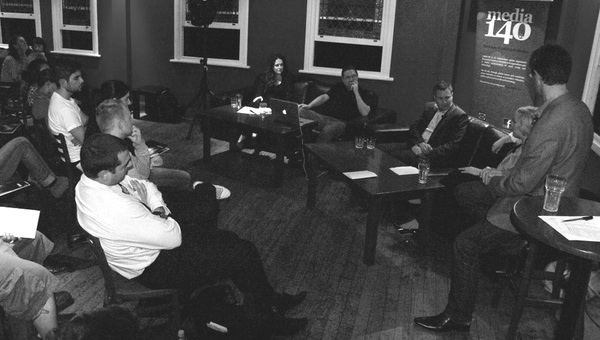
Panellists were (left to right in the photo) Jessica Hill from ABC Radio current affairs; me; lawyer David Stewart from Wrays; Karalee Evans, senior director & APAC digital strategist from PR firm Text 100; and moderator John Kerrison from Sky News Australia.

Note that I could have embedded playable audio directly into this web page, but why should I give Audioboo and CBS Interactive the ability to track visitors to my website, whether they play the audio or not?

Embedding may be convenient, but that convenience is paid for with the privacy of your website visitors.

[Photo: The media140+ panel discussion as photographed by Neerav Bhatt. Image turned to black and white by me, used under a Creative Commons BY-NC-SA license.]

The Media140 folks are running a panel discussion in Sydney this Thursday 24 November on Digital Anonymity: Do we have a right to anonymity online?

As Google and Facebook try by force to remove anonymity from the web, is privacy no longer seen as a fundamental right? Will it become a commodified product we will have to purchase? We take a look at the legal, social and media perspectives and ask the question is it really that important?

The moderator is John Kerrison from Sky News Business, and the panel includes Anne Hurley, the interim head of the Internet Industry Association Karalee Evans, senior director & APAC digital strategist, Text 100; Jessica Hill from ABC Radio current affairs; lawyer David Stewart from Wrays; and [coughs] me.

It’s at the Hotel Clarendon, 156 Devonshire Street, Surry Hills. 6.30pm for a 7pm start, $10m admission, and I’m told you’d better book.

Mr Kerrison seems to be taking it very seriously, with scenarios to discuss and all sorts of actual planning. We should be able to derail him pretty quickly, I should imagine.

[Update 22 November: Edited to reflect the change in line-up.]

This Friday 18 June 2010 (i.e. tomorrow) I’m liveblogging from X|Media|Lab’s Global Media Ideas conference at the Sydney Opera House. And to be honest, I really don’t know why.

Well, I do know why. I was invited to. And I said yes. But my reticence, if that’s the right word, is based on two concerns:

  1. I’m starting to think that liveblogging is a wank.

    I’ve previously written that Twitter is useless for covering conferences and, yesterday, that Twitter is useless for political debates. Liveblogging isn’t much different. Just because technology enables something to be done doesn’t mean that it’s useful. Especially this instant-comment stuff.

    If the aim is to deliver the conference experience to people who can’t attend physically, then we’ve got streaming video or — gasp! — television.

    If the aim is to give people my thoughts about the event, then surely it’d be better for me to take notes and then, later, write something coherent. Not deliver a dribble of instant judgements on what’s being said. Such live streams always tend towards superficial quips, jokes and out-of-context sound bites.

  2. Haven’t we really had quite enough talking about “ideas”?

    This event is part of Vivid Sydney, “a festival of light, music and ideas”. Now don’t get me started on the “light” bit. My opinion of people who think that pointing coloured lights at city buildings is somehow the height of creativity can only be expressed using strings of Anglo-Saxon words and references to veterinary apparatus that are completely inappropriate at this hour of the day. Even for me. No, the “ideas” part is sufficiently rage-inducing.

    We’ve only just had TEDxSydney, “Ideas worth spreading”. I find the whole TED thing a bit of a wank. They’re an idea-junkie’s equivalent of a Tony Robbins seminar. Quick, high-energy presentations that get everyone’s adrenalin going, mixed with a burst of endorphins from having supposedly learnt something new. From being “inspired”. And then everyone goes back to being the same middle-class consumption-driven tool they were before, desperate to buy their iPad on Day One lest they somehow fall behind. Until the next chance to break out of their dull routine and, once more, be “inspired”.

    Maybe it’s time, especially in this whole “OMFG what’s happening to the media?” realm, to start moving beyond talking about “ideas” and get on with the “doing”. Or, even better, some “achieving”.

    As Thomas Edison said, Genius is one percent inspiration, ninety-nine percent perspiration.

    And you know what? Once we’ve achieved something, there’s no need to create a presentation in Keynote — never PowerPoint, oh no! — with big, bold Creative Commons-licensed photos and maybe three big words on screen in Helvetica, in yellow. No, we can just STFU and go and achieve something else.

None of this is meant to be critical of X|Media|Lab. In my experience, their conferences such as Media 2010 have been professionally-run events with a fascinating range of speakers. I’m flattered, I suppose, that they think my presence is of value.

However X|Media|Lab is a commercial operation serving a market that, clearly, is there to be served. Events like TEDx and Media 2010 and this one and Media140 Sydney last year are always sold out. X|Media|Lab makes money — good on ‘em! Everyone has a feel-good time. But what do events like this really achieve?

Maybe I’m being too harsh. Maybe The Lab days on Saturday and Sunday are the meat of the event. (I’d link to the page about The Lab if the website actually let you link to individual content pages. Twats.) Sixteen “innovative Australian digital projects” get two days of mentoring from heavies in “the industry”. Good for them.

But I am concerned that the conference day, tomorrow, is billed as “No time-wasting boring panels, just densely-packed, information-rich, clear and helpful, set piece keynotes from digital media luminaries from all over the world.”

If I have one complaint about almost every conference I’ve ever attended, it’s that there’s never enough time for discussion. The discussions are where everyone learns. If it’s just going to be one-way communication, a “luminary” (ugh!) talking at people, then that can be achieved by putting a video on a website. We can skip the pretension of booking a venue at the Sydney Opera House.

Anyway, here is the liveblog page. Things will kick off around 9am tomorrow Sydney time. Just be aware of how I’m currently thinking about this event.

Since the most popular posts for 2009 were pretty disappointing, I reckon, here’s my personal selection of my thirteen best, more timeless posts for 2009. Happy reading!

[Update 29 December 2009: In case it isn't obvious, these are in order of writing through the year, not of merit or anything else.]

  1. Jim Wallace’s pro-censorship lies and distortions (26 January) It disgusts me that someone claiming to speak on behalf of “moral” Christianity deliberately distorts the evidence and misrepresents his opponents. It’s the most appalling hypocrisy. While this piece relates to specific events in the news, the explanation of his dirty tricks stands the test of time, methinks.
  2. “Clive Hamilton, you’re really starting to shit me!” (16 February) Wallace’s compatriot Clive Hamilton is equally guilty of dodgy rhetoric and straight-up misrepresentation. Again, some useful lessons about political messaging.
  3. Fisting Twitter and the birth of “trend fisting” (1 March) This was the most popular post too. Perhaps this is my true legacy from 2009?
  4. Pia Waugh: An interview for Ada Lovelace Day 2009 (24 March) This video interview was recorded before Pia started working for Senator Kate Lundy. An interesting backgrounder.
  5. Anzac Day 2009: Sacrifice (25 April) Anzac Day always brings out my reflective nature — though perhaps only I would start an Anzac piece with cat vomit.
  6. Look, about that damn topless gnome… (27 May) I’m annoyed that a tangential discussion about a $3.50 garden gnome soaked up so much time which should have been spent on the real purpose of Project TOTO. Nevertheless, it gave me a chance to make some points about independence and how organisations can get trapped in their own worldview.
  7. The Poverty Web (3 July) The only lengthy Project TOTO piece to be written while I was actually in Tanzania, and still perhaps the best — though more will emerge. Eventually.
  8. The really real revolutionary revolution of the Internet (23 July) I posit that things like the many Government 2.0 initiatives are still only nibbling around the edges.
  9. Conversations are not markets, people! (26 July) This one was popular. I’ve noticed that this year I’ve been increasingly concerned about the focus on markets and business at the neglect of other aspects of our society.
  10. Risk, Fear and Paranoia: Perspective, People! (27 September) Penny Sharpe MLC asked me to say something controversial at her NSW Sphere event on 4 September. Here it is. The full video and transcript of my somewhat rambling discussion of the challenges facing the Government 2.0 revolution.
  11. Letter from Newcastle (8 October) I wrote so very few “observational essays” in 2009. This is the best, I reckon.
  12. Media140: What do journos do better, exactly? (5 November) My presentation to Media140 Sydney was widely misunderstood. I was posing a question, a challenge, not saying that journalists have no purpose. What I was trying to say was that in a rapidly-changing media landscape, employee-journalists need to be able to answer this question.
  13. Virgin Blue’s mistake reveals countless selfish whingers (15 November) Apart from all my writing about Internet censorship, the other prominent theme does seem to be a certain dissatisfaction with selfishness and consumerism. What struck me most about the comments on this piece was that those who disagreed took it all so very personally.

One thing this list doesn’t reflect is that so much of my writing was elsewhere this year. My plan to do more paid media work and less geek-for-hire did actually unfold reasonably well.

I’ve been very happy with some of the pieces I wrote for Crikey, newmatilda.com, ZDNet.com.au and ABC Online, and the work I did on the podcasts A Series of Tubes and Patch Monday, and even the various radio and TV interviews that were linked to as the year progressed.

Most of the written material is linked from my Media Output page. I encourage you to explore — if only for your children’s sake.

You might also like to check out my personal favourites from 2008.

Stilgherrian’s links for 08 November 2009 through 18 November 2009:

See what happens when you don’t curate your links for ten days, during which time there’s a conference which generates a bazillion things to link to? Sigh.

This is such a huge batch of links that I’ll start them over the fold. They’re not all about Media140 Sydney, trust me.

Read the rest of this entry »

Media140 logo: click for more info

Whew! Media140 Sydney was exhausting and several kinds of wonderful despite some irritation. Many thanks to Julie Posetti and Ande Gregson and Sarah Allen and everyone else.

Oh, a thousand loose ends to tie up! How will I respond?

  • I’ll make only a superficial pass through everything today, ‘cos I have other commitments. Mostly that’ll be reviewing all the open tabs in my web browser and quickly reviewing my messages on Twitter and adding things to my to-do list for later.
  • As I do that, I’ll link to everything I find. You can follow that on my Delicious links tagged “media140″. I’ll also post the more significant notes on my Twitter stream.
  • While I’m doing that, I may post quick drive-by comments on other people’s blogs, but mostly I’ll leave them for a couple of days.
  • I’ll also be compiling notes for follow-up posts. One will expand upon my own presentation, which is already getting interesting comments. Others will reflect upon other people’s presentations and the various discussions.

If you want me to expand upon any specific issues raised at the conference, please let me know in the comments.

Further process notes will be added as I go along, in the comments to this post. Or not. It’s going to be one of those days…

[This is my presentation for the Media140 Sydney panel "Do Journos Do it Better? Journalists in SocMedia Communities". This is being posted here automatically, at 5pm, just as the panel is scheduled to start. Given that sessions earlier in the day may cover similar ground, I may well re-word things as I go.]

Media140 logo: click for more info

“Do journos do it better?” Do journos do what better? I think this is actually the more interesting question: What is it that journalists actually do in our society?

Or, to stick with the question, what do they do in “social media communities” — although as I’ll explain, all communities are “social media communities”?

Now if I were presenting an Oscar I’d start by quoting the dictionary. “The Macquarie Dictionary defines ‘journalist’ as ‘someone engaged in journalism’.”

Very helpful.

However “journalism” in turn is glossed as “the occupation of writing for, editing, and producing newspapers and other periodicals, and television and radio shows”.

So the question as stated is meaningless. Of course journalists are better at “It” — journalism — because they’re the ones doing it. If you’re not a journalist you’re not doing journalism, therefore you’re not merely bad at it, you’re not even doing it at all!

This is why I think the whole bloggers versus journalists debate was and still is so incredibly stupid. Both sets of people are doing much the same thing — creating words and pictures, probably about current events, maybe for money, maybe for the love of it or for professional status. Maybe they’re doing it well, maybe they’re doing it badly.

But during the Industrial Age, journalism with a capital “J” ended up meaning, specifically, the employees of industrial mass-media factories — especially newspapers. Employees whose jobs were to create the specific widgets of news needed by a production line — a five-paragraph story, a 30-second radio news item or whatever.

Or, with respect to my friends at the MEAA, “journalist” meant membership of a certain trade union.

Now, coming back to that word “social” in “social media”…

Read the rest of this entry »

Media140 logo: click for conference program

I’ll be at the Media140 Sydney conference all day Thursday and Friday. If you’re not going, you can still watch everything on the live stream.

I’m taking part in a panel starting at 5pm Thursday, Sydney time: Do Journos Do it Better? Journalists in SocMedia Communities. As I’ve mentioned before, I’m hoping this moves beyond the stale “bloggers vs journalists” (non-)debate.

My fellow panellists are freelance journalist, columnist and blogger Mia Freedman; new media consultant and recovering journalist Bronwen Clune; Valerio Veo, who heads up online news and current affairs at SBS; social media consultant Laurel Papworth; and late addition Dr Lawrie Zion from La Trobe University.

The moderator is Julian Morrow, co-founder of The Chaser, so I suspect they’re looking for a lighter, end-of-day discussion — particularly as there’s a more serious-looking panel earlier in the day called Social Media: Death or Salvation of Professional Journalism?

(I’m not sure why it can’t be both, death and transformation, but still… every headline has to be a binary opposite to turn it into winners and losers. Sigh.)

My own 5-minute rant is summarised in this tweet:

Who cares if journos do It better if It is outdated and no-one wants It? Whatever “It” is. Journalism ain’t newspapers, radio or TV.

Yes, it’s quite deliberate that “It” is capitalised.

The Twitter hashtag is #media140, and I daresay I’ll be posting snippets as it all unfolds. Stay, as they say, tuned.

« Older entries