Rss Feed
Tweeter button
Technorati button
Reddit button
Myspace button
Linkedin button
Webonews button
Delicious button
Digg button
Stumbleupon button
Newsvine button

tanzania

You are currently browsing articles tagged tanzania.

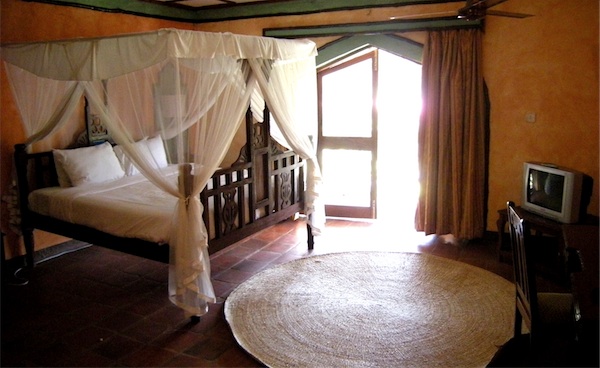
Photograph of a room at the Zanzibar Beach Resort, showing mosquito nets on the four-poster bed

Everywhere you go in Tanzania, there are nets. Mosquito nets. And not just here at the comfortable Zanzibar Beach Resort, where we stayed one night, but every little accommodation place we saw throughout the country. They’re serious about nets.

To be honest, at first I thought it was a just a bit of Africana for the tourists — hey, a four-poster bed certainly makes you feel like you’re somewhere different, right? But not so.

One morning in Dodoma, the ActionAid Australia campaigner travelling with me, Lena Aahlby, asked whether I’d bothered using the mosquito net. “No,” I said. “It’s dry, there weren’t any mosquitoes around, so I didn’t bother.”

Despite the scary warnings in my little travel medicine book, I hadn’t bothered with insect repellent either.

But our Tanzanian colleague Albert Jimwaga leapt in. “Oh, you’ve got to use the mosquito nets,” he said, a genuinely worried tone in his voice. “It doesn’t matter if you can’t see any mosquitoes, because they only come out late at night. You have to use the nets!”

It turns out this wasn’t just polite concern for his overseas visitors.

In Tanzania and other African nations, the threat from malaria is real.

As Abdul Kajumulo points out, malaria kills more than 100,000 infants annually, and attacks between 16 and 18 million people countrywide each year. That’s around 45% of the population. And that’s despite Tanzania having a decent anti-malaria strategy, apparently.

For my brief stay in country, spending AUD 30 for a month on gut-churning Doxycycline is a viable prevention strategy. But poor rural peasants only earn AUD 120 a year, so many malaria cases go untreated — with an obvious toll on individuals, families and the economy.

And then there’s dengue fever, for which there’s no vaccination and no cure.

I now have real respect for the humble mosquito net. I can see why, when there’s flooding or other cause for human displacement, a truckload of mosquito nets is high on the agenda.

[Disclaimer: Stilgherrian was in Tanzania as a guest of ActionAid Australia. His opinions do not necessarily represent the views of that organisation or its international affiliates.]

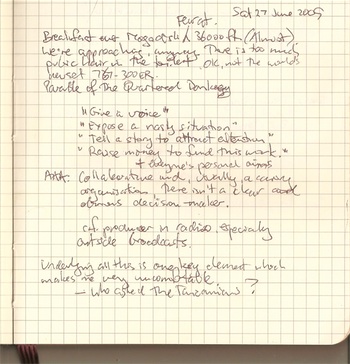
Photograph of a page from Stilgherrian's notebook

Saturday 27 June 2009. This isn’t exactly the world’s newest Boeing 767-300ER, and there’s slightly too much pubic hair in the toilets. Breakfast is being served, and my stupidly-expensive Moleskine notebook is filling up with notes about the Parable of the Quartered Donkey.

That’s quartered as in hanged, drawn and quartered.

I’m the donkey.

The smiling Kenya Airways staff go about their business of bread rolls and bitter coffee en route from Bangkok to Nairobi, where I’ll change for my flight to Dar es Salaam. I wake from a brief period of something vaguely approximating sleep to the realisation that Project TOTO has one significant flaw: multiple goals, with conflicting requirements.

Something deep in my gut says this is going to be a problem.

Flash forward to today. It’s only two weeks since I arrived in Tanzania and a week since I left again, but the world is eager to analyse the project’s “success” or “failure”. We already have Laurel Papworth’s Stilgherrian: Wherefor art thou, bloggers? (which has triggered some excellent discussion) and Fi Bendall’s Sharing the knowledge: How NGOs can benefit from online consumer awareness.

Both articles are well worth reading. Both highlight what I think is a serious problem: short-term thinking.

Read the rest of this entry »

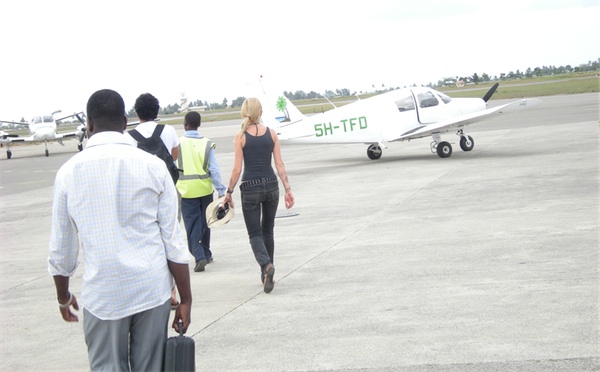
Passengers walking past a light aircraft to a ZanAir Cessna 404 Titan

I’m back in Sydney. I’m almost caught up on sleep. Almost. It’s time to start writing about my Project TOTO journey to Tanzania for ActionAid Australia.

I’ll split my posts into two streams:

  1. Brief essays like my old Unreliable Bangkok series, which I’ll call Unreliable Tanzania. They’ll be personal reflections about my experiences in Tanzania, observing not just ActionAid’s work but also the people, society and country generally — as well as recording my own state of mind. They’ll be presented in rough chronological order, but will weave together thoughts from throughout the journey — much as I did in The Poverty Web.
  2. There’ll also be posts reflecting on Project TOTO itself. What worked? What didn’t? And, given that ActionAid is already looking for the next outreach blogger, how can we improve things for the next participant and generate more value for ActionAid?

In between, I’ll post my photos on the Project TOTO (ActionAid) Flickr group — but don’t rush there just yet, because currently there’s only photos from the farewell party, and that gives totally the wrong impression.

Now, having explained that framework, this very first Unreliable Tanzania will break the pattern by giving you a quick rundown of my itinerary — because things changed somewhat from the initial plan.

Read the rest of this entry »

Stilgherrian’s links for 21 June 2009 through 11 July 2009, posted as an act of desperation:

Late yesterday afternoon Dar es Salaam time, we finally posted the first posts at the ActionAid Tanzania blog.

It’s been a long journey. On Monday we started with that most basic of questions: “What is a blog?” Then, when we spoke about people adding comments and the comment-moderation process, that inevitably led to further discussions about how the organisation should handle the inevitable problems of abusive commenters, or people who posted material which put the organisation at risk.

We were on the road Tuesday through Friday — and I’ll have plenty to tell you about that in due course — but when we returned to the task on Saturday there were further discussions before the first posts could appear.

How did the fact that two staff members were blogging reconcile with a communications policy that says only the Country Director can speak for the organisation? A disclaimer! What would our first bloggers write about? Introduce themselves! Should we have a formal welcome from the Country Director, given that Tanzania is a more formal country than Australia? Yes!

And there were many questions which regular users of online forums in the West would take for granted. What are “tags”? What’s the difference between “tag” used to describe a folksonomy and a “tag” in HTML? What is HTML anyway? Should I even mention the word “avatar”?

We never did get time to set up RSS readers. I’ll handle that via email. Small steps, and focus on what’s needed immediately.

Explaining social media from the very beginning to intelligent and well-educated people who had not yet encountered it was a brilliant learning experience for me too. I will have more to say.

Meanwhile, please enjoy the introductions from Country Director Rose Mushi, Abdul Kajumulo and Albert Jimwaga. I know they’d appreciate your comments and questions.

Richard Chirgwin decided to devote almost the entire edition of his A Series of Tubes podcast to Project TOTO. It’s now online for your listening pleasure. As Richard puts it, “One word of warning: calling Tanzania involves a game of count-the-codec: there’s Stil’s mobile, followed by a satellite link (I edited out the delays), followed by the PSTN and finally an Internode VoIP service at my end. Some quality issues may be expected.”

04 July 2009 by Stilgherrian | No comments

Kilimani village secretary Juma Hassan lila Kalibu shows off the new computer room at their school

This is Juma Hassan lila Kalibu, secretary of Kilimani village in Zanzibar, showing off the village school’s new computer room. As you can see, it has no computers. Or electricity. Or desks. Or chairs. Or anything, really.

When I visited this village last Sunday as part of ActionAid Australia’s Project TOTO — this school is one of their projects — it was a striking example of what we’d been discussing the previous day with ActionAid’s Zanzibar team: the poverty web. You can’t just dump one single piece of modernity into the poor rural environment and expect everything to work. As James Burke’s classic TV series Connections showed, modern Western civilisation is a built on a web of interlocking technologies, processes, structures and institutions, and you need all of them to make things work.

Kilimani has none of them.

Kilimani is literally a series of mud-brick huts. I’ll post more photos later — but this school, with its concrete floor and rendered walls, is as far ahead of the villagers’ homes as a medieval cathedral was ahead of the peasant hovels that clustered nearby. It’s appropriate, I think, that everywhere I’ve travelled in Tanzania, education is seen as the key to future prosperity. Well, not prosperity exactly, but whatever’s one notch up on the scale from abject poverty.

Consider this. Computers need electricity, amongst other things. Even if you string in the wires to connect this village to the power grid, someone might decide that the scrap metal value of the copper wires is more important to them than the electricity right now. A family in poor parts of the Tanzanian mainland might have a total annual cash income of TZS 150,000. That’s about AUD 120. When you only have $10 a month, a couple dollars of copper represents significant wealth — and at the mine we visited in Nzega in northern Tanzania yesterday they have to post guards to stop people stealing the water pipes and fences.

OK, assuming the wires and transformers aren’t stolen, what happens when something breaks? Who’s paying for the spare parts? Who’s trained to do the work? What use is a technical college when there are no teachers? Who’d come to work as a teacher when the homes have no electricity or running water? A basic education is a pathway out of here! So you need electricity to attract the teachers to… um, but that’s where we started!

How do you unravel this poverty web? Buggered if I know! But that’s the challenge facing countries like Tanzania. Hundreds, perhaps thousands of things we take for granted in the West simply aren’t there, and all the things you need to build those things are not there. They could be bought, sure, but there isn’t the money.

Money. There you have it.

Juma Hassan lila Kalibu, dressed in his Sunday best to greet his honoured guests, is certainly proud of his school, the most magnificent building in the village. And he would like our help. Some paper would be nice. And some pens.

If you haven’t been following my Twitter stream you may wonder where I’ve been. Well, right this moment I’m in Singida in northern Tanzania, sitting at a desk in ActionAid’s district office here. All is going well with Project TOTO.

Today (D5) we’ve drove north from the capital Dodoma, headed for Mwanza on Lake Victoria. I reckon I’ll only get to post meaningful — or at least lengthy — material once I get a few hours to myself. And I’ve no idea when that’s likely to happen.

It’s half-way through my time in Tanzania and we’ve travelled half the country it seems. I can’t post much while on the move — have you ever tried to type on a netbook while your 4WD is doing 60km/h down a dodgy temporary road dodging b-double petrol trucks which suddenly emerge from the dust right in front of you? So I’ve decided instead to take copious notes — mental, pictorial and on paper — and let the writing emerge once I return to Sydney.

Meanwhile, check out the photos Lena Aahlby took, posted over at Archie Law’s blog.

As promised (threatened?), here’s the video evidence from Saturday’s Project TOTO farewell party. I feel… honoured. And only slightly insulted.

Thanks heaps to ’Pong for the video work (although I did the cutaways which allowed him to edit it). Apologies to Mark Pesce, whose to-camera piece wasn’t recorded properly — although we can see him lurking in the background in his lovely red jumper, and raising his eyebrows quizzically.

Also, I am too fat.

It’s D-1. I depart from Sydney airport in just 29.5 hours. I still have a million things to do. I am incredibly stressed. I hope to write more later today. My Twitter stream will reveal more, however.

It’s D-7 for Project TOTO, and I’m stressed beyond all belief. It’s now less than a week until I leave for Africa, and my Farewell Party is tomorrow. Meanwhile, the astoundingly clever First Dog on the Moon at Crikey has contributed a morale-building cartoon.

First Dog on the Moon cartoon for Project TOTO

Click through for the full-sized image.

Yes, I still have thousands of things to do. But it’s Friday night and I’m exhausted, so I’ll tell you all about it in the morning. Probably.

Meanwhile, I’d live to know what you’re thinking about Project TOTO, so have a look at the previous posts and say stuff and ask questions and things.

And if you’re wondering who the people quoted are, try @mpesce, @snarkyplatypus, @kcarruthers and @apostrophepong. And also click through to ActionAid Australia for The Good Cause.

« Older entries