Invitations to the Australia 2020 Summit will be sent out next week. “The Government has reserved a right to make some appointments of their own and they can be people who either didn’t apply or people who did apply and we left out,” says Steering Committee member Tim Costello. “With the Prime Minister saying we want the brightest and best there, anyone with any sort of healthy ego felt compelled to apply, so it’s attracted absolutely brilliant people.”
Never rely on people
Never rely on people to point out the glitches. I’ve just printed one of my business’ invoices for the first time in ages — hey, I do everything on screen — and noticed that the template is still tagged with “Holiday Arrangements 2007-08”. In 2.5 months, no-one has mentioned it. Then again, I’m hardly surprised. Energy Australia tells me that street lights stay broken for months because no-one tells them — even though they can usually fix them promptly.
Enceladus from Cassini
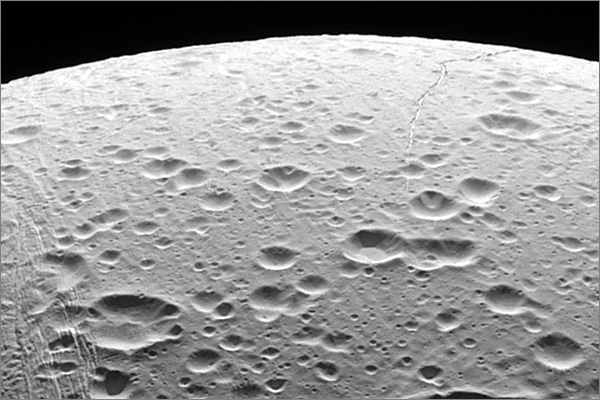
Have I been too harsh on NASA? Last week the Cassini spacecraft zoomed past Saturn’s moon Enceladus and took these magnificent pictures. Hat-tip to the Bad Astronomy Blog.
Is Fitzgibbon really confident about the Super Hornets?
I’ve just watched defence minister Joel Fitzgibbon being interviewed on The 7.30 Report about the Super Hornet purchase. It’s not reassuring. When challenged on the performance shortfalls compared with the Russian-built Sukhois being bought by our neighbours — basic factors in a fighter aircraft like speed, acceleration, climb rate and turning circle — he keeps flipping the conversation back to avionics and interoperability. “Never mind the quality, feel the width,” eh Joel? Check it out while the video’s still online and tell me what you think about his body language.
Lego spacecraft from 2001
Speaking of Arthur C Clarke, how about a Lego model of Discovery, the spacecraft from 2001: A Space Odyssey? Ta for the pointer, Richard.
Remembering the Space Age: Arthur C Clarke dead at 90
 Bugger. The Space Age ended today. Sir Arthur C Clarke, the grand master of science fiction, is dead at age 90. According to the BBC he died in Sri Lanka, his adopted home since 1956, from a cardio-respiratory attack.
Clarke is best-known, of course, for his collaboration with Stanley Kubrick on the 1966 1968 film 2001: A Space Odyssey. Even today it’s visually stunning, a grand expression of 1960s technological confidence. Even today, the ending still makes no sense whatsoever, with or without LSD.
Everyone remembers that the computer HAL 9000 went mad and killed the crew. The real lesson is that HAL went mad because his masters had told him to lie, to cover up the mission’s true purpose. This Cold War-era fable about how paranoia corrupts the mind remains completely relevant in this age of The Continual War on Terror.
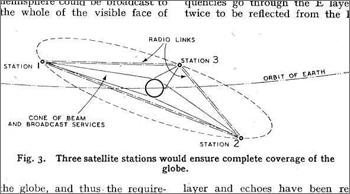
What Clarke should really be remembered for, however — and what could have made him a multi-billionaire — is suggesting the use of geostationary satellites for international telecommunications.
Clarke’s 1945 paper “Extra-Terrestrial Relays — Can Rocket Stations Give Worldwide Radio Coverage?” sketched out the idea so thoroughly that it counts as “prior art” and no-one’s been able to gain patents ever since.
Apart from 33 novels, 13 short-story collections, TV programs and countless non-fiction works, Clarke was a regular letter-writer to New Scientist magazine. Sometimes he wrote about the ethics and politics of science and technology, but more often than not it was to point out that some newly-patented idea had already been described in one of his novels decades before. Not to boast, just to chuckle.
Sir Arthur is dead. The Space Age is dead.
At least the First Space Age is dead. The 1960s imperative “to boldly go” as imagined by visionaries like Clarke has congealed into a bloated, bureaucratic NASA which has, in the US at least, drained all the excitement from spaceflight.
Long live Space Age 2.0, funded not by governments asserting their fitness to rule the world, but by entrepreneurs like Sir Richard Branson and Virgin Galactic. Space will never be the same.
[A slightly different version of this story was published in Crikey today.]