
Google+ gives me grief, generally

It seems to have been my annointed role this week to press back against the rush to join Google+, the new social networking service (SNS) from Google.

It all began when I posted the Patch Monday podcast on, erm, Monday. “Can Google+ kill Facebook? Twitter?” I asked. But as I discussed the potential success of Google+ and its strengths and weaknesses compared with Facebook, I couldn’t help but think…

I don’t want to do this.

Join Google+, that is.

I’d first written about Google+ for Crikey a week and a bit earlier. It was a cranky piece. I speculated that Google would have to come up with something pretty persuasive to get people to migrate from Facebook.

That of course soon triggered one of the usual, predictable comments.

sorry im not on facebook, i dont need to be, i dont have a mobile phone, i really dont need one, i dont have a GPS, i have a brain and know how to get around, hell, i dont even have a watch, i do have a job , im thankfull of that and i do manufacture and retail a product that everyone wants.

… said William Magnusson, who also seems to live without capital letters, apostrophes or the ability to decide when it’s time to end his sentence and start a new one.

I’d expected that. But what I hadn’t expected was much of the reaction to my follow-up Crikey piece, There’s no way I’m handing over data to Google+, and to a lesser extent my ABC The Drum piece, Why rush? Let others find the Google+ privacy landmines.

Continue reading “Google+ gives me grief, generally”

Talking voicemail hacking on 1395 FIVEaa Adelaide

It seems that awareness of the News of the World voicemail hacking scandal is starting to spread from media-about-the-media like Crikey through the mainstream current affairs programs to, well, mainstream talk radio.

Earlier this morning I was interviewed on the topic by Adelaide radio 1395 FIVEaa, and here’s the audio.

It was kinda fun to be interviewed by presenters Keith Conlon and John Kenneally. Keith taught me how to do radio when I started in that medium and he was station manager at what is now Radio Adelaide. I later worked with him and with John at the ABC. And the newsreader I heard just before our interview, Jane Doyle, was at the ABC at that time too. Small world.

The audio is ©2011 dmgRadio Australia, but since they don’t post many of their live interviews I’m doing their job for them. Besides, it’s not as if I get paid, and it’s not as if this ain’t a decent plug for them.

Talking voicemail hacking on ABC TV’s “7.30”

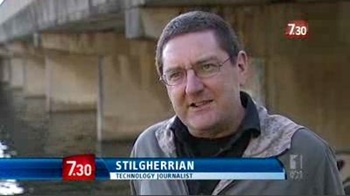
I was interviewed by ABC TV’s current affairs program 7.30 yesterday for a story about voicemail hacking, More allegations against Murdoch media.

Interestingly, most of the soundbites we recorded were about how easy it is to access someone’s voicemail, but the resulting story was more about whether something like the News of the World scandal could already be happening in Australia.

Recording this piece was a pleasant reminder of working in daily live radio. The pace is kinda fun. The ABC called me at 2.15pm, and arranged for the crew to meet me at 3.15pm. We drove to a nearby park and recorded the main interview as well as the cutaways in a total of 45 minutes. And that was in between the noise of aircraft taking off, motor cycles, and pedestrians and cyclists walking between me and the camera.

I’m shown using both laptop and phone. Does that put me into the category of mouse-using TV expert?

Weekly Wrap 57

A weekly summary of what I’ve been doing elsewhere on the internets. Last week I said something’s gotta give. This week it gave.

Stress and exhaustion and a much lower productivity level than the previous two weeks has led to this post being two days late.

Podcasts

  • Patch Monday episode 95, “Malware? It’s just business!” Malware, these days, is so good that it simply has to be produced by professional development teams. As Yuval Ben-Itzhak, chief technology officer of AVG, explains, malware is distributed automatically, and runs on millions of target computers without causing any visible signs that something bad is happening.

Articles

Media Appearances

None.

Corporate Largesse

  • On Monday 4 July I had an extremely long lunch with people who are continuing their interest in having me work with them on a forthcoming media project. I still can’t say much, except I will drop in one word: Television.

Elsewhere

Most of my day-to-day observations are on my high-volume Twitter stream, and random photos and other observations turn up on my Posterous stream. The photos also appear on Flickr, where I eventually add geolocation data and tags.

[Photo: The Wilds of Lilyfield, the view eastwards towards the Sydney CBD from the corner of Lilyfield and Balmain Roads.]

Weekly Wrap 56

A weekly summary of what I’ve been doing elsewhere on the internets. Last week was busy enough, but this week was even busier. Something’s gotta give.

Podcasts

  • Patch Monday episode 94, “ISP filtering goes ‘voluntary'”. Even though Australia’s controversial mandatory internet filtering program is at least two years away from being implemented, internet service providers will soon start filtering child exploitation material on a voluntary basis. My guests are Peter Black, who teaches internet and media law at the Queensland University of Technology; Network engineer Mark Newton; Lyle Shelton, chief of staff of the Australian Christian Lobby.

Articles

Media Appearances

Two radio spots this week, and a guest appearance on someone else’s podcast.

Corporate Largesse

None. I am reliably informed that the drought will be broken next week.

Elsewhere

Most of my day-to-day observations are on my high-volume Twitter stream, and random photos and other observations turn up on my Posterous stream. The photos also appear on Flickr, where I eventually add geolocation data and tags.

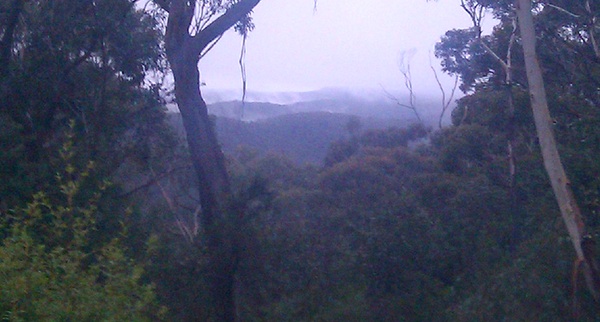
[Photo: A misty dawn at Bunjaree Cottages, 1 July 2011. This is the view from Roselle Cottage, not normally rented to the punters. The much-battered camera in my phone does not do this scene justice.]

CSO: Voluntary filtering removes the controversy

My first op-ed for CSO, “The Resource for Data Security Executives”, has just been posted. It’s voluntary ISP-level internet filtering, but a different angle from my Crikey piece earlier today.

After nearly four chaotic years, Australia’s internet filtering scheme is finally coming together in a way that makes sense technically and politically, if not necessarily for effective child protection.

The chaos wasn’t all communications minister Senator Stephen Conroy’s fault. The “clean feed” was announced as Labor policy back in March 2006 by then-leader Kim Beazley. ISPs would filter out the nasties hosted overseas, where they couldn’t be hit with a takedown notice from the Australian Communications and Media Authority (ACMA).

But Conroy’s name was on Labor’s Plan for Cyber-safety published just five days out from the federal election in late 2007, and once in government it was Conroy’s job to explain that plan and sell it to voters. Everyone presumably imagined it’d be a protect-the-kiddies no-brainer.

Problem was, neither the plan not Conroy’s explanations were clear…

As I say, it’s my first outing for CSO, but if all goes according to plan there’ll be more. And in case you’re wondering, CSO is a job title. Chief Security Officer.