

Weekly Wrap 130: Storms, sunburn and a two-hour cruise

The week of Monday 26 November to Sunday 2 December 2012 was strange. It started with stormy weather, and the misty conditions continued until Wednesday. But by Thursday I was sunburnt and dehydrated in sweltering heat.

I should not have walked through the heat from Potts Point to the Sydney CBD, even though I could take a photograph of the city along the way.

It was also a stressful week. To the usual month-end cashflow blockage was added a series of strange problems with a client’s marketing email template.

The client had chosen to use an old template, and the line spacing fell apart in modern versions of Microsoft Outlook. Then some of the links to PDF files on their website didn’t work, with the links being somehow scrambled so they delivered a “404 File not found” error instead of the PDF file. Sometimes.

Eventually we discovered that the links broke — sometimes — when URLs containing white-space characters (such as “%20” for a space) were passed from Outlook to an out-of-date version of Adobe Reader.

Thankfully the week ended with some semblance of normality, and the weekend was restful.

Podcasts

Articles

Media Appearances

  • On Sunday morning I was asked, at the last minute, to be the bespoke Twitterer for ABC Radio National’s Sunday Extra. That just means that I had to listen to the program — which I was doing anyway — and tweet about it.

Corporate Largesse

  • On Wednesday I attended the Retail Tech Forum at Wildfire Restaurant, Circular Quay, which was organised by Bass PR for various clients: Dassault Systèmes, who do many things but in this case provide 3D modelling and visualisation tools for retail environments; retail software systems vendor Island Pacific Australia; 3Q Holdings, who also do retail tech; Meridian Systems, who make “technology solutions” for the project management of “capital buildings” and the maintenance thereof; and analysts Frost & Sullivan. I daresay an article will come out of this at some point. Meanwhile, here’s the lunch menu and pictures of the beef short rib starter and the corn-fed chicken main course.
  • On Thursday I had lunch at Establishment with the people behind Uber Sydney, a smartphone-based service that provides on-demand ordering of a black town car. An article will come out of this eventually.
  • On Thursday afternoon I went on a two-hour cruise of Sydney Harbour aboard Matilda III, which was the Internet Industry Association’s Harbour Policy Party. The photographs start here.
  • On Thursday evening I dropped into The Indies’ Christmas party at the Burdekin Hotel on Oxford Street, The Indies being the four PR firms Bass PR, Shuna Boyd PR (which doesn’t seem to have a website?), Einsteinz Communications and Espresso Communications. I had just one glass of wine, my only alcohol for the entire day, before exhaustion set in.

The Week Ahead

Starting this week I’ll be based in Hurstville, a southern suburb of Sydney, thanks to a housesitting arrangement with someone who shall remain anonymous. I’ll be there until the end of the first week of January. Unless plans change.

This week is another busy week. I daresay I won’t get around to producing the Patch Monday podcast until Monday morning. I’ve got some writing to do too. Then on Tuesday, Optus is showcasing their 4G smartphones at a lunch in Surry Hills. On Wednesday I’m attending VMware’s Cloud Panel, a lunchtime event at The Star casino.

I’ll try to record next week’s Patch Monday podcast on Thursday, because on Thursday night I’m going to Fuel Communications‘ Christmas party and then on Friday I’m covering a one-day conference Privacy in the 21st Century (PDF), organised by the Communications Law Centre at the University of Technology Sydney (UTS). Since I’m covering that conference for both Crikey and ZDNet, it’ll be sensible to get that podcast out of the way.

[Photo: The Nepean was crossed. It has been my habit to take a photograph each time I cross the Nepean River en route from Wentworth Falls to Sydney or vice versa, which I then tweet with the caption Crossing the Nepean. Yesterday I missed, and the outbound train was already at Emu Plains before I could take a snapshot.]

Talking Click Frenzy on ABC 702 Sydney

I hadn’t even heard of Click Frenzy until the thing fell over, which shows how much attention I pay to the realm of commercial retail. But I ended up talking about it on ABC 702 Sydney the other day, because, well, it fell over.
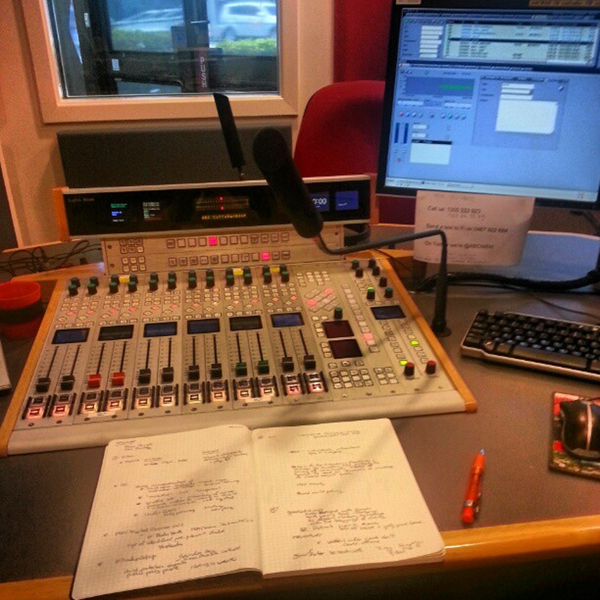
I’ve posted the entire radio segment here, including the comments by Margie Osmond, chief executive of the Australian Retailers Association, because I was baffled by her excuse that technical incompetence is OK because other people are sometimes incompetent too.

I think the important thing to understand with this is that it’s been running for about five, six years in overseas countries. It runs in the US and UK and a whole range of other places under the Cyber Monday banner. And for all of that period that it has been operating overseas, as recently as last year, they routinely have crashes as part of this mechanism, simply because of the unpredictable peaks and troughs that occur as part of the mechanisms.

Traffic analysis is a thing, folks, and so is robust network design. Just because you can’t do it, doesn’t mean it can’t be done.

I was fairly even-handed in my commentary, pointing out that it’s possible for the developers to have recommended a more robust architecture that then wasn’t implemented because of cost or whatever. But later in the day I discovered more about the technical problems and I’d have gone in harder.

In particular, I discovered that they’d committed a rather bad security mistake, which I wrote about for ZDNet: Password exposed in Click Frenzy security slip.

The morning presenter at ABC 702 Sydney is Linda Mottram.

The audio is ©2012 Australian Broadcasting Corporation.

Talking censorship and more on ABC Download This Show

This week saw my third appearance on Marc Fennell’s program Download This Show on ABC Radio National. Great fun.

Cleaning up the web: Nearly three years since announcing the proposed mandatory internet filtering system Cleenfeed, Communications Minister Stephen Conroy’s scheme is dead. But what have they replaced it with and were we better off with Conroy’s old system? Meanwhile, we peek into the secret UN meeting that could radically change the way the net is governed, and take time out to ask whether games can truly change our minds and society.

The internet “filtering” stuff of course relates to the Interpol blacklist that I’ve written about for Crikey once or twice, and which was also the subject of this week’s Patch Monday podcast.

My fellow guest was digital arts evangelist Fee Plumley. The audio below is linked directly from the ABC’s website.

The audio is ©2012 Australian Broadcasting Corporation.

[Photo: Waiting in ABC Studio 291, Coffs Harbour, the location from which I joined the program.]

Talking data mining on ABC Gippsland

Every now and then I end up doing an explainer that starts at the very beginning — like this radio spot about data mining for ABC Gippsland this morning.

Breakfast presenter Gerard Callinan has posted the audio under the title Mapping key strokes. Who’s watching?

For many of us, the idea of going a day without using the internet either at work or at home is almost unimaginable. Have you ever thought what happens to the information that you leave behind when visiting your favourite websites? Every page you visit, every survey you take, every ad you click on builds up a profile which is used by marketing companies and increasingly, political parties to build up a picture about what sort of things you are interested in and how you might be swayed to buy items or even vote in an election.

Here’s a slightly different version of the audio here, with the volume re-normalised — which just means it’s now supposedly at the optimal volume.

I think Mr Callinan got slightly paranoid after he’d read a certain op-ed I wrote earlier this year.

I’m not so sure how well I explained things. This was a live-to-air piece at 0720 AEDT after I’d had just three and a half hours of sleep and a few hours dealing with, um, a very aggressive intestinal problem. So I wasn’t as focused as I’d like to have been.

If I had my time again, I’d have made sure to explain how the advertising embedded in web pages, or the Facebook “Like” buttons, allow those organisations to track you across multiple sites. And I’d have made sure to have a link I could give out for some concise “How to protect your privacy online” guides.

The audio is of course ©2012 Australian Broadcasting Corporation, but as usual I’m posting it here as an archive.

Talking Google’s defamation loss on ABC 702 Sydney

A Melbourne man’s successful defamation suit against Google has been one of the big “technology” news stories this week. I wrote about it for Crikey yesterday, and spoke about it on the radio.

The Crikey piece, “Google defames us all, but should we sue?”, is currently behind their paywall, though you can sign up for a 21-day free trial. It will emerge from the paywall in two weeks.

In it I argue that we may need a new legal category for online conversations, something that’s obviously not private but also not as formal as “publication”. I’ll come back to that theme once you can all see the story for free, you cheapskates.

Yesterday afternoon I briefly outlined the case to Richard Glover on ABC 702 Sydney. And here’s the audio.

The audio is of course ©2012 Australian Broadcasting Corporation, but as usual I’m posting it here as an archive.

Talking journalism and iPhone 5 on ABC Media Report

Yes, Apple released a new iPhone 5 this week. I wrote about it for Crikey. And I spoke about it on ABC Radio National’s Media Report yesterday, in the context of using smartphones for journalism.

Will the new iPhone improve citizen journalism? More broadly, can we use modern Android phones to produce quality journalism?

The tools I mentioned were:

  • CoveritLive for liveblogging.
  • WordPress for blogging more generally, though of course there are others.
  • Any number of tools for posting photos and other images, but I mentioned Flickr and Twitpic.
  • YouTube is the gorilla in the room for posting video, but there’s also services for live video streaming such as Ustream and Livestream. The latter even works as a video switching service in the cloud.

“You’re going to get phone calls after this, Richard, from plenty of people who say ‘No, no, no, use something else. You can get into kind of religious wars about this sort of thing, and it’ll all be out of date by November,” I said. Which is true, but I still might write an article talking about this in more detail some time.

The audio is of course ©2012 Australian Broadcasting Corporation, and over at their website you can listen to the entire episode.