
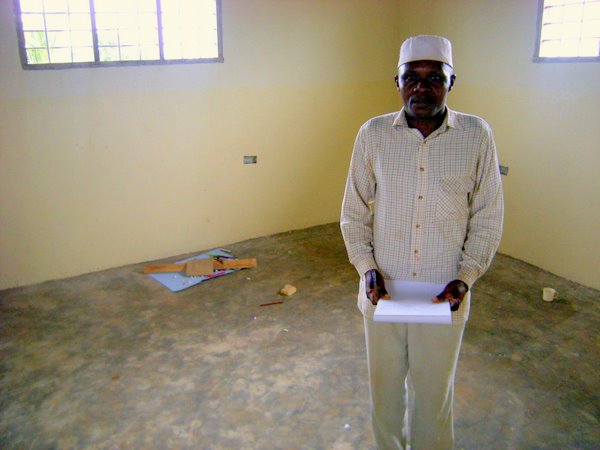
This is Juma Hassan lila Kalibu, secretary of Kilimani [see update below] village in Zanzibar, showing off the village school’s new computer room. As you can see, it has no computers. Or electricity. Or desks. Or chairs. Or anything, really.
When I visited this village last Sunday as part of ActionAid Australia‘s Project TOTO — this school is one of their projects — it was a striking example of what we’d been discussing the previous day with ActionAid’s Zanzibar team: the poverty web. You can’t just dump one single piece of modernity into the poor rural environment and expect everything to work. As James Burke’s classic TV series Connections showed, modern Western civilisation is a built on a web of interlocking technologies, processes, structures and institutions, and you need all of them to make things work.
Kilimani has none of them.
Kilimani is literally a series of mud-brick huts. I’ll post more photos later — but this school, with its concrete floor and rendered walls, is as far ahead of the villagers’ homes as a medieval cathedral was ahead of the peasant hovels that clustered nearby. It’s appropriate, I think, that everywhere I’ve travelled in Tanzania, education is seen as the key to future prosperity. Well, not prosperity exactly, but whatever’s one notch up on the scale from abject poverty.
Consider this. Computers need electricity, amongst other things. Even if you string in the wires to connect this village to the power grid, someone might decide that the scrap metal value of the copper wires is more important to them than the electricity right now. A family in poor parts of the Tanzanian mainland might have a total annual cash income of TZS 150,000. That’s about AUD 120. When you only have $10 a month, a couple dollars of copper represents significant wealth — and at the mine we visited in Nzega in northern Tanzania yesterday they have to post guards to stop people stealing the water pipes and fences.
OK, assuming the wires and transformers aren’t stolen, what happens when something breaks? Who’s paying for the spare parts? Who’s trained to do the work? What use is a technical college when there are no teachers? Who’d come to work as a teacher when the homes have no electricity or running water? A basic education is a pathway out of here! So you need electricity to attract the teachers to… um, but that’s where we started!
How do you unravel this poverty web? Buggered if I know! But that’s the challenge facing countries like Tanzania. Hundreds, perhaps thousands of things we take for granted in the West simply aren’t there, and all the things you need to build those things are not there. They could be bought, sure, but there isn’t the money.
Money. There you have it.
Juma Hassan lila Kalibu, dressed in his Sunday best to greet his honoured guests, is certainly proud of his school, the most magnificent building in the village. And he would like our help. Some paper would be nice. And some pens.
[Update 13 June 2010: I have just discovered that this village is not called Kilimani at all. Kilimani is the location of the Zanzibar Beach Resort, just south of Zanzibar Town. That’s the hotel where we stayed overnight in Zanzibar — and be warned, their web is a dreadful slow-to-load Flash job with looping music that can’t be turned off. It’s quite possible this village is called Kisimani, located here on Google Maps and not marked at all on Bing Maps. I will investigate.]
You unravel it in the right order. Things like mobile phones need no wires and simple infrastructure. But they still need electricity, but only a small amount. You start with a few people, like the local business man who needs to call the market in the next town to sell some farm goods. You need the basics, like water, roads, sewerage. Later you need computers. If you give the kids computers to learn, the smart ones will leave and go and live overseas. It is one of the tragedies of these places. But some will stay and make things better. The question is: how will computers make things better for people in this environment. If you give them computers, some will work it out. But you need lower tech to start with. Like you said, there is so much infrastructure we take for granted that makes the whole thing work.
Another thing is not to think of it as income earning, but change creating. If people can interact with the outside world, some will see beyond where they are and start making a change. It is these people you need to find and nurture.
Have a look at other places that are further along the transition. When we went to this village in China in 1992, there was no running water. The houses we went into had maybe two pieces of furniture in the lounge. The buildings were 99% mud brick. But now, they are less than 50% mud brick, they have better roads, electricity, TV, and little trucks and cars. That is in 17 years.
http://www.flickr.com/photos/yewenyi/378081886/
http://www.flickr.com/photos/yewenyi/381547477/
Yewenyi’s comments are correct and I like the idea of change creating rather than income earning.
As Yewenyi would know China’s success in enabling people to escape poverty is largely due to large rates of equitable economic growth, which has enabled larger numbers of Chinese to share in the countries prosperity rather than a select few which tragically happens in most developing and under developed countries.
There are still massive social problems in China but in 25 words or less my take on the two major reasons for China’s success is the increased ability of the State to provide essential services to its people, for example health and education, whilst also providing the required level of regulatory oversight to enable a robust private sector to be the engine of economic growth.
As many have noted the key ingredient missing in China is a robust and active civil society, eg academia, NGOs, media, faith based organizations, which is able to lobby the government to be accountable to its people and provide the appropriate environment for people to claim their human rights.
For me, human rights has to include civil and political rights in addition to economic, social and cultural rights. This combination is essential for the development of a fair, just, equitable and prosperous society and this is the approach that we at ActionAid take in all of our work.
I’m looking forward to seeing where this debate goes and to Stil’s thoughts after he’s had time to digest everything that he’s seen in the last week or so.
Cheers,
Archie
@yewenyi: There are certainly villages in Tanzania where the transition you describe is happening. I doubt that my slice through the country on its central highway was representative, but I saw it happening in three broad areas:
I also understand this transition has just happened incredibly quickly in a little Kenyan village which just happens to be the ancestral home of some bloke called Barack Hussein Obama.
@Archie Law: The “civil society” thing is key, yes — and it’s good to see a real explanation of what it means, rather than Senator Stephen Conroy using it in his catchphrase “I believe in a civil society” as a dog-whistle to reinforce his politically-convenient meme about the Internet being full of filth.
That is, though, a far longer-term and far less photogenic story to sell — and that’s going to be a challenge for ActionAid.
It’s very easy to zoom into a village, take a few photos of the generous white folk with the smiling black kiddies, poor but happy, then return later to show the success story of young Hassan who, thanks to our generosity, has gone on to become a doctor. That’s the standard narrative which assuages white middle-class guilt and doesn’t demand too much thought on behalf of the donor.
It’s a lot harder to sell the idea of funding a lawyer to investigate a politician’s property transactions, or an accountant to figure out exactly what that local road improvement grant was actually spent on. And it’s perhaps harder still to focus on those in the media.
I don’t know what the answer is, but I know that’s the question.