Smartphones as sexual display

On one of my recent visits to NSW Parliament House on Macquarie Street the security guard who X-rayed my bag noted that while it contained plenty of Apple kit, such as my MacBook Pro, I carried a Nokia phone rather than an iPhone. “That’s because I haven’t drunk the Kool-Aid,” I replied. “Plus they’re all just tools for a job.”

Many people do seem to choose their devices more through brand identity than practical value. I was going to write more about that, but that renowned bastard Stephen Fry has beaten me to it. It’s all about sexual display.

When two businessmen drop down in neighbouring aeroplane seats and each gets out a smartphone an electricity will crackle between them like that between two sexually heated adolescents whose thighs have accidentally touched in the backseat of the school bus. If one businessman fishes from his shirt pocket a BlackBerry while the other gets out an iPhone a whole range of complex thoughts will begin to boil in the brains of each: resentment, contempt, insecurity and irritation are merely the emotions bubbling closest to the surface: deep down, dark and primal forces stir. We do not possess antlers, horns or tusks, we cannot display fans of feather or manes of fur, the best we can do is express our personality, aspirations, beliefs, outlook, sexual potency, status, right to breed and place in the hierarchy through the choices we make in our possessions: and no possession, here in the early part of the twenty-first century, speaks quite so loudly as our smartphone. Once upon a time it was our motorcar and in the future it may well be a robot, a rocket-pack or a hoverpenis that defines us, but for the moment it is, for good or ill, a smartphone.

Many women reading this will detect that the foregoing is an issue almost entirely for males, who remain the prime sufferers in this kind of tribal status war. My suspicion is that women are, if not immune, far less emotionally bound up in the business than men. I may be wrong and welcome clarification either way on this point.

I do realise that quoting Stephen Fry doesn’t make up for writing an original piece, but at least it means I’m trying to keep up to date with my writing.
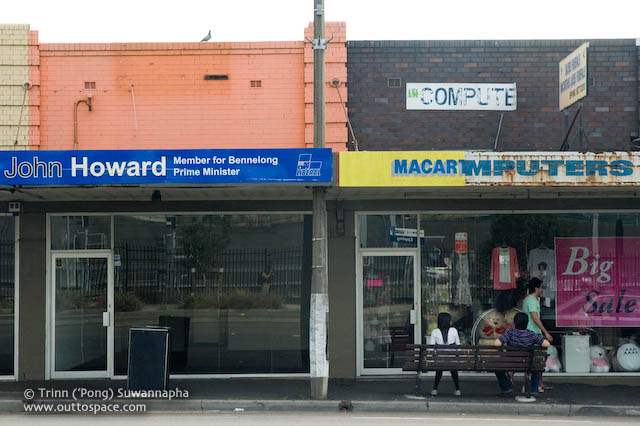

Empty remnants of John Howard

Photograph of John Howard's campaign office in Epping by Trinn ('Pong) Suwannapha
Yesterday ’Pong and I journeyed to Epping in Sydney’s north-west suburbs to photograph this monument to history: John Howard’s campaign office for the 2007 federal election. It’s still empty almost two years later.

Epping seemed strangely bleak. This was far from being the only empty shop on Beecroft Road. Signs were dilapidated. In the alley behind the shops, magpies rummaged through restaurant garbage bins in search of food. The eucalypt smoke enshrouding the suburb — the result of back-burning operation before summer — didn’t help.

Two years ago posts referencing John Howard dominated this website’s tag cloud. It’s been a long time since he was Prime Minister, but he’s still prominent here and in the mainstream media through things like his Menzies Lecture — and that was a strange attempt to stamp his own rhetoric onto Australia’s political history.

I wonder how long it’ll be until we stop hearing about the miserable old toad?

[Photo: A Space for Howard ©2009 Trinn (’Pong) Suwannapha. All rights reserved.]

Talking Telstra and transparency on Radio National

Telstra logo

My world was dominated by Telstra last week. Apart from my writing and a radio spot about the government’s plans to split the telco, I also spoke on ABC Radio National’s Future Tense on Thursday about the sudden closure of their nowwearetalking blog.

I’d already written about that shutdown here and over at Crikey. However the Radio National conversation was in the more general context of how social media is affecting corporate transparency.

You can listen to the program (at least for now) and read the full transcript over at the ABC’s website. The other guests were Shel Holtz, co-author of Tactical Transparency; Mark Hannah, a New York-based communications consultant; Mike Hickinbotham, Telstra’s Social Media Senior Advisor; and ABC economic correspondent Stephen Long. well worth checking out.

Here’s the full text of my section.

Continue reading “Talking Telstra and transparency on Radio National”

Telstra split and Brendan Nelson: 2008 predictions revisited

Sol Trujillo: photo courtesy Telstra

I’ve read so much about the Telstra break-up this week, and written and spoken about it so much, that my brain’s still fizzing. But here’s one thing: I predicted this more than a year ago!

On 2 January 2008 I wrote, as part of my Predictions for 2008:

Telstra will be forced to separate its wholesale and retail businesses. Meanwhile the Sol Trujillo-led management team will continue to play nasty with the government, causing them to be increasingly sidelined — especially over the Rudd government’s new broadband rollout.

OK, I got the timing wrong. But it does seem that I was reading the signs correctly.

Looking back at those predictions, I’m saddened to see that former defence minister Brendan Nelson hasn’t been investigated for his role in that deal to buy $6 billion worth of Super Hornet fighter aircraft — even if someone has since pointed me to their potential use in an electronic warfare role — but has instead been made ambassador to the EC, NATO, Belgium and Luxembourg, and special representative to the World Health Organisation.

Not quite the outcome I was after, unless some Eurospook’s going to give the good Dr Nelson a thorough probing in Brussels.

If that happens, I don’t want pictures.

So, I’m updating my 2008 predictions score to 56.25%, which is now a pass instead of a fail. That’s fair, right?

[Photo: Former Telstra CEO Sol Trujillo, courtesy Wikipedia. I’m so thoroughly confused by the implications of the licensing on that image and a recent Creative Commons report on how people define “non-commercial” that I’ll just say this post is licensed by whatever Creative Commons license it needs to be to shut everyone up. FFS write in Plain English, people!]

Bonus links: This week’s writing about Telstra

Google and Bing, sitting in a tree…

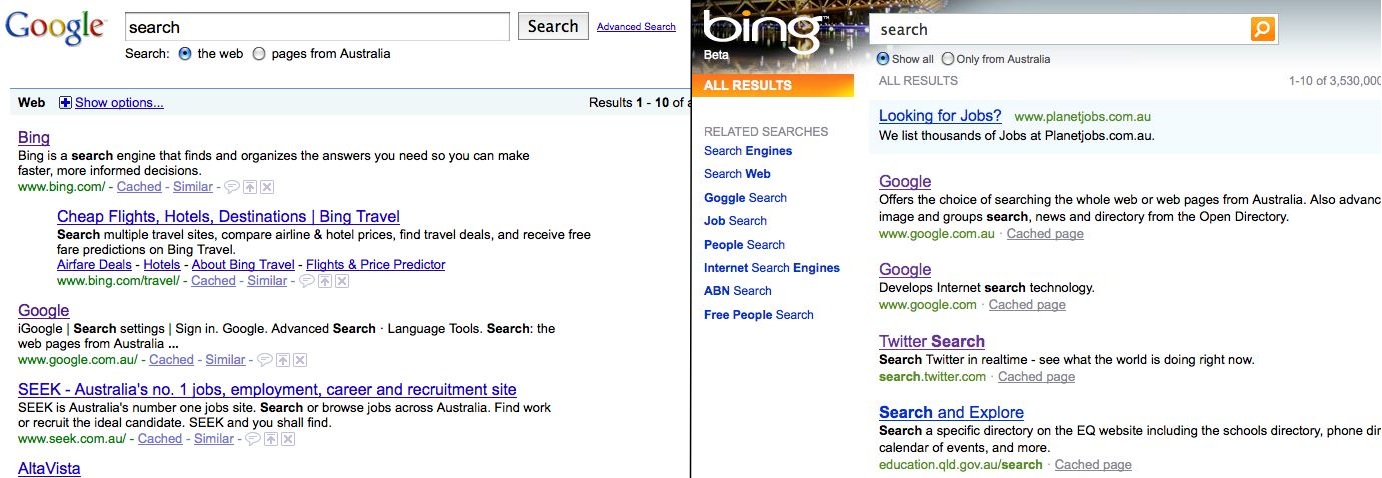
This is sweet! Look what happens when you search for the word “search” on the world’s two leading Internet search engines.

Screenshots of Google and Bin searches for "search": click for a closeup

Yes, if you Google for “search” the first result is Bing. And if you Google it on Bing, the first result is Google. Now who said these guys were competitors?

Hat-tip to Derek Jenkins (@ozdj), and doubtless others as the meme spreads.