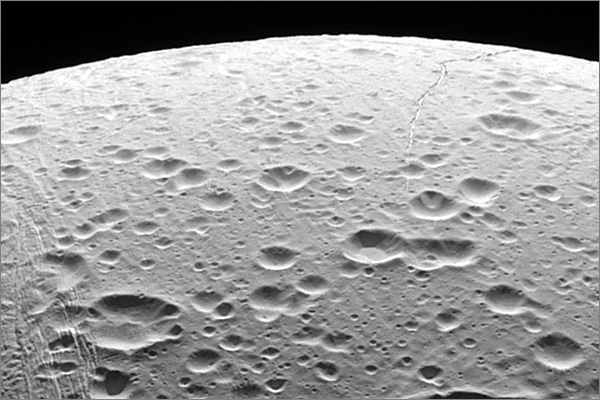
Have I been too harsh on NASA? Last week the Cassini spacecraft zoomed past Saturn’s moon Enceladus and took these magnificent pictures. Hat-tip to the Bad Astronomy Blog.

Word-whore. I write 'em. I talk 'em. Information, politics, media, and the cybers. I drink. I use bad words. All publication is a political act. All communication is propaganda. All art is pornography. All business is personal. All hail Eris! Vive les poissons rouges sauvages!
Have I been too harsh on NASA? Last week the Cassini spacecraft zoomed past Saturn’s moon Enceladus and took these magnificent pictures. Hat-tip to the Bad Astronomy Blog.
I’ve just watched defence minister Joel Fitzgibbon being interviewed on The 7.30 Report about the Super Hornet purchase. It’s not reassuring. When challenged on the performance shortfalls compared with the Russian-built Sukhois being bought by our neighbours — basic factors in a fighter aircraft like speed, acceleration, climb rate and turning circle — he keeps flipping the conversation back to avionics and interoperability. “Never mind the quality, feel the width,” eh Joel? Check it out while the video’s still online and tell me what you think about his body language.
Speaking of Arthur C Clarke, how about a Lego model of Discovery, the spacecraft from 2001: A Space Odyssey? Ta for the pointer, Richard.
 Bugger. The Space Age ended today. Sir Arthur C Clarke, the grand master of science fiction, is dead at age 90. According to the BBC he died in Sri Lanka, his adopted home since 1956, from a cardio-respiratory attack.
Clarke is best-known, of course, for his collaboration with Stanley Kubrick on the 1966 1968 film 2001: A Space Odyssey. Even today it’s visually stunning, a grand expression of 1960s technological confidence. Even today, the ending still makes no sense whatsoever, with or without LSD.
Everyone remembers that the computer HAL 9000 went mad and killed the crew. The real lesson is that HAL went mad because his masters had told him to lie, to cover up the mission’s true purpose. This Cold War-era fable about how paranoia corrupts the mind remains completely relevant in this age of The Continual War on Terror.
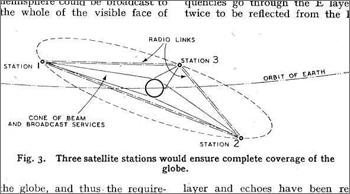
What Clarke should really be remembered for, however — and what could have made him a multi-billionaire — is suggesting the use of geostationary satellites for international telecommunications.
Clarke’s 1945 paper “Extra-Terrestrial Relays — Can Rocket Stations Give Worldwide Radio Coverage?” sketched out the idea so thoroughly that it counts as “prior art” and no-one’s been able to gain patents ever since.
Apart from 33 novels, 13 short-story collections, TV programs and countless non-fiction works, Clarke was a regular letter-writer to New Scientist magazine. Sometimes he wrote about the ethics and politics of science and technology, but more often than not it was to point out that some newly-patented idea had already been described in one of his novels decades before. Not to boast, just to chuckle.
Sir Arthur is dead. The Space Age is dead.
At least the First Space Age is dead. The 1960s imperative “to boldly go” as imagined by visionaries like Clarke has congealed into a bloated, bureaucratic NASA which has, in the US at least, drained all the excitement from spaceflight.
Long live Space Age 2.0, funded not by governments asserting their fitness to rule the world, but by entrepreneurs like Sir Richard Branson and Virgin Galactic. Space will never be the same.
[A slightly different version of this story was published in Crikey today.]

’Pong’s photo “Direction” (pictured), taken at Earthdance in Sydney last year, has been selected by leading photographer David Allen Harvey — who we had the great pleasure of meeting in Bangkok last year — for his Emerging Photographers Fund slideshow. Congratulations.
(It’s a stupid Flash-driven thing, so I can’t even link to the specific slideshow. You’ll have to follow the generic link, then select “Emerging Photographers Fund”, then select “Singles I”, then scroll through to image 31 of 32.)
’Pong doesn’t think it’s the best of his photos from Earthdance. It’s interesting to see people’s different choices.
Will the real Brendan Nelson please stand up? Is it the man Annabel Crabb saw on Tuesday, the mild-mannered doctor with “substantial empathy for those suffering from misfortune” whose “attention is drawn disproportionately to the Gothic end of the human suffering spectrum”? Or is the rabid Bon Jovi fan?