
So Howard screwed up housing affordability too

At some point we will have to stop blaming John Winston Howard for every problem we face. For the moment, though, it does seem that whenever we lift the lid on some important issue we find something smelly whose cause was inaction or ineptitude on JHo’s watch.
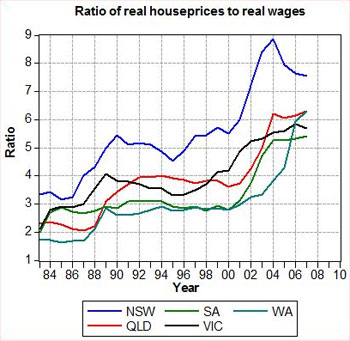
Graph of ratio of real house prices to real wages

Yesterday it was how we’re stuck with the Super Hornets thanks to “a lack of sound, long-term… planning decisions by the former Government over the course of the last decade”. Today let’s look at Chairman Rudd’s theme of the week, housing affordability.

It’s now more expensive to live in Sydney than in New York.

[P]roperty prices have jumped 400 per cent since 1986, while income has increased by only 120 per cent.

The mysterious but awesomely-brained Possum Comitatus explains how he ran the numbers, leading to this graph.

It’s worth reading the full analysis, but his conclusion is blunt:

[R]eal house prices remained virtually frozen over the period from 1990 through to 2000. It wasn’t until Howard started stuffing around with halving the capital gains rate and things like the first home buyers grant that real house prices started to accelerate…

It also highlights in real terms just how much the NSW market has dropped over the last couple of years.

Possum’s going to look at our policy options in part 2, coming soon. However The Australian‘s George Megalogenis has already started down that path — from the suitably cynical viewpoint of which options generate the most votes for whom.

Continue reading “So Howard screwed up housing affordability too”

Throwing new tools at the communication problem

If you think some fancy new communications tool will solve your problems, think again. According to one commenter at 43 Folders, “Reality was that the same bad habits were then applied to the new tool just like the old tools. And soon the new tool was just as cumbersome and inefficient as the old ones.” I’ll come back to this post next week, because some good lessons are accumulating — and it relates directly to some work I’m doing with clients.

Super Hornets are Go

Photograph of US Navy F-18E Super Hornet aircraft

Defence minister Joel Fitzgibbon has announced that the controversial purchase of 24 Super Hornet aircraft will go ahead.

The review of the Howard government’s decision to buy the aircraft — at a total cost of $6 billion even though the RAAF hadn’t wanted them — reached some damaging conclusions, including:

  • There has been a lack of sound, long-term air combat capability planning decisions by the former Government over the course of the last decade.
  • The retirement of the F-111 was made in haste but is not irreversible. The cost of turning the F-111 back on would be enormous and crews and skills have already moved on.
  • The former Government’s decision to leave Australia’s air defences in the hands of the Joint Strike Fighter project was a flawed leap of faith in scheduling terms and combined with the quick decision to retire the F-111 early, allowed an air combat capability gap to emerge.
  • The subsequent timetable the former Government put on the acquisition of an interim fighter left Defence planners with no choice but to recommend the Super Hornet. No other suitable aircraft could be produced to meet the 2010 deadline the former Government had set. One year on, that is now even more so the case.

Cancelling the order would still incur a financial penalty and create “undesirable tensions”, and the final conclusions is that “the Super Hornet is an excellent aircraft… and is the only aircraft which can meet the small delivery window created by the former Government’s poor planning processes and politically-driven responses.”

As a shareholder in Australia Inc, I’d like to know why the former “board members” allowed this to happen. When company directors are negligent they become personally liable so why, given the report’s damning conclusions, does Brendan Nelson not become personally liable?

Continue reading “Super Hornets are Go”

Twitter versus Del.icio.us versus blog posts

I’m starting to think that my “here’s what I’ve found” items should move from Twitter to Del.icio.us or maybe even Tumblr [no account there yet, will explore soon] and just be summarised here daily. Then Twitter can be just the day-to-day status stuff — which needn’t be archived here at all, but maybe elsewhere.

Are you OK with that one, Mat F?

There seems to be a surge in “RSS aggregator” products like FriendFeed to create a unified “life stream”. But the more I think about it, the more I think “one stream that contains everything” is wrong. It might be fine for archiving — for your needs. But what about those following you? Dumping everything into a single sewer of undifferentiated crap seems to throw the burden of understanding you onto you audience. And all successful media creation is about what the audience wants — no matter what the scale.

It’s better, I think, to separate out the threads into different streams. People can subscribe to the combination they want. And they can choose to view them in the aggregator of their choice.

Business contacts get your business posts. Family and friends get the status reports about your lunch. A select few choose to view the reports of your illicit camel sex. where they want them, when they want them.

Well, that’s what I think today, anyway. What do you think?