
Three quickies for you: The 40 Most Inappropriate Children’s Book Covers (I like Sharing is for Losers: an Ayn Rand Primer and Pop! Goes The Hamster And Other Fun Microwave Games). A nice rant about Sydney’s Fireworks Display Exhaustion Syndrome. And the story of the Bluetooth Burqa (hat-tip to 3 Quarks Daily).
67 Australian SAS captured airbase defended by 1000
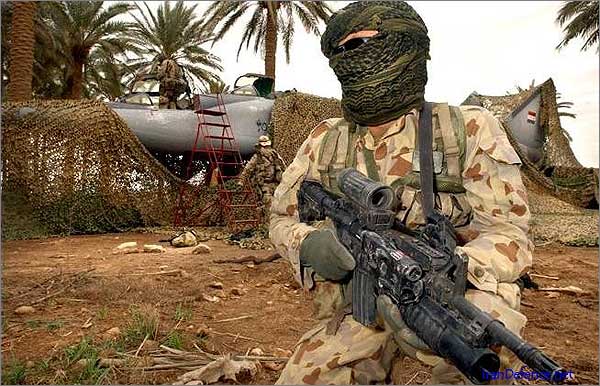
Why do we never hear about the real work of the Australian military overseas? I’ve written about this before, but I’ve just stumbled across another example. We should have heard about this!
According to a post at the Iran Defence Forum, where I snaffled the photo, 67 Australian SAS troopers captured an Iraqi airfield defended by over 1000 troops.
The Australian SAS captured an Iraqi airfield during the invasion with over 60 intact aircraft camouflaged and buried.
A MiG-25 Foxbat fighter was amongst the captured aircraft, and apparently it’s on its way to Perth to be displayed at the SAS base there.
As I said last time, surely you, dear Department of Defence, can tell enough of the story to inspire the kiddies without “revealing operational secrets”. Hell, I’d love to record this kind of oral history! You know where to find me.
Australia 2020 brings out the whingers
Another day, another lobbyist for one specific community sector fails to understand what the Australia 2020 Summit means. This time it’s Professor Warren Hogan whingeing that “the ageing population” isn’t mentioned enough.
As reported in that august journal Australian Ageing Agenda, Hogan reckons the “omission” of aged care from the Summit agenda is “inexplicable”.
“An immediate worry with the new Government comes from the failure to address any issues in aged care for the 2020 summit,” he said.
No, Professor Hogan, what’s really “inexplicable” are:
- Why you haven’t bothered looking at the list of topics at the Summit website, which clearly says: “Health — a long-term national health strategy — including the challenges of preventative health, workforce planning and the ageing population.” [my emphasis]
- How you reckon the Summit fails to address this issue when it hasn’t even happened yet.
I’m getting pretty goddam sick of the narrow-mindedness and short-term thinking shown by so many of the commentators so far.
Why the Great Firewall of China works
A lengthy article in The Atlantic explains just why China’s “Great Firewall” is so effective. As Boing Boing summarises, “The kicker is the social and political impact… simply by making it inconvenient to read certain sites, the Chinese government can keep politically charged issues from surfacing in the national discourse.”
Marc Andreessen on Barack Obama
Netscape founder Marc Andreessen spent 90 minutes with Barack Obama in early 2007. His report on that conversation is fascinating: “He said — and I’m going to paraphrase a little here: think about who I am — my father was Kenyan; I have close relatives in a small rural village in Kenya to this day; and I spent several years of my childhood living in Jakarta, Indonesia. Think about what it’s going to mean in many parts of the world — parts of the world that we really care about — when I show up as the President of the United States. I’ll be fundamentally changing the world’s perception of what the United States is all about.”
Critical Perspectives on Web 2.0
First Monday is a peer-reviewed journal about the Internet. Almost always good reading — but this month’s special feature Critical Perspectives on Web 2.0 is double-plus good.
The Preface gives the flavour:
Web 2.0 represents a blurring of the boundaries between Web users and producers, consumption and participation, authority and amateurism, play and work, data and the network, reality and virtuality. The rhetoric surrounding Web 2.0 infrastructures presents certain cultural claims about media, identity, and technology. It suggests that everyone can and should use new Internet technologies to organize and share information, to interact within communities, and to express oneself. It promises to empower creativity, to democratize media production, and to celebrate the individual while also relishing the power of collaboration and social networks.
But Web 2.0 also embodies a set of unintended consequences, including the increased flow of personal information across networks, the diffusion of one’s identity across fractured spaces, the emergence of powerful tools for peer surveillance, the exploitation of free labor for commercial gain, and the fear of increased corporatization of online social and collaborative spaces and outputs…
Much, much food for thought in the essays. Expect to see it reflected — somehow — in my writing over the coming week.
Hat-tip to Professor Roger Clarke, who says, “I thought my paper was reasonably critical of the phenomenon, but these make me seem like a pussycat (or maybe a respectable academic?).”