Talking Internet of Things on ABC Gold Coast

ABC logoThe fact that a bunch of technology journalists had gathered on the Gold Coast to discuss the latest tech trends caught the interest of the local ABC radio station. This conversation from Wednesday 19 February is the result.

Presenter Nicole Dyer and I ended up talking about the Internet of Things — and of course I mentioned the internet refrigerator and the internet rice cooker — smart cars, smart air conditioning, smart TVs and how they can be hacked. It’s a more lighthearted approach to some topics that I’ve discussed more seriously elsewhere.

The audio is ©2014 Australian Broadcasting Corporation.

Talking digital copyright on 3RRR’s Spoke

3555 logoMy recent critique of Attorney-General George Brandis’ comments about copyright reform in the digital age attracted plenty of positive comments — and also some media attention.

That critique was my ZDNet Australia column on the day of Brandis’ speech, Friday 14 February, What the Dickens will Brandis do to copyright in the digital realm?

The first piece of media interest was from Michelle Bennett, presenter of Spoke, the weekly social issues program on Melbourne community radio station 3RRR. The interview was recorded on Sunday 16 February and broadcast in the Spoke episode of Tuesday 18 February.

The conversation wasn’t just about Brandis’ comments, but also some of the background — including the so-called iiTrial between the Australian Federation Against Copyright Theft (AFACT) and internet service provider iiNet, the graduated response or “three strikes” rules for tackling copyright infringement, the Trans-Pacific Partnership (TPP) treaty, and the idea that internet access can be considered a basic human right.

I also mentioned Dr Rebecca Giblin’s research paper, Evaluating Graduated Response, which looked at those three strikes rules. The conclusion was that “there is little to no evidence that that graduated responses are either ‘successful’ or ‘effective’.”

The interview is ©2014 Triple R Broadcasters Ltd. Over at their website you can listen to the full program.

Discussing digital privacy for Hitachi Data Systems

Hitachi Data Systems privacy law graphic: click for whitepaperAustralia’s new privacy laws come into force on 12 March. On 12 February, four weeks before the new laws come into force, I hosted a panel discussion on dealing with these new law for Hitachi Data Systems.

The panelists were lawyer Alec Christie, a partner in the intellectual property and technology practice of global law firm DLA Piper; Jodie Sangster, chief executive officer of ADMA, the Association for Data-driven Marketing and Advertising (which used to be called the Australian Direct Marketing Association); and Adrian De Luca, chief technology officer for Hitachi Data Systems in the Asia-Pacific region.

Over the fold is the full 58-minute video. This was done as a Google Hangout, and since there were some internet glitches the video is a bit glitchy too, but the content itself is great.

Continue reading “Discussing digital privacy for Hitachi Data Systems”

Announcing 5at5, my new daily email letter

Screenshot of 5at5 website: click to go thereI come across a lot of fascinating stuff in the course of my alleged media work. It’s stuff worth sharing more widely. Back in December, I decided that I’d start sending out a daily email linking to the best. That email launches tomorrow, Monday 3 February.

It’s called 5at5, and it’ll bring you five items every weekday at around 5pm Sydney time.

They’ll be connected to [my] interests in some way — the politics of the internet and how technology is changing power relationships at every level of society, security and surveillance, military technology and history, language, journalism and human nature. And more.

I was amused to see Alexis Madrigal, technology editor at The Atlantic, launch his own daily email recently, 5 Intriguing Things. Five is the magic number, it seems.

I’ve chosen to use the same platform at Madrigal, TinyLetter, which is a subsidiary of email marketing platform MailChimp. Why? Mostly because it’s free. TinyLetter is limited to 3000 subscribers, but I’ll worry about that when it happens.

So now you’re going to click through to subscribe, right? Good puppy. Smart puppy.

Adventures in Identity: Still struggling with Google+

On Wednesday I decided to see if I could finally sort out my Google+ profile, which was suspended around two and a half years ago. I didn’t really get anywhere, but I did discover some new and different frustrations.

First, the back story…
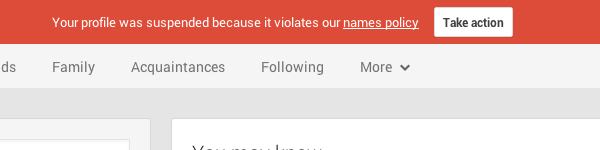
Google+ screenshot 1: see text for a description

As the first screenshot (above) says, “Your profile [that is, my profile] was suspected because it violates our names policy.” That’s because back in 2011, Google required that names consist of at least two words. To get something that looked close to my single-word name (a “mononym”), I’d entered it as “Stilgherrian .” But the full stop (“period” for American readers) isn’t allowed, and the profile was suspended.

I was so frustrated by that, and even more so by Google’s arrogant-seeming error messages, that I wrote an infamous expletive-filled blog post — which got more than 100,000 unique viewers on the first day. Even now, two and a half years later, it sometimes gets a couple hundred readers a month.

Since then, Google had supposedly started allowing people to display their “nicknames” (that is, pseudonyms”), at least in some contexts, so I figured that I’d give it another go. It wouldn’t worry me too much if I was “Stilgherrian Stilgherrian” under the hood, as long as my name was displayed properly.

So I clicked on “Take action”…

Continue reading “Adventures in Identity: Still struggling with Google+”