New “Corrupted Nerds” podcast, and we’re on iTunes

Cover art for Corrupted Nerds: Conversations episode 4: click for podcast web pageTwo more small steps in Corrupted Nerds’ plans for world domination: I’ve posted a new episode, and the podcast is listed in Apple’s iTunes Store.

Episode 4 of Corrupted Nerds: Conversations is a chat with Dr Kerry Hinton from the Centre for Energy-Efficient Telecommunications (CEET) about the looming energy crisis that’s being brought on by the move to cloud computing and, in particular, millions upon millions of inefficient wireless devices.

It’s a remarkably engaging conversation about how the internet consumes electricity.

Meanwhile, Apple’s approval process for the iTunes store was passed, and we’re listed, so that’ll make it easier for many people to subscribe. I’ve written a blog post explaining the different subscription options.

With four Conversations episodes online, plus an Extra with Senator Brett Mason’s speech from last year that inspired the title, it’s time for me to start tidying things up for some fundraising and sponsorship-seeking, so stand by for some news on that front very soon.

“Corrupted Nerds” podcast goes cloud and big data

Cover art for "Corrupted Nerds: Conversations" episode 3: click for podcast web pageI’ve finally posted a new episode of my Corrupted Nerds podcast, a wide-ranging conversation with Peter Coffee, vice-president and head of platform research at Salesforce.com.

Cloud computing is inevitable, says Coffee. “Processing power has grown at about 25% per year, and compounded over a period of 30-some years that’s a lot. But bandwidth has grown at about 45% per year over that same period of time.”

So whatever the application, no matter how complex, eventually it’ll be cheaper to process the data somewhere else, and your device — desktop, laptop, tablet or smartphone — only has to manage presentation and interaction.

I’d been wanting to catch up with Coffee for two or three years, and we finally managed to arrange being in the same room at the same time. I thoroughly enjoyed this conversation, and I think you’ll enjoy it too.

Talking Vote Compass on ABC 666 Canberra

ABC logo“It’s not every day that I find myself agreeing with Senator Eric Abetz,” began my column at ZDNet Australia yesterday. But as the remainder of my 89-word opening sentence reveals, we’re in agreement over just one word: Orwellian.

My concerns were about the data being collected by the ABC’s Vote Compass project, and what it might end up being used for somewhere down the track.

You should probably read the full article for the nuances of what I’m on about, but here’s a taste.

Vote Compass may remove personally identifiable information (PII) from its data before sharing it, but it’d be an easy task for a third-party researcher to re-identify users by cross-matching Vote Compass’ data with their existing databases.

“Scientists have demonstrated they can often ‘re-identify’ or ‘de-anonymise’ individuals hidden in anonymised data with astonishing ease,” wrote law professor Paul Ohm of the University of Colorado in 2009. It’s become easier since, for everyone from Google, Twitter, and Facebook to all the less well-known data mining companies on the planet…

The Orwellian scenario implicit in all this is that secretive data mining companies could match your political beliefs with the psychology of how you make decisions (gleaned from that “What breed of dog are you?” questionnaire you filled out five years ago) and use that to generate (through your favourite news site) a selection of persuasive news stories, opinion pieces, and advertising designed just for you — and you’d never know.

Well this piqued the interest of ABC 666 Canberra, and earlier this morning I was interviewed by presenter Genevieve Jacobs along with the creator of Vote Compass, Cliff van der Linden.

Here’s the audio — and my apologies for it being cut abruptly at the end. Finger trouble on my part. Ms Jacobs was saying that the ABC is satisfied with the precautions being taken by Vote Compass, and I must stress that I have no direct issue with their work either.

The audio is of course ©2013 Australian Broadcasting Corporation.

The article I mention is How Companies Learn Your Secrets by Charles Duhigg of The New York Times.

Do McAfee’s new cyberstats really represent a shift?

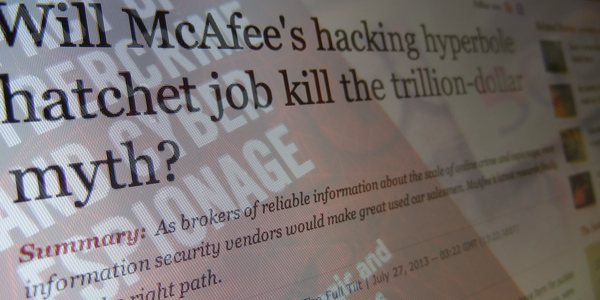
Composite image of ZDNet column headline and McAfee report title: click for ZDNet columnAs brokers of reliable information about the scale of online crime and espionage, most information security vendors would make great used car salesmen — but McAfee’s latest research finally seems to be taking the right path.

In my column at ZDNet Australia this week, I give McAfee some praise for the most recent research they’ve funded, a preliminary report from the Washington-based Center for Strategic and International Studies titled The Economic Impact of Cybercrime and Cyber Espionage that dismantles the daft idea that cyberstuff costs the global economy a trillion dollars a year.

McAfee now admits that you can’t run a small-N survey in a couple dozen large, wealthy nations — often a self-selected sample of known crime victims at that — and extrapolate the data globally.

Their new figure is “probably measured in the hundreds of billions of dollars”, although they never quite commit to one specific number…

“In the context of a $70 trillion global economy, these losses are small, but that does not mean it is not in the national interest to try to reduce the loss, and the theft of sensitive military technology creates damage whose full cost is not easily quantifiable in monetary terms,” McAfee writes.

True, but as McAfee themselves point out, this supposed cybercrime explosion is really down at the level of shoplifting. Retailers generally budget between 0.5% and 2% for pilferage and other such “shrinkage”.

I also mention my previous critical comments about various infosec vendors’ dodgy statistics — but I don’t link to them, because they were mostly published at non-CBS mastheads. So here’s a selection of stories I’ve written on this subject over the last couple of years.

Continue reading “Do McAfee’s new cyberstats really represent a shift?”

Talking NSA and spying on The Project

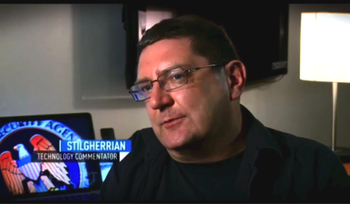
Screenshot from The Project, 8 July 2013The revelation that the US National Security Agency (NSA) was engaged in such comprehensive spying of American citizens and their allies, some of it possibly unconstitutional, continues to make headlines.

The focus has not narrowed to the manhunt for Edward Snowden as I’d feared. Instead, there’s a steady stream of mainstream news stories as new details emerge — including my third appearance on Channel TEN’s The Project on Monday night.

On the previous two occasions, when I was talking about cyberwar and crimefighting smartphones respectively, I was chatting with the presenters. Since they’re in Melbourne, that involved sitting in front of a green screen and looking down the barrel of a camera as if it’s your best friend.

But this time my comments were to be included in a stand-alone “package”, as they’re called, along with comments from Fairfax journalist Philip Dorling and others. So a videographer came to my hotel room on Friday afternoon to shoot me at my desk, while the Melbourne-based journalist asked me questions via speakerphone — and I looked toward a yellow piece of paper that indicated where the journalist might have been standing had he actually been there.

Ah, the magic of television!

The video of the three-and-a-half minute segment, including comments fore and aft by the presenters, is over the fold.

Continue reading “Talking NSA and spying on The Project”

Talking many things on the Reckoner podcast

Reckoner podcast logo: click for original websiteOn Sunday I was a guest on the podcast Reckoner with hosts Peter Wells and James Croft, which has been badged Episode Three | Freedom Of Choice.

We spoke about the Australian Taxation Office’s clunky e-tax for Mac software; Choice encouraging people to bypass geo-blocking to get at the digital content they want; a chap called Mattrick moving from Microsoft to Zynga; Yves St Laurent CEO Paul Deneve joining Apple; Samsung buying Boxee; and Twitter client Falcon Pro for Android going free, but gaming Twitter’s user-token limits.

There’s links to all those things on the episode page. That’s three links to that page now, so you should click on one of them. Go on.

That said, here’s the audio right here, embedded in this page so it’ll also appear in my Conversation podcast feed.

The audio is Copyright ©2013 Reckoner.