
Talking Facebook on ABC 666 Canberra

Today on I’m a Goddam Expert it’s Facebook, the recent round of changes, and what it means for users and the world of social networking generally. It began with Friday’s piece for Crikey, Hey Facebook, we want to share, but this is ridiculous, and so far I’ve been booked to do four radio spots. And counting.

I did two spots on Friday afternoon, one with Lindy Burns ABC 774 Melbourne the other with Melanie Tait on ABC 666 Canberra. Here’s the audio for the Canberra conversation.

The Melbourne conversation (2.1MB MP3) covered similar territory, but the recording dropped out near the end so I haven’t bothered posting it as a proper podcast.

This material is ©2011 Australian Broadcasting Corporation, but they generally don’t put these interviews online — and hey, it’s a good plug for them. Well, a minor but useful plug.

I’m doing two more this morning, also for ABC local radio stations. The Gold Coast at 0940 AEST and North Coast NSW at 1010.
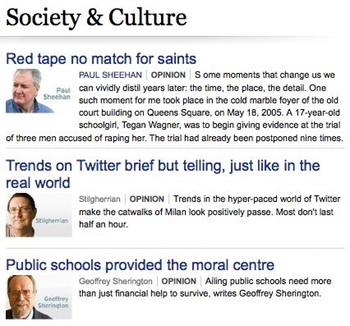

A Twitter-related Sydney Morning Herald debut

Today I returned to the print media with an opinion piece, Trends on Twitter brief but telling, just like in the real world, in the Sydney Morning Herald.

It’s an overview of Twitter’s “Trending Topics”, including the observation that marketers who try to game the trends are probably wasting their time. Research by Hewlett-Packard’s social computing lab [PDF] shows that there’s probably no point in focusing on the “influencers”.

Topics will trend or not based on whether people found it interesting to retweet at that moment. Just like Yahoo! Research’s Duncan Watts said a few years back.

Somehow I managed to refer to the fisting incident without using the word “fisting” itself.

I wouldn’t have thought about writing this piece myself, being too immersed in Twitter to realise that it needed explanations. Blame Joel Gibson, the SMH Opinion Editor. He commissioned it and did a decent job of improving my Sunday-written words.

I think it’s quite sweet that Fairfax decided to explain my name.

No Canberra for cyberwar after all

As it happens, I didn’t end up going to the 2nd National Cyber Warfare Conference in Canberra this week. The conference sessions weren’t open to the media, and I decided that it wasn’t worth the trip if we’d have to rely on second-hand information.

That said, we did manage to get a recording of the over-dinner speech by David Irvine, the director-general of Australian Security Intelligence Organisation, which Liam Tung turned into the story “Insidious” cyber chaos too fast for ASIO. It also served as part of the inspiration for my story Yet another free pass for Aussie spooks.

Who wants to go to Canberra anyway?

However SC Magazine did send Darren Pauli and John Hilvert, and their stories were:

Covering the 2nd National Cyber Warfare Conference

As soon as I arrive back from my trip to Kuala Lumpur on 13 September, I’m off to Canberra for the 2nd National Cyber Warfare Conference on 14 and 15 September. No I won’t be. See the comments.

I’m covering it for CSO Online, and for the moment I’m assuming that’ll be in the form of written material. I’d also like to cover it for the Patch Monday podcast, but I don’t think that’ll be possible due to the contractual arrangements.

The event itself runs for a day and a half. An afternoon of presentations followed by a day of roundtable discussions. I’m looking forward to it.

If there’s anything else happening in Canberra either side of this event, please let me know so I can plan to attend,

Twitter: a guide for busy paranoids

[This is a slightly edited version of the article written for “Stories: from The Local Government Web Network”, issue 3, August 2011, which was distributed at the LGWN’s conference in Sydney on 18 August. Some material in this article also appears in Tweeting your way out of Paranoia, the closing keynote presentation I delivered.]

If you’re not yet at least experimenting with Twitter, the real-time social messaging service, you should be.

Suppress the corporate paranoia. It’s a lot easier than you might think. And while Twitter does get far more attention than its relatively small size might suggest — truly active Twitter users number perhaps 20 million globally compared with Facebook’s 750 million active users and counting — it punches well above its weight in terms of connecting with influential community members.

Twitter may not ever become the core real-time service used by the masses. Or if it does, it may only be for a few years. You only have to look at the last decade to see the then-leading MySpace surpassed by Facebook in 2008, just four years after Facebook was founded. Google’s launch of Google+ in June this year has generated plenty of speculation that the search and advertising giant’s foray into social networking will in turn wipe Facebook off the planet. Who knows?

There will always be some real-time social messaging service, however. Whether that’s Twitter as a stand-alone service, or whether we all end up using a real-time component of Facebook or Google+ or something that has yet to be deployed — none of that matters. The principles and practices of real-time messaging will doubtless end up being much the same.

Anything you might do with Twitter will be easy to migrate to any other real-time messaging system. The lessons you learn will carry across too.

Continue reading “Twitter: a guide for busy paranoids”

LinkedIn’s inadequate response to privacy stupidity

LinkedIn has responded to criticism over their opting-in of everyone to their “social advertising” program with a self-serving blog post. I’m less than impressed.

I wrote two articles yesterday. For Crikey, Sorry too hard a word for LinkedIn over privacy faux pas, in which I describe LinkedIn’s response as bullshit. And for CSO Online, Five lessons from LinkedIn’s opt-out stupidity, which reminds people to keep an eye on social networking services for unannounced changes to the rules of engagement.

Paul Ducklin from security vendor Sophos gives them an easier time, praising them for a quick response. He’s nicer than I am.

In the cold, clear light of Saturday morning, what depresses me most about this whole episode is not that a supposedly-professional service would pull a trick like this and, when caught out, just smear PR bull over the top. It’s that they’ll probably get away with it, and imagine they handled it well.

Continue reading “LinkedIn’s inadequate response to privacy stupidity”