“Do Journos Do it Better?”

Photo of Media140 panellists Mia Freedman, Bronwen Clune, Valerio Veo, Laurel Papworth and Stilgherrian

The reprobates in the photo are me and my fellow panellists at forthcoming the Media140 Sydney conference, where we’ve been given the topic “Do Journos Do it Better? Journalists in SocMedia Communities.” Look out, folks!

From left to right, that’s freelance journalist, columnist and blogger Mia Freedman; new media consultant and recovering journalist Bronwen Clune; Valerio Veo, who heads up online news and current affairs at SBS; social media consultant Laurel Papworth; and me.

Now I’m hoping the discussion doesn’t degenerate back into those tedious bloggers versus journalists arguments from last year. Certainly by year’s end they seemed to have faded. And we do seem to have a more switched-on panel. But we’ll see.

Actually the full conference program looks good, with everyone from ABC managing director Mark Scott and Crikey editor Jonathan Green to… oh, look for yourself.

Media140 Sydney is on 5 and 6 November 2009 at the ABC’s Eugene Goossens’ Hall in Ultimo. Early-bird bookings at $145 close today have been extended to 5 October.

“Influence is the future of media”, eh?

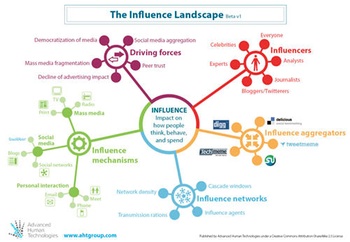
The Influence Landscape: click for a more details

This year, the Future of Media Summit has been replaced by the Future of Influence Summit. It’s next Tuesday 1 September, Sydney time. I’ll be going, and I can offer you a discount.

Summit-master Ross Dawson has changed the name because he reckons that influence is the future of media.

Ross writes:

We have already begun to discover this through the now-dominant concept of “social media”. In the Future of Media Strategic Framework that was launched for our Future of Media Summit 2006 we described the (symbiotic) relationship between Mainstream Media and Social Media.

Social media is all about human relationships, about how we shape our view of the world based on our peer communication. The extraordinary breadth of information and opinion that we are exposed to today, combined with the ability to converse, means our own opinions are often driven more by peers than traditional sources.

In fact this shift to the social means that media is becoming far more about peer influence than information and reporting.

This year companies globally will spend US$450 billion on advertising. The composition of advertising spend has changed dramatically over the last decade. That pace of change will rapidly accelerate in coming years. Total marketing spend is hardly set to reduce in an increasingly crowded marketplace, but it will be allocated to those activities that truly make a difference. Influence — based on conversations and aggregated opinion — will be at the centre of how companies seek to drive sales and customer engagement.

Today, people find content such as movies, music, news, books and so on primarily through aggregated channels. Instead of buying the New York Times and reading it cover to cover, people are pointed to the most relevant articles in the New York Times and elsewhere, based on what people find interesting. It is hardly new that people buy music or books because of recommendations — but now adding to their friends’ opinions and magazine reviews are a universe of influencers who provide guidance on what to buy. Influence is driving the world of content and publishing as never before, and this is just the beginning.

Last year’s Future of Media Summit was full of old media journalists and managers in denial.

It triggered my controversial essay Note to “old media” journalists: adapt, or stfu! (parts of which were even translated into French in Le Monde), a wonderful response from the MEAA’s Jonathan Este, and furthers writing from me including the essays “Trouble at t’paper” and Sunday Thoughts about Journalism.

A year later, a lot has changed — although my liveblog from Media 09 still reads as pessimistic. I’ll be interested to see what emerges, and to prepare myself I’ll be reading more of Ross’ blog over the next couple of days. Expect further posts.

Meanwhile if you want to register for the Future of Influence Summit, you’ll get 20% 25% off if you use the discount code TIESTIL.


Does the Internet get second-rate news coverage?

Crikey logo

On Sunday, Pipe International‘s new PPC-1 undersea fibre-optic data link from Guam to Sydney was fired up. As I wrote in Crikey in May, when the cable was landed at Collaroy on Sydney’s northern beaches, PPC-1 will increase Australia’s international data capacity by almost 50%. That’s like adding the third runway at Sydney Airport. So where was the media coverage?

I wrote about that in Crikey today, and it’s free to read: They’re building data pipes under the ocean: why no media coverage?

OK, there were some reports, in The Australian and in IT-related sites like iTnews, iTWire and ZDNet Australia. But where was the ABC? Fairfax papers?

There was a “robust discussion” on Twitter this afternoon between The Australian‘s Andrew Colley, ZDNet Australia‘s Renai LeMay, myself and others, and I’ll try to summarise that later. There were certainly key areas of disagreement!

For now, though, have a read of my Crikey piece and tell me what you think.

Why Twitter is useless for covering conferences

[Update 9.40pm: It’s only 40 minutes since I posted this, but discussion has already turned to the topic of the government’s role in developing new services rather than the original Twitter-as-Chinese-whispers theme. Hey, join the discussion!]

Twitter bird cartoon by Hugh MacLeod

Even though I’m one of Australia’s most prolific Twitter users, and even though it seems like I’ve spent half the week defending it from half-arsed criticism, I’m also well aware of its limitations. Like tonight.

Earlier this evening I attended the Government 2.0 Taskforce‘s Road Show in Sydney. At one point, I tweeted:

Nicholas Gruen seriously says that the government should have created community good like Google, Facebook and Twitter. #gov2au

That was soon picked up by people who weren’t in the room, who hadn’t heard the context. Hours later we’re still seeing tweets like this one:

@skaye: “The Govt should have invented twitter, flickr…” LIKE WTF?? #gov2au *shudder* (via @NickHodge) They struggle with discounts on utes!

Notice how the content mutated as the message was passed on? “Created” becomes “invented”, Flickr is added to the mix, and the “community good” qualifier has vanished.

Here’s what really happened…

Continue reading “Why Twitter is useless for covering conferences”