
Weekly Wrap 48

A weekly summary of what I’ve been doing elsewhere on the internets. This week was very much a calm — sort of — before the storm.

Podcasts

  • Patch Monday episode 86, “Apple: Big Brother or just misunderstood?”. When news broke that Apple’s iOS-based devices were logging location-based information, the media went wild. I speak with information security engineer Alex Levinson from Katana Forensics and Professor Roger Clarke, chair of the Australian Privacy Foundation.

Articles

  • APF urges criminal penalties for smartphone privacy breaches, for ZDNet Australia, based on Professor Clarke’s comments on Patch Monday.
  • Gamification: Hot, new, unethical? for the new site Technology Spectator. I’ll say it straight up: the mindset behind the gamification trend disgusts me. And, despite what the first two commenters on that op-ed imagine, it’s not because I haven’t heard or read enough about it. The more I hear and read from gamification’s buzzword-addled cheer squad the more disgusted I become.

Media Appearances

  • On Monday I spoke with Perth radio RTRfm about the Sony PlayStation Network hack.
  • On Friday I spoke with Kate O’Toole on ABC 105.7 Darwin about the surge of spam and malware following the killing of Osama bin Laden.

I haven’t posted the audio files of those radio interviews, even though I have them. Should I? Part of me says I should do so, because it helps create a proper archive of what I do. But another part of me reckons that radio in particular is ephemeral, and that my conversations about these issues really haven’t added much new to the vast global pool of media on these subjects. What do you think?

Corporate Largesse

None. But that will seriously change next week. Stand by.

Elsewhere

Most of my day-to-day observations are on my high-volume Twitter stream, and random photos and other observations turn up on my Posterous stream. The photos also appear on Flickr, where I eventually add geolocation data and tags.

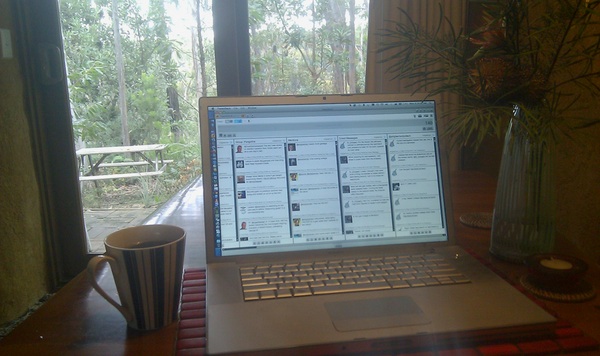
[Photo: Victory is mine! The view from the dining table at Wattle Cottage, one of the Bunjaree Cottages where I’ve been living off and on for the last three months. The title is because this was the last in a sequence of photos documenting my battle with the forces of natural gas. I guess you had to be there…]
Fowler’s Assange biography not really so bad

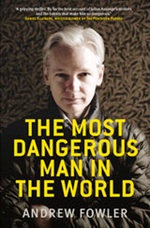
A couple weeks ago I wrote that Andrew Fowler’s biography of WikiLeaks’ Julian Assange, The Most Dangerous Man in the World, was failing to impress. I persisted reading, however, and things got better.

My main gripe then was that just 41 pages into the narrative I was getting the distinct impression that Melbourne University Press hadn’t assigned an editor who had the faintest grasp of internet technology, history and culture. I listed a bunch of what, to me, were glaring errors.

However once we get past Assange’s earlier hacker life and into more recent material, which is more about interpersonal relationships and international politics, the book is significantly stronger. Indeed, The Most Dangerous Man in the World does a good job of tying together the various threads of the Assange and WikiLeaks stories, and even buries on page 217 an important revelation — if it is a revelation.

I have been reliably told that ASIO played an active part in the investigation into Assange, trawling through his life and activities in Australia. But what must be just as worrying for him, and has also never been revealed before, is the fact that the inquiry also included officers from ASIS, Australia’s overseas intelligence agency, which has strong links with the US.

Personally I’m not surprised by that news one bit. That’s just the intelligence organisations doing their jobs of investigating perceived threats to national security, as should be expected. But given how some folks get all frothed up whenever they discover that spooks are involved, I’m wondering why this wasn’t given more prominence.

The book still has some curious wording, such as on page 147 where WikiLeaks is described as “a child of the anarchic blogosphere”. I’m not sure that’s the right heritage to stress and, as I wrote before, Robert Manne’s free-to-read essay in The Monthly does a much better job of capturing Assange’s and WikiLeaks’ cypherpunk roots. On page 165 there’s a reference to “what’s known as the DefCon conference”, as if there’s some doubt as to the name of one of the longest-running and most-respected hacker events on the planet. And there’s still plenty of that sloppy editing I referred to, such as the Chaos Computer Club being explained twice.

Nevertheless, reading The Most Dangerous Man in the World will give you the core narratives. Just be aware that the technical and cultural descriptions are wobbly, and use it to get the timelines straight in your head.

Weekly Wrap 47

A weekly summary of what I’ve been doing elsewhere on the internets. Thanks to the collision of Easter and Anzac Day to create a very long weekend indeed, there were only three official workings days.

Podcasts

There was no Patch Monday podcast because Monday was a public holiday. However I did record the key interviews for the next two episodes. That’s the furthest ahead I’ve ever been.

Articles

  • Tired Microsoft delivers solid profits, for now, for Crikey, which as you might imagine is a commentary on the company’s quarterly results.
  • I also wrote a piece for ZDNet Australia that should be published tomorrow, and my first two opinion pieces for an outlet that… well… I’ll tell you about that next week.

Media Appearances

  • On Wednesday I was interviewed by Carol Duncan on ABC Radio 1233 Newcastle about the security breach of Sony’s PlayStation Network. The audio is available at the ABC website.
  • I was interviewed on the same subject by the OzSpot gaming podcast, a production of CBS Interactive’s GameSpot.
  • [Update 8 May 2011: The direct link to the podcast doesn’t work. You’ll have to scroll down the list of episodes in the “archive” section on the right to find the one for 26 April.]

  • On Thursday I was interviewed by John Kenneally and Jane Doyle on Adelaide radio FIVEaa about… the Sony PlayStation Network hack. There’s no audio published at their website. Should I post my copy, do you think?

Corporate Largesse

None.

Elsewhere

Most of my day-to-day observations are on my high-volume Twitter stream, and random photos and other observations turn up on my Posterous stream. The photos also appear on Flickr, where I eventually add geolocation data and tags.

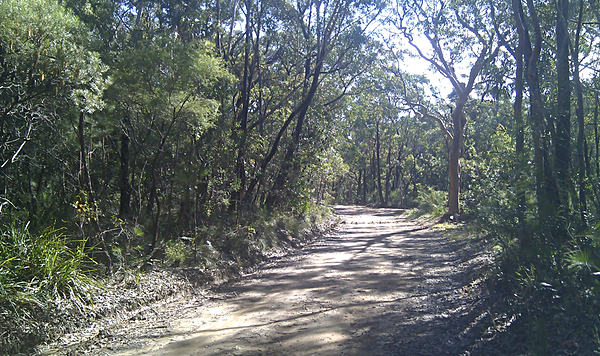
[Photo: Road to Bunjaree Cottages, taken earlier today. This is one of the dirt roads leading to Bunjaree Cottages, which is where I’ve been staying off and on for the last three months. This isn’t the official road to take, as for a short distance it crosses through private property, but it’s the way I usually take when walking into Wentworth Falls.]

On stage for the Microsoft Politics & Technology Forum

I’ve attended the previous two Microsoft Politics & Technology Forums in Canberra as their guest, but this year there’s a difference. I’ll be on stage. The date is 1 June 2011. The venue is the Parliament House Theatrette. And it’s free.

The theme is Do we trust the internet? That’s all about openness and transparency in politics.

Technology and politics is more interwoven than ever before.

We’ve seen sensitive government information being revealed on Wikileaks, and mobilisation of communities across the Middle East using social media resulting in regime change in Tunisia, Egypt and unrest in Libya and Bahrain.

The first social media election in the UK saw an incoming Conservative Coalition government, overturning 13 years of Labor rule. David Cameron’s Conservative party trumped other parties in social media campaigning.

The Australian Government has its own Declaration of Open Government, a central recommendation of the Government 2.0 Taskforce. The declaration promotes “greater participation in Australia’s democracy, and is committed to open government based on a culture of engagement, built on better access to and use of government held information, and sustained by the innovative use of technology.”

This and much more will be discussed when UK’s leading political blogger Iain Dale (pictured) will be addressing Microsoft’s 3rd Politics and Technology Forum: Openness and Transparency in Politics. The Forum is supported by Open Forum.

Iain Dale will then participate in a panel discussion of distinguished speakers including Senator Kate Lundy, Parliamentary Secretary to the Prime Minister; Joe Hockey MP, Shadow Treasurer; Stilgherrian; and Microsoft’s Gianpaolo Carraro. The event MC is Mark Pesce.

I’m particularly amused by the facts that I’m “distinguished” and that I’m not explained by any job title or description. I am self-explanatory. Or possibly indescribable.

It’ll cost you nothing to register for this free event, but you’ll need to use the SEKRIT ticket code. Which is “dale”.

Previous Microsoft Politics & Technology Forums

The first Forum was in 2008. Thanks to Microsoft’s Nick Hodge, you can view videos of Matt Bai’s keynote address, Panel 1 on Blogging, social networks, political movements and the media with Annabel Crabb, Peter Black and Mark Textor, and Panel 2 on Politics 2.0: information technology and the future of political campaigning with Joe Hockey, Senator Andrew Bartlett, Senator Kate Lundy and Antony Green.

During this first event, I provided commentary via Twitter and was, um, generally helpful to the discussion from the audience. My most important outburst is during the first panel discussion, though I can be heard but not seen. I have yet to dig the tweets out of Twitter’s archive.

The second Forum was in 2009, with the theme “Campaigning Online”. I did a live blog, and later turned my notes of Joe Trippi’s keynote address into the post Notes on Obama’s election campaign.

I daresay there are videos somewhere, but I couldn’t be arsed looking for them just now.

Anzac Day 2011: Recycling the recycled stuff

Given that last year on Anzac Day I just recycled two previous Anzac Day posts, I’d planned to write something new this year. But I haven’t.

There’s two reasons for this.

One is that I’d thought I might write something about the way the defence establishment has handled various controversies recently, including the incident at the Australian Defence Force Academy. But once I started doing the research it all got a bit too depressing. And I wondered what I might say that hadn’t already been said. So I killed that idea.

The other is that when I looked back at those recycled posts, I realised they actually still say what I think I’d like to say on this occasion. So, recycled posts it is.

Those posts are Anzac Day Rememberings and Anzac Day 2009: Sacrifice.

They shall grow not old,
As we that are left grow old,
Age shall not weary them,
Nor the years condemn.
At the going down of the sun,
And in the morning
We will remember them.
Lest we Forget

As I wrote two years ago, we trust that our politicians, who decide where and when these men and women serve, make worthy decisions about their most valuable contributions. Sometimes they never return, or return… changed.

Prime Minister Gillard, are you making worthy decisions? Tony Abbott, are your policy proposals also worthy? Please look me straight in the eye when you answer that.

[Photo credit: The rosemary sprig was taken from Matthew Hall‘s Twitter page from 2008. If I owe someone for that usage, I’ll make good.]