
Weekly Wrap 16

A weekly summary of what I’ve been doing elsewhere on the internets. Well, the bits I’m going to talk about publicly.

Articles

Podcasts

Geekery

I still spend roughly a third of my time doing random “geek for hire” stuff with a few long-standing clients. I reckon I might as well list any significant moments.

  • I still provide internet hosting for approximately 110 domains for around 40 clients, including my own activities such as this website. I’m right in the middle of migrating all that to a new server. Indeed, this site is now running on that server. It’s another dedicated Linux box at ServePath in San Francisco, although they seem to be emphasising their GoGrid branding these days. I’m thrilled to discover that just packaging and migrating the data will take 14 hours, and my planned process won’t work. A busy weekend ahead. Sigh.

Elsewhere

Most of my day-to-day observations are on my high-volume Twitter stream, and random photos and other observations turn up on my Posterous stream. The photos also appear on Flickr, where I eventually add geolocation data and tags.

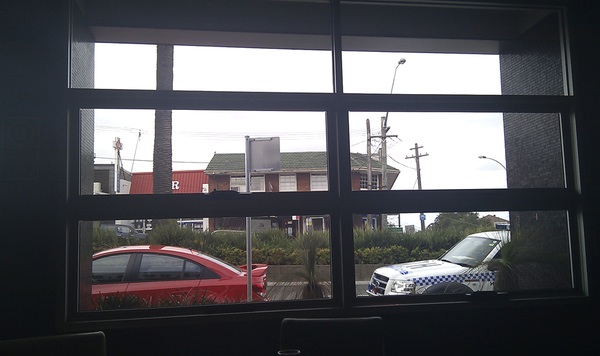
[Photo: The view from Beverly Hills Hotel, Sydney, which is a substantially less glamorous view than last week’s photo.]


Why Wotif founder Graeme Wood is an arsehat

Wotif is, undoubtedly, an Australian internet success story. But that doesn’t mean its founder Graeme Wood’s opinions about the future of the internet are worth listening to.

Wood spoke at the 21st World Computer Congress in Brisbane yesterday and, as Fairfax reports, he said this about the National Broadband Network:

If all you do is download the same stuff — only faster — how can you justify that as an investment?

If the mix of the normal usage — email, music, video, Facebook, gaming, stays the same, but just happens faster — is there an economic or social benefit in that for the private user?

See that “if” part? His whole critique is based on the premise that if you have broadband a hundred times faster that what anyone has now, there still wouldn’t be any new applications. Really?

All arguments depend on their assumptions, and at least we can credit Wood for pointing out what his assumptions are. But his assumptions are crap and should be ignored.

If the moon were made of something different and were a different colour, then it would be green cheese. But it’s not.

If vastly faster bandwidth were available then new things do become possible. The fact that you, Mr Wood, can’t think of them isn’t a critique of the NBN. It’s a critique of your limited imagination. Or, even if you have no imagination yourself, your inability to stay in touch with the people sketching out those future applications.

Let’s invert that and go back a few years to the mid-1990s. Instead of the 10Mb/s or more ADSL2+ connections that suburban homes have now, and that most regional users still dream of, we have 56kb/s dial-up links.

Remember 1995? No VoiP telephony, unless there’s no-one else using the internet link. No Skype. No video chat. No AJAX-based software as a service — including Wotif’s own rich interface for booking hotel rooms. No streaming video from the ABC’s iView. No waiting for rich, graphics-filled web pages for news sites. No YouTube. Sure, there were MP3 files, if you were prepared to wait half an hour for each one. Waiting hours to download your monthly Windows updates.

And everyone else in the home waiting until you finish, so they could have their turn.

Wood would be there, saying, “If the mix of the normal usage — email, Gopher, FTP downloads of a text file, web surfing to GeoCities stays the same, but just happens faster — is there an economic or social benefit?”

Of course there is. Even with no new applications, everything happens faster. So everyone can consume faster. Generate profits faster. Do work instead of waiting for software to download.

That someone who purports to be an entrepreneur on the internet has forgotten all this so quickly is appalling.

Thank you for playing, Mr Wood. Now fuck off.

Weekly Wrap 15

A weekly summary of what I’ve been doing elsewhere on the internets.

Articles

Podcasts

  • Patch Monday episode 57, “CCTV surveillance: reality versus myth”. My guest is Professor Brian Lovell from NICTA’s Queensland Research Lab.

[Photo: Circular Quay station at dusk, showing how us Sydney residents tend to take the magnificent views for granted.]

Weekly Wrap 13 and 14

A weekly summary of what I’ve been doing elsewhere on the internets, once again done fortnightly because I forgot to do it last weekend. Suffer.

Articles

  • Nile’s porn excuse doesn’t hold water, for Crikey. Sydney’s Daily Telegraph alleged that various NSW politicians had been using their parliamentary computers to access pornography, and that anti-sex-industry campaigner and Christian Democrats leader Reverend Fred Nile was the worst culprit. He denied it, but as the story stood on 2 September 2010 I didn’t believe him.
  • NSW Parliament’s flawed porn hunt, for Crikey. By the following day, it was clear that the “audit” of parliamentary web browsing was deeply flawed.
  • What the NBN will deliver to Windsor’s mob, for Crikey. Independent MP Tony Windsor said that the National Broadband Network was a major factor in him choosing to support Labor over the Liberal-National Coalition.
  • ACMA and Nine demonstrate Australia’s institutionalised racism, for ABC Unleashed. Sam Newman’s continued low-brow bigotry on The AFL Footy Show gets “punished” with a slap on the wrist. Again. It took only six comments before someone accused me of political correctness gone mad and compared Australian with North Korea. And another commenter said that I “looked like a potato that had been boiled too far”. The standard of discussion at ABC Online isn’t all that flash.

Podcasts

  • Patch Monday episode 55, “BYO computers: cloud security risk?”.
  • Patch Monday episode 56, “Parliament’s poor porn probe exposed”. If ZDNet allowed longer headlines and more robust language in their stories, I’d have entitled this podcast “Pollies’ piss poor Parly porn probe exposed”. Poetry.

Media Appearances

Elsewhere

Most of my day-to-day observations are on my high-volume Twitter stream, and random photos and other observations turn up on my Posterous stream. The photos eventually appear on Flickr.

[Photo: Enmore Village on a Spring evening, taken from one of my favourite afternoon working spots at the Warren View Hotel, corner of Stanmore and Enmore Roads. Compare it with the photo in this post, My village really is home.]

Weekly Wrap 12

A weekly summary of what I’ve been doing elsewhere on the internets. Not so much media work this week, but what I did do related to the hung parliament and the importance of broadband to the independent MPs who hold the balance of power.

Articles

Podcasts

  • Patch Monday episode 54, “Broadband election’s harsh come-down”, which explains the issues as they stood on Monday 23 August 2010, plus a repeat of my conversation from earlier this year with Jan Meijer of Norway’s UNINETT explaining why online voting is a lot trickier than might seem.

Media Appearances

None. I was surprised by this. But then again everyone wanted to talk to the “block of three” independent MPs, not me.

Geekery

I still spend roughly a third of my time doing random “geek for hire” stuff with a few long-standing clients. I reckon I might as well list any significant moments.

  • Cleaned up the home page for Fender Australia. They’ve been a client for a decade now, and the guts of the website includes hundreds of manually-maintained pages which date back to 2001. The red and black design was a quick re-skin back in 2007. This week’s work was simply to tidy up a layout which had become messy since then. Yes, it will become a database-driven website soon. We’ve also been saying that for at least two years.

Elsewhere

I should also mention that most of my day-to-day observations are on my high-volume Twitter stream, and random photos and other observations turn up on my Posterous stream. The photos eventually appear on Flickr.

[Photo: Modern Living in Enmore, a shop window full of wigs on dummies’ heads, Enmore Road.]

Weekly Wrap 10 and 11

A weekly summary of what I’ve been doing elsewhere on the internets. Well, a fortnightly summary today, because I forgot to do a post like this last week. Sigh.

Actually, a lot of this relates to the federal election here in Australia, so you’d better digest it all now before you vote today. Hurry up!

Articles

Podcasts

  • Patch Monday episode 52, “Media laws dying for digital update” with guest Peter Black from the Queensland University of Technology.
  • Patch Monday episode 53, “Understanding the broadband election” with guest Narelle Clark, a network engineering consultant who’s most recent gig was as research director of the CSIRO’s Networking Technologies Laboratory. She’s also vice-president of the Internet Society of Australia and on the board of trustees for the Internet Society globally.
  • A Series of Tubes episode 115. Host Richard Chirgwin talks with Anup Changaroth of Ciena Networks about gigabit fibre networks, the product life cycle, and the value of Layer 2 carrier networks, and me about broadband policy.

Media Appearances

[Photo: Tights are not pants, Enmore Road. Further proof, Ladies, that tights are indeed not pants. Not even if you’re also wearing heels.]