Talking Twitter and the election on Syn Radio

I’ve just been chatting about Twitter and other internet issues during the Australian Federal Election 2010 with Melbourne’s Syn Media, which broadcasts on 90.7 FM. And here’s a podcast.

I was interviewed by Tamsyn Byrne and Emma Buckley Lennox for the “Below the Line” election program. This recording is missing the final few seconds of the conversation, but that was really just the thank-you and a mention of my website.

The Conversations category is where I post the unedited versions of interviews I do, or the various media spots I do which aren’t podcast elsewhere. If you’d like to grab all of them in the future, subscribe to the RSS feed.

Weekly Wrap 9

A weekly summary of what I’ve been doing elsewhere on the internets — and this week there’s been a lot of it!

Articles

  • Gay marriage an irrelevant sideshow, for ABC Unleashed. I reckon the way “the gay and lesbian community” abused Senator Penny Wong for simply re-stating Labor policy was disgusting. Did they really expect her to break ranks and criticise her party’s policy just because some random punter asked her a question on Q&A?
  • AFACT didn’t explain notices to iiNet for ZDNet.com.au. On Wednesday I covered day three of the Federal Court appeal by the Australian Federation Against Copyright Theft in their case against Australia’s third-largest ISP. This is straight reportage of the morning’s proceedings.
  • Will AFACT’s appeal solve anything? for ZDNet.com.au. On Thursday, I wrote this op-ed piece, picking up on one of the appeal judge’s comments about this appeal not necessarily solving anything long-term.

Podcasts

  • Patch Monday episode 51, “Data breaches: it’s criminals again” with guest Brad Arkin, who Mark Goudie, who heads up the forensics practice for Verizon Business Asia-Pacific in Melbourne. We discuss Verizon’s 2010 Data Breach Investigations Report [PDF].
  • A Series of Tubes episode 114. Host Richard Chirgwin talks with APNIC Chief Scientist Geoff Houston about the impending exhaustion of IPv4 internet addresses, and me about the AFACT v iiNet appeal, the demise of Google Wave, and a few political things.

Media Appearances

[Photo: The view from Courtroom 1, Federal Court of Australia, Sydney, photographed on 4 August 2010. The brown smudges are not on your screen: the windows need cleaning from the outside.]

ICT Election Forum: what questions?

The Australian Computer Society (ACS) is once more holding a Federal Election Forum on ICT issues, with the Minister for Broadband, Communications and the Digital Economy Senator Stephen Conroy, his Coalition counterpart Tony Smith MP, and The Greens’ spokesperson Senator Scott Ludlam.

As you can see from the photos, Australia’s political diversity is once more represented by a bunch of middle-aged men in dark suits.

When I wrote about the equivalent event in 2007, I noted that the Minster at the time, Liberal Senator Helen Coonan, looked rattled and scored a few own goals. Conroy, by comparison, was alert and scored some sharp political points. And Democrat leader Senator Lyn Allison — remember the Democrats? — was quietly confident.

Labor’s broadband promise was a Fibre to the Node network with a “guaranteed” minimum speed of 12Mb/sec to 98% of Australians, costing $4.7 billion. The Liberals were promising WiMaX through the OPEL consortium. From memory, mandatory internet censorship didn’t even get a mention, as both parties only added that little gem to their agendas after the official campaign period had started.

How times have changed…

This year’s moderator is Sky News political editor, David Speers. An odd choice, I must say. Sure, he has the profile and Sky News Business is the host broadcaster. But wouldn’t it have been better to have someone with a better technical knowledge of the portfolio, rather than a general political news reporter? My worry is that it’ll degenerate into political point-scoring rather than analysing competing policies.

So let’s help out Mr Speers. What are the issues this year, do you think? What questions should he ask?

I think we can take a question or two about internet censorship for granted. Please try to think beyond the obvious indignation du jour.

The Federal Election Forum is next Tuesday 10 August 2010 at the National Press Club in Canberra. The debate starts at 1pm Canberra time and will be broadcast on Sky News Business and possibly ABC News 24. [Update 3pm: The Forum will also be streamed live at YouTube’s Australia Votes channel.]

[Photo credits: Stephen Conroy via Wikimedia Commons. Tony Smith via Office of Tony Smith MP. Scott Ludlam via The Greens. This composite image is licensed for re-use under a Creative Commons CC-BY-SA-2.0 license.]

Weekly Wrap 8

A weekly summary of what I’ve been doing elsewhere on the internets.

Articles

Podcasts

  • Patch Monday episode 50, “Security lessons from Adobe Reader” with guest Brad Arkin, who heads up security and privacy at Adobe. The next version of Adobe Reader for Windows to be released later this year will include a “sandbox”, making it much more resistant to certain kinds of attacks.

Media Appearances

  • On Thursday afternoon I did a quick spot on ABC Radio Statewide NSW with Paul Turton, talking about, of all things, running out of IP addresses, DNSSEC and this mangled story about the seven secret people who can reboot the internet. Alas, this isn’t podcast anywhere.
  • On Friday I recorded an interview with ABC Radio National’s Future Tense which will be broadcast next Thursday.

[Photo: Circular Quay viewed from the railway station, photographed on 27 July 2010. We really do take this view for granted.]

Adam Schwab’s NBN reply

Yesterday I posted a fairly blunt attack on Adam Schwab‘s analysis of the national Broadband Network (NBN). Today he sent this response, which I publish in full.

Stilgherrian is, on most occasions, one of the leading technology writers in Australia — his coverage of the planned internet filter was first class, as was his recent reporting of the planned $400 million under-sea cable between Sydney and Los Angeles. However, Stilgherrian let his lofty standards drop and seriously damaged his journalistic credibility with his blinding support for the National Broadband Network (NBN). Sadly, it appears that Stilgherrian’s ostensible desire that other people to pay for a shiny piece of broadband infrastructure has gotten in the way of him actually considering whether the multi-billion dollar public investment is a good idea for Australian taxpayers.

Stilgherrian launched a blistering attack on an article I wrote in Crikey, alleging that it was “full of misunderstandings and straight-up mistakes”. A somewhat ironic comment given most of his criticisms were themselves quite obviously incorrect. Specifically, Stilgherrian stated that:

[Schwab] thinks the NBN is an internet service provider (ISP). He wants it to deliver short-term commercial return on investment. And he doesn’t differentiate between needs now and a decade or two or three in the future.

Perhaps Stilgherrian should have either read the original article properly or spent thirty seconds contacting me before jumping to incorrect conclusions as to my ‘thoughts’. Nowhere in the original article was it stated that the NBN would be a retail network. The NBN has always been a wholesale network. The original article referred to the speculated final retail prices which may result from the NBN, but did not specify that the NBN would be the retailer. Nor was that point even remotely relevant to the main intent of the article.

Second, the original article also never referred to a ‘short-term commercial return on investment’. Rather, the it noted that no proper cost/benefit analysis had been undertaken. It is correct that ‘return on investment’ to taxpayers is not a purely financial determination (for example, returns from a public investment will partly be in the form of higher living standards which flows from the investment). But the article was making the specific point that no analysis of the returns had been undertaken (instead, proponents of the NBN had pointed to rather unconvincing benefits, like eHealth or the ability to hold videoconferencing as justifications for the project).

It is certainly possible that if such an analysis were ever carried out the study may deem that the NBN is in the best interests of taxpayers (although critics claim that such is unlikely given the inevitable ‘waste’ and inefficiencies which would result from a public project of such a size). The point remains — no such determination was ever undertaken.

Like many proponents of the NBN, Stilgherrian falls into the trap of simply assuming “faster internet is better”, regardless of the costs. Of course, prima facie, faster internet is superior to slower internet. I, like most people, would prefer faster broadband. I, like most people, would also like the Government to buy me a Porsche. However, it is preferable that the Government does not make spending decisions based on the desires of certain individuals rather than the economy as a whole, as that would result in misallocation of capital and a terrible waste of taxpayer money. (Admittedly, there are many other terrible Government policies from both sides of the political spectrum, so the NBN is certainly not the worst Government promise, just the most expensive).

A decision on the scale of the NBN should be properly considered — the costs (which are obviously financial, and look like bring are in the range of $30-$35 billion — depending on the final result of the Telstra deal) should be weighed against all the benefits of the faster broadband infrastructure which too may be substantial but are in the most part, still unidentified.

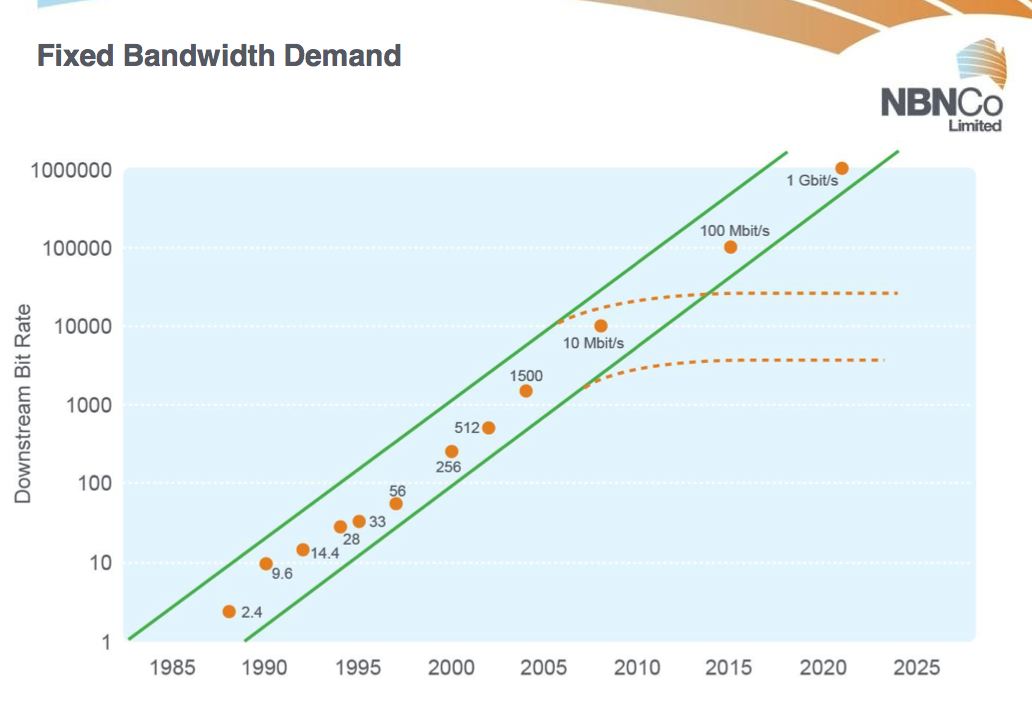
Stilgherrian then submitted a range of reasons why the public benefit resulting from faster broadband outweighs the cost, including inserting a nice-looking graph prepared by none other than the National Broadband Network itself.

Stilgherrian also made a couple of valid, yet obvious points — wireless in itself is not a sole solution and certainly isn’t able to carry the amount of data of fibre. But that is to ignore other existing infrastructure and the fact that private companies (like iiNet, TPG, Foxtel and Telstra) are also able to roll out high speed broadband to compliment existing infrastructure. (Most CBD businesses already have high speed broadband).

There is also the option of having a broadband network which covers predominantly higher density areas at a marginally lower speed, substantially mitigating the cost but retaining many of the benefits Stilgherrian referred to.

The NBN was drastically altered at the time of the global financial crisis by a Government which was looking to stimulate the economy without proper economic analysis. The plan went from a $6 billion to a $4 billion to a $43 billion scheme at what appeared to be the whim of a now deposed Prime Minister. The original article questioned whether that remains the correct decision for Australian taxpayers. It may be, but to the decision has become so politically clouded that taxpayers can’t be confident that they are receiving a return (be it financial or otherwise) from their investment.


I haven’t properly digested this response yet, but I do think it’s nice to be able to continue the conversation. I’ll probably write something on the weekend.

Adam Schwab’s NBN “analysis” arsehattery

[Update 30 July 2010: The conversation continues. Adam Schwab has written a response to this article.]

Crikey logo

Two weeks ago in Crikey, Adam Schwab dismissed the National Broadband Network (NBN) as “a poll-driven economic disaster”. His “analysis” is so full of misunderstandings and straight-up mistakes that it’s hard to know whether he’s pushing a pre-election agenda, deliberately trolling or is just an ignorant arsehat.

In a recent piece for ABC Unleased I proposed three tests for the credibility of NBN analysis. Schwab fails all three. He thinks the NBN is an internet service provider (ISP). He wants it to deliver short-term commercial return on investment. And he doesn’t differentiate between needs now and a decade or two or three in the future.

The NBN replaces an ageing copper network with a new one based on optical fibre. Internet access is an obvious application, but it’s also about services from pay TV to security monitoring to health — and, indeed, to good old voice telephone if that’s all you want. An analysis that only considers internet access is missing a lot of potential revenue.

The whole point of public infrastructure is that it generates benefits for all, not just short-term commercial return for investors. Think interstate highways, schools, armies, hospitals, police. It’s what governments do. As Crikey reported last year, OECD modelling shows that savings of 0.5% to 1.5% in just four sectors —  electricity, health, transport and education – would indirectly pay for a fibre-to-the-premises network in ten years.

Arguing that current internet speeds are fine for what people currently do is a tautology. If speeds weren’t OK for current activities, they wouldn’t be activities at all.

This graph shows the exponential growth in our typical demand for fixed-line internet speed since we first got dial-up modems in the 1980s. By 2015 the NBN’s initial 100Mb per second speed won’t be that stupid phrase “super-fast” any more, but merely average. Just twelve years from now we’ll want ten times that much, 1Gb per second.

Schwab is proposing that suddenly, today, this growth in demand will take the orange path and stop. Forever. Why would that happen?

All this is enough to dismiss Schwab’s nay-saying as irrelevant. But wait. There’s more…

Continue reading “Adam Schwab’s NBN “analysis” arsehattery”