

Weekly Wrap 4

A weekly summary of what I’ve been doing elsewhere on the internets, posted a day early because I’m about to go off-grid for the weekend.

Articles

  • Inside Microsoft’s Security War Room, my debut for iTnews, along with a photo gallery. During my Microsoft-funded trip to Redmond, Washington, I visited the War Room where they work on critical security patches for all Microsoft products.
  • The political naivety of the digital elites for ABC Unleashed, in which I bemoan the way some people seem to see all politics through the narrow, narrow prism of the Australian government’s mandatory internet censorship policies. The comments are fascinating, especially those who seem to think I’m in favour of Senator Conroy and the government’s internet censorship plans.

Podcasts

[Photo: A sign spotted outside the ZanziBar, Newtown, last night, offering free Snuggies for hire. “Snuggie”? If you haven’t heard of this device before, check their website or watch the infomercial.]

Labor’s Plan for Cyber Safety, November 2007

The Labor Party has removed their pre-election policy on internet censorship from the ALP website, so here it is. Labor’s Plan for Cyber Safety (November 2007) [61kB PDF].

This policy, with Senator Stephen Conroy listed as the author, was a last-minute addition to the ALP’s policies in the final weeks before the 2007 federal election.

(You can also still find it via this Internet Archive snapshot taken the day before the election, but it’s always good to have a spare, right?)

I’m posting this because I’ll be referring to it in various articles over the next few weeks. Stand by.

Alastair MacGibbon on the Cyber Crime report

While I’ve already given my opinion of the federal parliament’s Cyber Crime report, why not listen to an actual expert opinion?

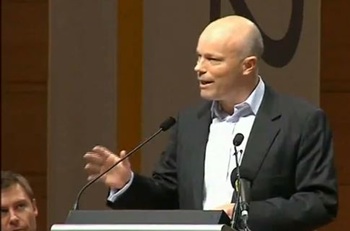
Last night I spoke with Alastair MacGibbon (pictured) for today’s Patch Monday podcast. We recorded way too much material for the podcast, so here’s the full conversation.

MacGibbon was the founding Director of the Australian High Tech Crime Centre, was with the Australian Federal Police for 15 years, he graduated from the FBI’s National Academy in the US, was Head of Trust, Safety & Customer Support for eBay Asia Pacific for four years — in short, he knows his way around this stuff.

We talk through some of the recommendations of the report Hackers, Fraudsters and Botnets: Tackling the Problem of Cyber Crime released last Monday — including MacGibbon’s own somewhat controversial view that we should actively block people’s computers from accessing the internet if their security software isn’t up to scratch.

If you’d like to grab all of these Conversations in the future, subscribe to the RSS feed.

[Photo: Alastair MacGibbon speaking at the recent Intelligence Squared debate, Governments should not censor the internet, in a frame grab taken from the ABC TV broadcast.]

Bernard Keane on Conroy vs Lundy

[Update 1.30pm: Prime Minister Gillard has just announced her cabinet changes and Senator Conroy remains where he is. If you listen to the interview you’ll realise why.]

Now that Julia Gillard is Prime Minister, could or should Senator Kate Lundy replace Senator Stephen Conroy as Minister for Broadband, Communication and the Digital Economy?

Delimiter‘s Renai LeMai has previously suggested that Lundy would make a better communications minister, and last Thursday he asked the question again. Gizmodo Australia is even actively campaigning for the change.

ZDnet.com.au‘s David Braue also reckons Gillard can save the comms ministry by involving Lundy — although he doesn’t go as far as calling for Conroy to be sacked, instead suggesting he become the Minister for the National Broadband Network.

In this week’s Patch Monday podcast, to be posted this morning, I chat with Crikey‘s Canberra correspondent Bernard Keane (pictured) about the possibility.

The #nocleanfeed anti-censorship campaigners might think a change in PM is reason enough to lobby for a change in communications minister, but Keane is not so sure. We cover that in the Patch Monday conversation.

Once we got talking, we also chatted about the historical context. A previous communications minister, Senator Richard Alston, was twice voted “global village idiot”, for instance. And we went into the political issues in more depth than appropriate for Patch Monday‘s technology industry focus. So, here’s the full conversation.

I always record much more material than ends up in articles or podcasts, so I’m toying with the idea of posting all of my raw interviews here. Whaddyareckon?

Just in case I take that path, I’m creating a category of posts called Conversations, and you can subscribe to the RSS feed.

Weekly Wrap 3

A weekly summary of what I’ve been doing elsewhere on the internets.

Articles

  • NBN not over the line yet for Crikey, which outlines last weekend’s agreement between Telstra and the National Broadband Network Company (NBN Co). If this non-binding Heads of Agreement makes it all the way to a final deal, NBN Co pays an estimated $9 billion over coming years in exchange for access to Telstra’s “passive network assets” such as cable pits and ducts and exchanges, and to compensate Telstra for losing customers from its copper network to NBN fibre.
  • No wonder the cyber criminals are winning for ABC Unleashed, my commentary on the House of Representatives report on cyber crime, Hackers, Fraudsters and Botnets: Tackling the Problem of Cyber Crime.

Podcasts

  • Patch Monday episode 45 is about the future, near and far. The near future of business priorities for the coming financial year — cloud computing, collaboration and mobility — and the further future of the Telstra / NBN Co agreement.

Media Appearances

[Photo: “Samsung Space”, taken at the launch of Samsung’s Galaxy S Android-based smartphone at the Royal Hall of Industries, The Entertainment Quarter, Sydney on 23 June 2010. Click to embiggen. As we entered this UV-lit space, Mike Oldfield’s “Tubular Bells” played. Of course.]