
The really real revolutionary revolution of the Internet

James Burke

The man in the photo, science historian and broadcaster James Burke, is a revolutionary. So pay attention. This is important.

I don’t mean “revolutionary” in the lame-arsed sense used by every pissant little company with a new kind of double-whacko widget that’ll “revolutionise” the double-whacko widget industry. Because it’s now available in three different colours.

No, I mean the real kind of revolutionary: someone who advocates a revolution — yes, as in a complete overthrow of the established political system.

I’ve just finished watching Burke’s ten-part TV series from 1985, The Day The Universe Changed. It’s available on DVD, but you can also do what I did and watch the whole thing on YouTube. At least until some copyright-addled arsehole decides that you can’t.

As Wikipedia says:

The series’ primary focus is on the effect of advances in science and technology on western philosophy. The title comes from the philosophical idea that the universe essentially only exists as you perceive it through what you know; therefore, if you change your perception of the universe with new knowledge, you have essentially changed the universe itself.

To illustrate this concept, James Burke tells the various stories of important scientific discoveries and technological advances and how they fundamentally altered how western civilization perceives the world.

Apart from anything else, TDTUC is an excellent history of western scientific thought. But, after taking you on this journey, Burke’s final episode is a revolutionary call to action.

Continue reading “The really real revolutionary revolution of the Internet”

Whaddyareckon of the Ruddblog?

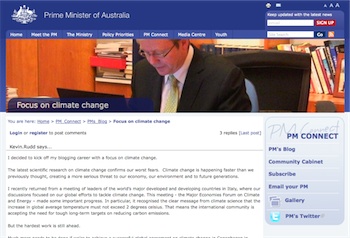
Prime Minister Kevin Rudd's new blog

Kevin Rudd launched his prime ministerial blog yesterday. I’m not sure it’s going to work — as I already told the Fairfax newspapers.

In addition to the common prohibitions on defamatory and abusive content, the rules for Mr Rudd’s blog say that comments will be accepted for only “five business days” from the time the post is published, be moderated by his staff strictly during business hours, cannot include links to other websites, and are limited to 300 words.

“Not allowing links to other websites is just dumb,” one blogger, Stilgherrian, told the Herald. “Links are the currency of the web. They allow you to reference work that’s already out there. If you can’t do that, and you’re limited to 300 words, then the discussion won’t ever get past repeating slogans.”

It was a sentiment shared by “An Onymous Lefty” blogger, Jeremy Sear, who posted a response to the Prime Minister’s blog titled “Kevin Rudd is hip to the kids… of 2004”.

“The strict moderation will remove the livelier aspects of discussion,” Mr Sear said.

I also reckon the first post, about climate change, sounds like a prepared political speech, with a question tacked on the end to make it look bloggy.

How do you think we can make Australians more aware that we need to act on climate change now?

I thought we’d mostly moved well past “creating awareness” and the biggest criticism of the government’s climate change policy was the lack of actual action so far.

But what do you think?

[Note: The original Fairfax piece doesn’t have links: I’ve added them in myself. Fairfax is still too rude or daft or whatever to link out to the things they mention. It’s nice that they included my quote, given that.]

Psywar in Iran

Crikey logo

“This is it. The big one. This is the first revolution that has been catapulted onto a global stage and transformed by social media,” says Clay Shirky, professor at New York University and author of the book Here Comes Everybody: The Power of Organizing Without Organizations. And what’s had the greatest impact? “It’s Twitter,” says Shirky.

So starts my piece in Crikey yesterday, We’re all wearing green for Iran now, apparently.

The article covers two main points.

One, this isn’t really the first time demonstrations have been organised or teargas reported via Twitter. Try Bangkok in October 2008. Try Chişinău in April 2009. And as Business Week pointed out, A Twitter revolution? Hardly.

Two, people are changing their avatars green to “support democracy in Iran” based on very little information. And as commenter Rena Zurawel claimed:

Whether it is a Rose Revolution in Georgia, or Orange Revolution in the Ukraine or a Green revolution in Iran — the source and inspiration is exactly the same: $70 million decided by the Congress to spend on so called “democratic changes in Iran”.

That last point intrigued me, so I poked around a bit.

I found this 2008 report from STRATFOR Global Intelligence: Geopolitical Diary: Iran, Psywar and the Hersh Article which is reproduced in full over the jump.

Continue reading “Psywar in Iran”