Tanzania awaits the economic leap

The Economist logo

I’ve stumbled across this article from 7 May in The Economist which expresses some worries about Tanzania’s economy.

The country already gets 40% of its government budget in aid, but now it wants even more foreign cash to help it through the economic downturn. How much is enough? Tanzania’s president, Jakaya Kikwete, smiles grimly. “We’re trying to bring down our dependency, but we’re grateful for what we receive.”

Kikwete charms potential investors with his sales patter, but is that enough?

Tanzania, many complain, is a “slow” or even “terrible” place to do business — and “ungrateful” for foreign aid or investment. Even its boosters admit it is wrapped in red tape and lacks skilled workers. Almost everyone says Mr Kikwete is spending too much time burnishing Tanzania’s image abroad and not enough fixing problems at home. Last year he chaired the African Union.

In any event, he hopes that aid will keep Tanzania afloat long enough for its economy eventually to make a great leap forward. Shiny new buildings even in provincial towns, along with new roads and water projects, signal optimism. Politics are stable. A rowdy separatist movement in the island of Zanzibar is quiet for now…

With many resources including gold and natural gas, 85% of exports are still agriculture. And 40% of the government’s budget being aid? There’s gotta be some interesting questions to ask there!

A Series of Tubes episode 86

The latest A Series of Tubes podcast is online for your listening pleasure. Richard Chirgwin talks with Chris King and David Thrum of Palo Alto Networks about the firewall market; sponsor Nortel about last week’s announcements at Interop; and me about National E-Security Week and the decisions of French courts on anti-piracy legislation.

Project TOTO: The Cultural Briefing

Photograph of Tanzanian villagers, courtesy of ActionAid Australia

One of the most challenging aspects of Project TOTO is that I’ll have to build a rapport with my Tanzanian hosts and colleagues extremely quickly. So yesterday ActionAid Australia gave me a cultural briefing as well as the project briefing.

Here’s what I learned:

  1. Tanzanians are generally very polite, and will avoid saying anything which they fear might offend. I’ll therefore have to encourage them to open up a bit — especially when blogging for a Western audience.
  2. Tanzanian society is still quite hierarchical. People respect age and authority. No-one will say they have a bad government or local official, except in very private conversations.
  3. While the population is split religiously roughly one-third each Muslim, Christian and traditional tribal religions, there’s no major tensions between them.
  4. Women are “quiet and humble”, especially in rural areas, and when there’s men around they’re unlikely to speak unless asked, or if it’s a one-to-one conversation.
  5. There’s less physical contact than we’re used to in Australia. No kissing in public! However men and women do shake hands as a greeting.
  6. Photo of a bottle of Tusker Lager

  7. Rural people eat a lot of the local green bananas, and plenty of green vegetables, either fried or boiled. My doctor will be happy.
  8. I should avoid eating meat outside restaurants and the like. However the rural folk might offer a visitor meat and it would be impolite to refuse. What should I do? I must make that decision at the time. Tapeworms FTW!
  9. My travel doctor was right when she told me to drink only bottled water. The locals will offer soft drinks like Coca-Cola and Fanta, which I will accept and drink.
  10. The local beer is the Kenyan Tusker Lager and it’s quite acceptable, if a little heavy for the climate. I’ll be asked whether I want it “hot” or “cold”.
  11. South African wine is available, but relatively expensive. I’ve been advised to avoid the local wine.
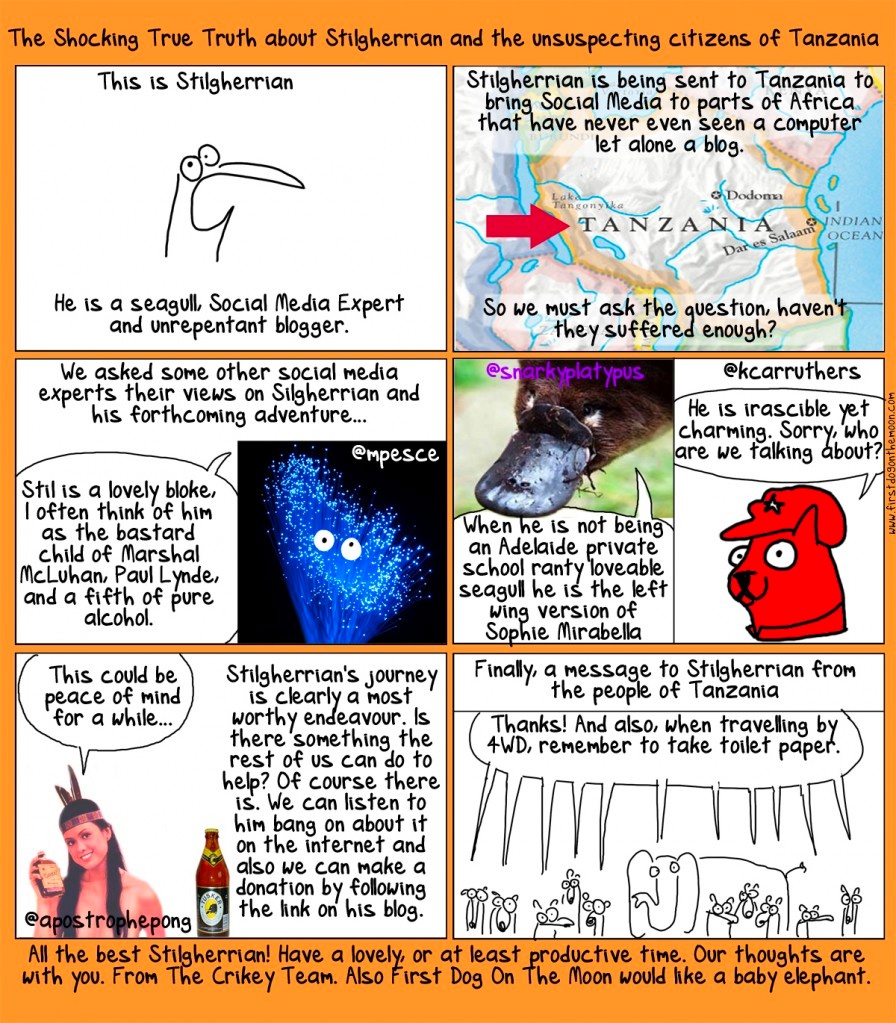
  12. When travelling by 4WD, remember to take toilet paper.
  13. In the city, Westerners are likely to be perceived according to the usual stereotypes: Americans are loud and religious, Australians are relaxed and joke a lot, Germans are strict and so on. In rural areas we’re all the same: “You’re all white and you’ve got money.”

And apart from that, it’s just the usual stuff when arriving in a new culture: Listen more than you speak, and show respect.

Care to add any other tips?

Phonecasting in WordPress

While chatting with Jeff Waugh, we worked out a great way of blogging from remote Tanzania: podcasting by telephone! Here’s how.

Even if we’re not in one of the 70% of Tanzanian villages with mobile phone coverage, we’ll still have a satellite phone. We call into a voicemail service like mBox and just start talking. It then emails us the MP3 file of the recording.

WordPress already lets you blog by email, checking a standard POP3 mailbox and turning whatever it finds there into a blog post. Email subject becomes post title, email body becomes content. But it doesn’t support attachments. Yet.

Jeff reckons it’d be easy enough to see if the email contains an MP3 file and extract it. It could then be handed to, say, the PodPress plug-in, which in turn makes sure the MP3 file is properly connected to the blog post to work as a podcast. PodPress then automatically updates your podcast listing in iTunes and other directories.

As an added bonus, WordPress can automatically send a message to Twitter when a new episode goes online.

How do we avoid spam? Well, mBox uses Caller ID to make sure the email has a subject like:

mBox Voice message from NNNNNNNNNNN to MMMMMMMMMM

We can check the email headers to ensure they’re legitimately from mBox or whoever we use. And we can use the sender’s phone number to correctly assign the author, and the receiving phone number to, well, post into different categories or whatever.

So, to run through it again… I’m standing on the ferry to Zanzibar. I make a satellite phone call to describe the magnificent view. Five minutes later, that’s a podcast. And everybody gets notified via Twitter.

Of course there’s bound to be some potential for screwing this up, but whaddyareckon?