
My invitation to the Australia 2020 Summit has yet to arrive. I guess it’s been a busy week, so I’ll be patient. However the 100 delegates to the 2020 Youth Summit the weekend before have been announced.
Appearing on 2 Web Crew
Duncan Riley asked me to appear on the 2 Web Crew podcast this week, which will be recorded at 1300 this afternoon Sydney time. You’ll be able to listen to it live as it’s being recorded (and chat back to us) and then the edited version will appear in a few days. Meanwhile I’m trying to find my best options for setting up Skype — I’ve never really bothered with it until now.
A recursive photo from Bangkok
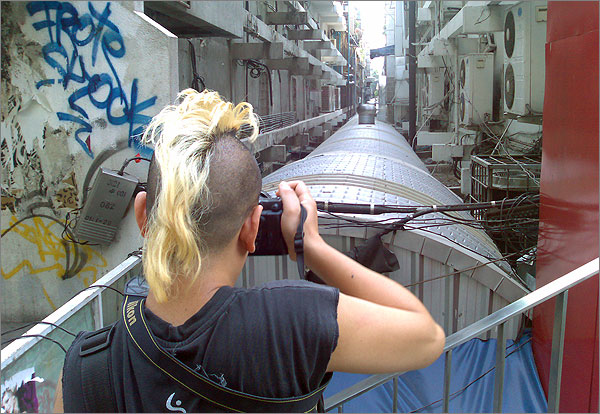
This is my photo of ’Pong taking this photo in Bangkok. Recursion is always an interesting phenomenon.
Homer Simpson as a non-cartoon
Various people pointed me to this, and they said they found it creepy. I think it’s cool. Homer Simpson rendered as a “real” human!
Common Ground run by a dangerous cult?
I always used to enjoy the wholesome food from the Common Ground Café at Sydney’s Royal Easter Show, the Newtown Festival and other events. There’s now a bad taste in my mouth now that I’ve discovered they’re owned by an isolationist cult with abusive child-discipline practices.
A former member says workers aren’t paid and there’s no workers compensation or insurance.
[Update 25 April 2012: I’m closing comments on this post now, for the reasons given in the final comment. If you want to tell me anything more about Twelve Tribes or Common Ground Cafe, please email me.]
Lesson from Iraq: don’t ignore international law

Of all the writing about the 5th anniversary of the US-led invasion of Iraq, one of the more interesting pieces is by Mary Ellen O’Connell (pictured) of Notre Dame Law School. In Learning from the Iraq War: The Wisdom of International Law, she argues that the most tangible lesson is that the US ignores international law at its peril.
Going into Iraq, we ignored the UN Charter, which prohibits the use of force except in self-defense or with Security Council authorization. Once in Iraq, we ignored the Hague Regulations, requiring us to put a stop to looting and to make only necessary changes to local law and government. We ignored the Geneva Conventions, which prohibit secret detention and abuse of prisoners of the kind we saw at Abu Ghraib.
The talk on Iraq is all about what went wrong, whether the surge is working, and when we can get out. We hear virtually nothing about international law and look set to repeat our mistakes. Violating the law has cost our nation and Iraq dearly. It has denied us the guidance of rules based on long experience and moral consensus. We have lost standing in the world, a literal fortune, and precious lives. Rather than internalizing the lesson of law violation in Iraq, we continue to defy the law in serious and self-destructive ways.
At some point, sooner or later, America needs to understand that international law does indeed apply to everyone — including America. Otherwise any US action against any other nation breaking the law is nothing but hypocrisy. (Hat-tip to Blog Them Out of the Stone Age.)