
A weekly summary of what I’ve been doing elsewhere on the internets. It was another massive week of writing this week, including a trip to Melbourne.
Continue reading “Weekly Wrap 60: Media whoredom continues”
Word-whore. I write 'em. I talk 'em. Information, politics, media, and the cybers. I drink. I use bad words. All publication is a political act. All communication is propaganda. All art is pornography. All business is personal. All hail Eris! Vive les poissons rouges sauvages!
A weekly summary of what I’ve been doing elsewhere on the internets. It was another massive week of writing this week, including a trip to Melbourne.
Continue reading “Weekly Wrap 60: Media whoredom continues”
I’m heading to Melbourne this week to cover IBM’s Pulse 11 for ZDNet Australia. The event runs 27 to 28 July at the Crown Promenade, although I’ll be flying down late Tuesday afternoon and returning on Friday.
“Pulse is your premier event for accessing the solutions and expertise that can help your organisation transform the way it designs, delivers and manages business services,” says the promo material in a sentence remarkably free of concrete nouns. About eight pars in you’ll discover that it’s about things like managing cloud services and making sure your IT systems are secure and compliant with regulations.
I simply do not understand this corporate aversion to being specific.
It’s my first trip to Melbourne in about five years, so I’m looking forward to it. I’ll have a little free time on Thursday afternoon and evening, so do feel free to make suggestions.
I’m attending Pulse 11 as a guest of IBM.
A weekly summary of what I’ve been doing elsewhere on the internets. While Sydney dealt with its wettest July since 1950, I was at the Bunjaree Cottages in Wentworth Falls, writing and writing and writing and writing. And talking on the radio.
“Make hay while the sun shines,” goes the old saying. But for a writer, it’s about making paragraphs while the rain pours. Being stuck indoors with a magnificent view really helps.
None. But there’ll be plenty next week. I’ll tell you more about that later this morning.
Most of my day-to-day observations are on my high-volume Twitter stream, and random photos and other observations turn up on my Posterous stream. The photos also appear on Flickr, where I eventually add geolocation data and tags.
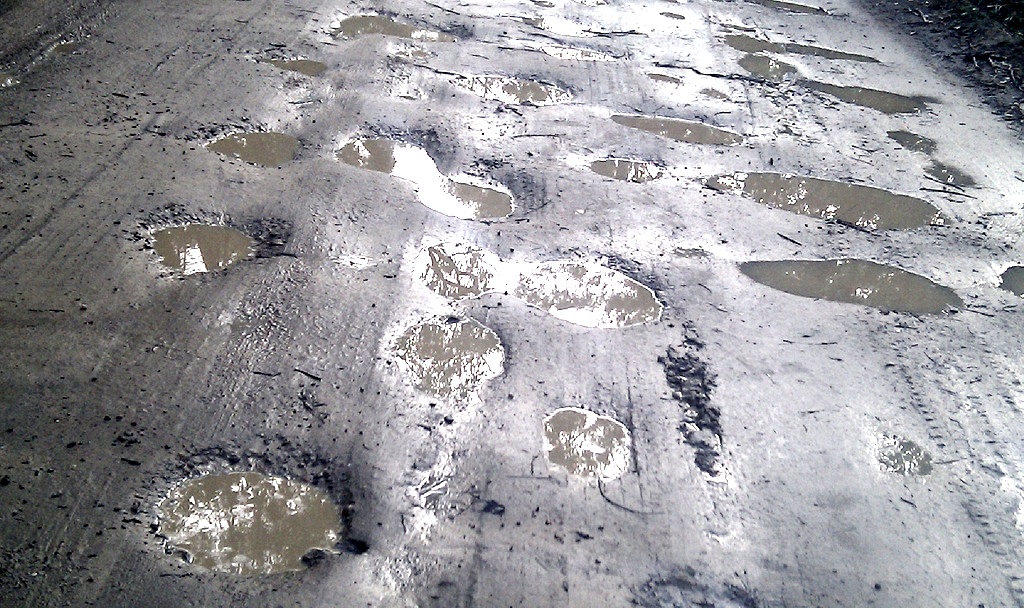
[Photo: Potholes on Frenchmans Road, Wentworth Falls, photographed on 20 July 2011. This is a slightly modified version, here’s the original.]
Australia’s Standing Committee of Attorneys-General has been meeting in Adelaide these past two days. They’ve finally agreed to allow an R18+ classification for computer games. But I’m surprised to see they’ve said almost nothing about online crime.
In their Communiqué and Summary of Decisions [25kb PDF] they say:
R 18+ Classification for Computer Games
Ministers made a decision in principle, to introduce an R 18+ category for computer games. NSW abstained.
Ministers:
(a) agreed to take the Guidelines for the Classification of Computer games, as amended at the meeting, to their respective Cabinets
(b) agreed in principle, with the exception of the NSW Attorney General who abstained, that the Commonwealth introduce the proposed amendments to the National Classification Code to support the introduction of an R 18+ category
(c) agreed, with the exception of the NSW Attorney General who abstained, to commence drafting amendments to their enforcement legislation to reflect the introduction of an R 18 + category for computer games
(d) agreed that it would be desirable for classifications of existing games to be reviewed in light of the new classification Guidelines.
This leads to the interesting possibility that the federal government could legislate to create the R18+ category, but NSW could choose not to implement matching laws. The result would be that the games would be legal to sell everywhere in Australia except NSW.
A similar situation already exists for X-rated movies. The federal government passed the laws, but the states changed their minds later. So X-rated material is available in the ACT.
But as I say, there was precious little on cybercrime.
Continue reading “R18+ computer games, finally, but little on cybercrime”
Early this morning, Australia’s Minister for Privacy Brendan O’Connor announced that the government will start a public consultation into whether Australia should have a statutory right to privacy.
The media release was emailed at 6.26am AEST, a clear sign that it was a calm, reasoned decision made as part of a long-term government strategy. Sorry? No? Read the release?
“The News of the World scandal and other recent mass breaches of privacy, both at home and abroad, have put the spotlight on whether there should be such a right.”
The Australian Law Reform Commission’s recommendation for such a law has been sitting on the table for three years now. But hey, something in the news cycle triggers a potential “announceable” and… disco!
Right then.
I’ve already written straight news stories today for CSO Online, Australia to consider right-to-privacy law and Watchdogs welcome Australia’s right-to-privacy move. I’ll be writing about the timing thing tomorrow for ABC’s The Drum.
Right now, though, I have one question. It’s a question I’ve asked before, but I was reminded by something Mark Newton said earlier this evening.
How come we don’t see such sudden action, ever, when is comes to giving Australians a statutory right to freedom of speech?

LulzSec’s hack of The Sun and other UK websites belonging to Rupert Murdoch’s News International yesterday was one of the highest-profile infosec breaches in history. But will it mean anything beyond today’s news cycle? I suspect not.
(If you’re not up to speed on this, please read my initial summary for CSO Online or a shorter but fresher story for Crikey.)
As I thought about this overnight, and after chatting with Paul Ducklin from information security vendor Sophos, I came to the conclusion that despite all the media coverage yesterday nothing will change.
I wrote that up as an op-ed for CSO Online, Four lessons from LulzSec vs Murdoch.
We’ve seen hack after hack after hack, but civilisation has stubbornly refused to crumble. We’ve cried wolf a few hundred times too often. We’re experiencing what Paul Ducklin from Sophos calls “hack fatigue”.
We only hear about successful hacks, from LulzSec or anyone else, Ducklin told CSO Online. “They can crow about every time they have a success,” he said, “but you never hear about the sites they never broke into.”
And the idea that LulzSEc’s high-profile hacks will suddenly focus attention on organisation’s information security vulnerabilities? Bah. We’ve been flooded with media reports of high-profile hacks for the last few years, from NATO to Paris Hilton, Google to prime minister Gillard.
After all those stories we held urgent meetings, changed our ways, and put infosec at the top of the business agenda, right?
Yeah right.
So now what? I’ll put my money on LulzSec being forgotten until their next high-profile attack, or their arrest.
[Picture: Early this morning Australian time, LulzSec tweeted: “The Sun taken care of… now what about the moon…”, linking to that image (source unknown). Is it a hint? Or a meaningless distraction?]