Politicians and Social Media: a catalogue of cluelessness

I’ll be in Perth on 27–28 October for PodCamp, the New Media Community UnConference, where I’m presenting a session on Social Media and the Federal Election.

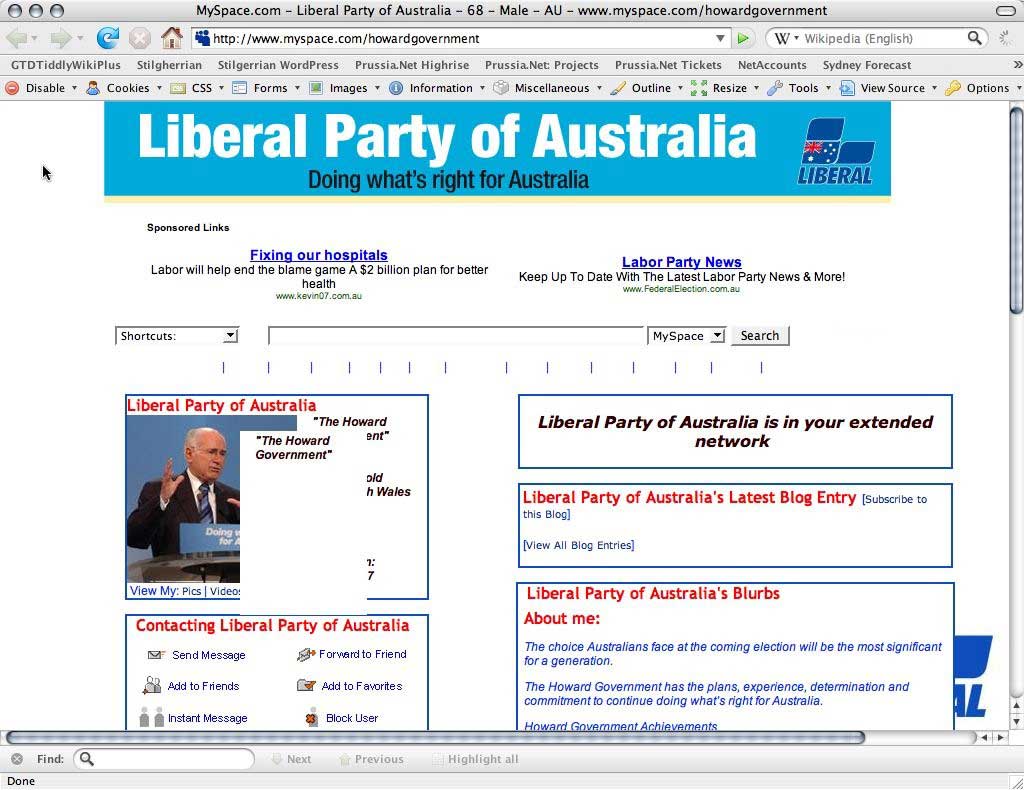
Screenshot of John Howard MySpace, 18 October 2007

While my first visit to Perth will be fun enough, I’m also enjoying researching my presentation. Australian politicians really don’t have a clue about this stuff.

Starting at the top of the food chain, John Howard’s MySpace profile is a disaster. The screenshot (right) records how it looked this morning — with a a broken rectangle obscuring part of the photo and adverts for the Labor party. Click for the full-size version.

MySpace is the world’s largest and best-known social media operation. Yet this profile doesn’t have anything to offer apart from a recycled media release. No blog entries. Not even any personal information beyond Howard’s age — reminding MySpace’s relatively youthful audience that he’s “old”.

How could John Howard’s personal profile not even mention cricket? If a profile contains even less information than we already know, why would we bother reading it? Why would we bother coming back?

At the other end of the spectrum — in more ways than one! — is Australian Democrats Senator Andrew Bartlett.

Continue reading “Politicians and Social Media: a catalogue of cluelessness”

Day off

Thanks for all the recent comments. I haven’t responded yet because I took most of today off work, recovering from “election overload” and hiding from the unnaturally hot weather. I will look at them all soon.

“Officially” is the new “literally”

“Labor, the party of the working class, has officially become the party of choice for intellectuals,” claimed The Australian last Thursday. Sorry, which “official” said this?

No, it wasn’t a Labor party official announcing a change in their funding source. Nor some mythical official spokesperson for “intellectuals” — could there ever be such a central organisation? No, the “official” is just the journalist who wrote the story, or his sub-editor.

In one way this is like that common mis-use of the word “literally”. As in: “Kevin Rudd was literally torn apart in Parliament this afternoon.” But there’s also some lovely propaganda at work — either because the journo thought it’d make it more dramatic, or because (heaven forbid!) The Australian is continuing its pro-Coalition stance.

Continue reading ““Officially” is the new “literally””