Domain: misleading advertising?

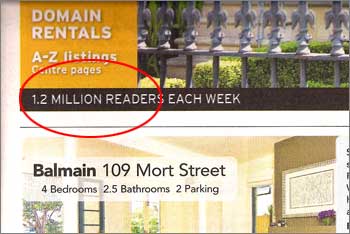
Scan of Domain cover, claiming 1.2 million readers

The Sydney Morning Herald‘s over-blown real estate section (right) claims 1.2 million readers each week. That’s misleading, surely?

According to Fairfax’s own circulation figures, the Saturday SMH gets 1,176,000 readers from a circulation of 364,000.

OK, rounded to two significant figures, I’m cool with that. But I reckon putting that 1.2 million figure on the cover of Domain is misleading — in the Trade Practices Act sense of the word — ‘cos it implies that the real estate ads get that many readers. I really, really doubt that.

The first thing many (if not most) readers do is fillet the paper, throwing out the classifieds-filled supplements. And if you look in the bins at any suburban railway station on a weekday, you’ll see them chock full’o unopened, unread Domain, Drive, MyCareer and all the other crap they don’t need.

So, Fairfax, misleading advertising? What’s the real readership of the real estate ads?

Published twice in one day

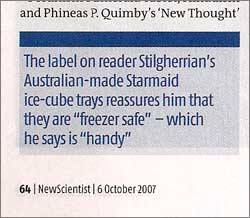
Scan of New Scientist piece

I’m happy. I’ve been published twice today, thrice this week.

As I mentioned before, Crikey was happy for me to cover today’s panel discussion with IT minister Senator Helen Coonan and her Labor opponent Senator Stephen Conroy. They were joined this morning by Democrats leader, Senator Lyn Allison.

My Crikey story points out that Coonan scored at least three own goals. I’m chuffed that it was selected as a “top story” for subscribers.

My other Crikey story was about Australia’s contribution to the Space Age, published on Wednesday and including my comments about the spaceport we never seem to get.

I’ll do a public version of both those stories tomorrow.

And the third piece was a little snippet for New Scientist, which I sent them on 24 June. There’s a picture (right), but here are the words for search engines to find.

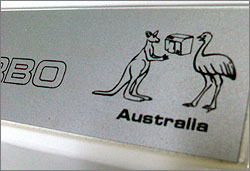
The label on reader Stilgherrian’s Australian-made Starmaid ice-cube trays reassures him that they are “freezer safe” — which he says is “handy”.

But right now it’s Red Wine Time…

2007 Ig Nobel Prizes

The 2007 Ig Nobel Prizes have just been announced. My favourites: A toss-up between “Linguistics: Juan Manuel Toro, Josep B. Trobalon and Nuria Sebastian-Galles, for determining that rats sometimes can’t distinguish between Japanese, played backward, and Dutch, played backward” and “Aviation: Patricia V. Agostino, Santiago A. Plano and Diego A. Golombek, for discovering that hamsters recover from jetlag more quickly when given Viagra.”

How’s that whistle, little doggie?

Given the fascinating discussion happening in my piece about the Citizenship Test — and there’s plenty for me to respond to, I know, I’ll get to it — it’s appropriate to mention the Australia Institute’s new report Under the Radar: Dog-Whistle Politics in Australia.

You can download the table of contents and summary (21k PDF) free. The full report is $21.

Continue reading “How’s that whistle, little doggie?”

The Space Age is Dead

Photograph of Sputnik 1What has happened to our sense of adventure? 50 years ago today that Russian metal thing (left) went “Beep, beep, beep” and we were thrust into the Space Age. But now the Space Age is dead.

On 4 October 1957, it was a beach ball with a beeper inside. A month later, 3 November, it was a differently-shaped Russian metal thing with a dog inside.

“Jay-zus,” thought America, collectively. “Those goddam Commies have gotten into space! And they’ve got The Bomb.” They called it “the Sputnik Crisis” and the US created ARPA (which eventually developed the Internet) and New Math (which created a huge market in hula hoops for primary schools).

The first human in space was in 1961. And only eight years later people were walking on the moon.

But now, in 2007, it’s been 35 years since anyone’s been to the moon. Indeed, it’s been 35 years since anyone’s been more than 480km from Earth.

Continue reading “The Space Age is Dead”