NSW offers $100k prizes for application development

Crikey logo

In a surprise visit to today’s NSW Sphere event, Premier Nathan Rees announced the apps4nsw program — offering prizes of $100,000 for innovative applications with make use of government data for public good.

I’ve got a piece on the Crikey website, NSW gets its geek on:

“This is all about making government data easy for everyone to use to solve everyday problems,” said Rees…

Entries may be websites or web based services, mobile applications or stand-alone PC based or kiosk-based applications.

“The prizes will be judged by an expert panel – which doesn’t include me – and there will also be a People’s Choice Award and the opportunity for the best entry to go to a prototyping phase”, said Rees.

“Anything we develop as a result of the competition will be licensed as open source and freely available to government and the public. These will be public apps for the common good.”

This is a fascinating initiative. Have a squizz at the Crikey piece. I’ll write more later.

NSW Sphere: Government 2.0 for NSW

I should’ve written more about this earlier, but today I’m speaking at NSW Sphere, a discussion event on Government 2.0 organised by Penny Sharpe MLC.

It’s being run along the style of Senator Kate Lundy’s Public Sphere events, and interest is so high that all places are booked out.

As I write this, some early-bird participants are watching the movie Us Now, and I’m figuring out exactly what I’ll say in my 10-minute presentation, Risk, Fear, Paranoia: Perspective, People!

You can participate live wherever you are, and I’ll post my presentation and thoughts later. The Twitter hashtag is #nswsphere.

“Influence is the future of media”, eh?

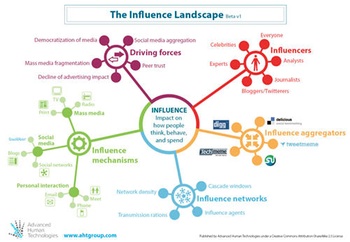
The Influence Landscape: click for a more details

This year, the Future of Media Summit has been replaced by the Future of Influence Summit. It’s next Tuesday 1 September, Sydney time. I’ll be going, and I can offer you a discount.

Summit-master Ross Dawson has changed the name because he reckons that influence is the future of media.

Ross writes:

We have already begun to discover this through the now-dominant concept of “social media”. In the Future of Media Strategic Framework that was launched for our Future of Media Summit 2006 we described the (symbiotic) relationship between Mainstream Media and Social Media.

Social media is all about human relationships, about how we shape our view of the world based on our peer communication. The extraordinary breadth of information and opinion that we are exposed to today, combined with the ability to converse, means our own opinions are often driven more by peers than traditional sources.

In fact this shift to the social means that media is becoming far more about peer influence than information and reporting.

This year companies globally will spend US$450 billion on advertising. The composition of advertising spend has changed dramatically over the last decade. That pace of change will rapidly accelerate in coming years. Total marketing spend is hardly set to reduce in an increasingly crowded marketplace, but it will be allocated to those activities that truly make a difference. Influence — based on conversations and aggregated opinion — will be at the centre of how companies seek to drive sales and customer engagement.

Today, people find content such as movies, music, news, books and so on primarily through aggregated channels. Instead of buying the New York Times and reading it cover to cover, people are pointed to the most relevant articles in the New York Times and elsewhere, based on what people find interesting. It is hardly new that people buy music or books because of recommendations — but now adding to their friends’ opinions and magazine reviews are a universe of influencers who provide guidance on what to buy. Influence is driving the world of content and publishing as never before, and this is just the beginning.

Last year’s Future of Media Summit was full of old media journalists and managers in denial.

It triggered my controversial essay Note to “old media” journalists: adapt, or stfu! (parts of which were even translated into French in Le Monde), a wonderful response from the MEAA’s Jonathan Este, and furthers writing from me including the essays “Trouble at t’paper” and Sunday Thoughts about Journalism.

A year later, a lot has changed — although my liveblog from Media 09 still reads as pessimistic. I’ll be interested to see what emerges, and to prepare myself I’ll be reading more of Ross’ blog over the next couple of days. Expect further posts.

Meanwhile if you want to register for the Future of Influence Summit, you’ll get 20% 25% off if you use the discount code TIESTIL.

Irrational hatred of the Internet

“Hating the Internet because of child pornography is a bit like hating the roads because of drug trafficking. If you had no roads there would be much less of it.” A great observation from a friend today.

Yes, “bad things” happen online, just as “bad things” happen anywhere. But when Clive Hamilton screeches about all the naughty things he’s found online, it looks to me like a deliberate attempt to press our emotional buttons and avoid rational debate. And he does it repeatedly.

The police don’t try to stop drug trafficking by putting a road block in everyone’s street and searching every vehicle. No, they use intelligence — in both senses of the word — to work out where best to deploy their finite resources for maximum results.

They also allocate their resources between conflicting demands so society as a whole is best protected. Their risk assessments tell them to worry more about the suspected rapists, serial killers or violent thugs in their community than some kid with a few grams of weed.

The people who actually understand child protection continually remind us that the greatest threats to children are the same as they always have been — abuse in their own home by family and close family friends, poverty, and bullying by their peers. Why oh why do we have to keep repeating that, Senator Conroy?

Does the Internet get second-rate news coverage?

Crikey logo

On Sunday, Pipe International‘s new PPC-1 undersea fibre-optic data link from Guam to Sydney was fired up. As I wrote in Crikey in May, when the cable was landed at Collaroy on Sydney’s northern beaches, PPC-1 will increase Australia’s international data capacity by almost 50%. That’s like adding the third runway at Sydney Airport. So where was the media coverage?

I wrote about that in Crikey today, and it’s free to read: They’re building data pipes under the ocean: why no media coverage?

OK, there were some reports, in The Australian and in IT-related sites like iTnews, iTWire and ZDNet Australia. But where was the ABC? Fairfax papers?

There was a “robust discussion” on Twitter this afternoon between The Australian‘s Andrew Colley, ZDNet Australia‘s Renai LeMay, myself and others, and I’ll try to summarise that later. There were certainly key areas of disagreement!

For now, though, have a read of my Crikey piece and tell me what you think.