

Crikey Conversations episode 1 with Mark Pesce and me

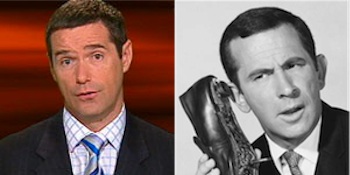
Screenshot from Crikey Conversations with Mark Pesce and Stilgherrian

The first episode of Crikey‘s new video series Crikey Conversations is now online, with me interviewing inventor and futurist Mark Pesce.

The series, sponsored by Microsoft, features various folks talking about the world of 2020 — which is only 11 years away. Gosh.

While some of Mark and my regular viewers and readers may well be sick of the material we discuss by now — hey, it’s what we do! — it’s aimed at a non-geek audience. So if you do pass it on to someone, I’d love some feedback.

As you can also see, Microsoft must’ve paid Crikey the extra fee for me to put pants on before the shoot.

I’m not sure whether there’s a credit in the video, but I’d personally like to thank Advanced BusinessLink (Australia) for the use of their boardroom and its spectacular view, and Adam Bateson for making the connection.

Quality Journalism: How to pay for it? Does it matter?

Photograph of Geraldine Dougue

ABC Radio National’s Saturday Extra is holding a forum this evening: Quality Journalism: How to pay for it? Does it matter? And I’ll be there.

Host Geraldine Dougue (pictured) will be joined by Eric Beecher (Publisher Crikey and Business Spectator), Wendy Bacon (Centre for Independent Journalism, UTS), Alan Kohler (Publisher, Business Spectator and Eureka Report), John Hewson (Liberal Party Federal Leader, 1990-1994) and Campbell Reid (Group Editorial Director, News Ltd).

I’m reporting on it for tomorrow’s Crikey email, and of course it’ll be broadcast on Saturday Extra on Saturday morning 11 April.

If you want a preview, follow my Twitter stream from 6pm this evening Sydney time.

Conroy’s continued lies and gaffes

Composite photograph of Stephen Conroy and Maxwell Smart

Of all the moments of frustration in last night’s SBS program Insight — and there were many — the most revealing was from host Jenny Brockie. After almost an hour debating Internet “filtering”, Brockie said, “I’m still unclear about whether it works or whether it doesn’t work, as a system.”

Thus begins my article in Crikey today — though it’s behind the paywall. If you’re not yet a subscriber (and why not?) you can get yourself a 21-day free trial. [Update: Things are only behind the Crikey paywall for 14 days, Click away!]

My key theme is that the reason no-one can agree on whether “the filter” will “work” is that no-one has defined exactly what it’s supposed to do — least of all the Minister, Senator Stephen Conroy.

“I have only ever identified [the material to be blocked as] Refused Classification in terms of child porn, bestiality, rape, incest sites, those sorts of things,” Conroy said last night. “For adults who want to be able to watch the other sort of material, we’re not proposing to do that. We’ve never proposed to do that.”

Except that, as the article details, the story has changed over time.

OK, this morning’s post about Senator Conroy being sacked was a little April Fools’ Day jokette. But with the continuing controversy over Internet censorship, the delayed National Broadband Network (though that finally gets an announcement of something or other this week), and yesterday’s gaffe about iiNet spying on its customers, could it soon be true?

Conroy dumped as Minister for Broadband

Photograph of Senator Stephen Conroy

Senator Stephen Conroy has been sacked as Minister for Broadband, Communications and the Digital Economy.

According to early reports, Prime Minister Kevin Rudd remained tight-lipped when questioned about the reasons for Conroy’s departure. “Senator Conroy did a commendable job over the past 14 months, but it’s time for a change of direction”, he said.

The move leaves the government’s unpopular ISP filtering plan up in the air. Continual delays with the NBN tender and the exclusion of Telstra from the plan have been cited by analysts as key reasons for why Conroy has been dumped. Earlier this year, the Senator was found by a Whirlpool survey to be a less effective communications minister than his Liberal predecessors.

Conroy has been in the post since Labor took government in 2007, and was previously the Shadow Minister for Trade, Corporate Governance and Financial Services.

Is Conroy really this ignorant of his own portfolio?

If this report about Senator Stephen Conroy’s comments this morning is right, then he’s either completely out of touch with what actually happens in an ISP, or thoroughly disingenuous.

In what was at times a heated morning at the CommsDay Summit in Sydney, Conroy told an overflowing room that the idea that iiNet “have no idea if any customers are illegally downloading music” on their network is a “stunning defence”.

“The capacity to be able to ignore what your customers are doing on your network is being fought out in the Courts but I thought the defence of ‘we have no idea what anyone is downloading over our network’ was a classic,” Conroy said.

Is Senator Conroy aware that it’s completely unethical — if not downright illegal — to monitor or otherwise intercept the contents of someone else’s communications?

As a “common carrier”, iiNet or any other ISP does not and indeed can not monitor the content of communications flowing through their network any more than Telstra or another telco can listen in to our telephone conversations, or Australia Post can open our mail and read it. At least not without a warrant or other due legal process.

Anyway, how can an ISP tell whether a particular data stream is an “illegal” copy or not? A music file looks just the same whether it’s being used legally under the terms of its license or under fair dealing, or not. Does Senator Conroy imagine illegally-made copies are stamped “pirate” or something?

It looks like the report is true, because ZDNet just posted their version.

If Conroy is still saying such daft stuff even after last week’s episode of Q&A, then tonight’s edition of Insight should be a laugh too.

What now for Senator Conroy and the Magic Filter?

Photograph of Senator Stephen Conroy

After Senator Stephen Conroy’s disastrous week last week — the ACMA blacklist of banned Internet content leaked and shown to be rubbish, the Classification Board’s website hacked and his damagingly poor performance on Q&A — what next? And what’s Conroy’s exit strategy?

Last month, Greens Senator Scott Ludlam wondered how we can move beyond criticism of the highly-flawed Internet filtering plan:

We’re all in vociferous agreement about what won’t work. But what will? Can this enormously empowered campaign speak with one cogent voice about what we’re for?

How do we empower parents to make the best choices for their families, and law enforcement agencies to prosecute the creators and distributors of the worst material trafficked over the internet?

Is there a way to adequately prepare children to understand other threats such as cyber-bullying, without asphyxiating the greatest information sharing tool in history?

Can we directly challenge the epidemic of sexualised violence against women and children in this country and place the online tip of the iceberg into its proper context?

All very good questions. And as Warwick Rendell points out, this isn’t just an abstract debate.

Continue reading “What now for Senator Conroy and the Magic Filter?”