
Telstra, you goddam bloody idiots!

Telstra logo

Once more, Telstra demonstrates its appalling arrogance. They’ve just been excluded from bidding for Australia’s National Broadband Network for submitting a non-compliant bid, and now try to deny it despite their own clear evidence.

The Australian IT reports today:

In a statement to the stock exchange, Telstra said it had been excluded from the bidding process because its proposal submitted on November 26 did not include a plan on how to involve small and medium-sized enterprises in the building of the network.

26 November was the closing date for submissions, published well in advance. And yet:

Telstra chairman Donald McGauchie said the reason for its exclusion was “trivial”…

“Telstra provided its SME plan to the Government in early December and, in Telstra’s view, in accordance with the RFP (request for proposals),” said Mr McGauchie.

No, you fuckwit. The closing date was 26 November. Supplying information in “early December” means your submission was missing key elements. Morons.

Did you ask the teacher for an extension? Did you have a note from your mother? FFS! I stand by what I wrote in October: Get over yourself, Telstra!

If you can’t even provide your goddam submission on time, why the hell would we be stupid enough to give you $4.7B of our money?


Kruddiversary: The internet thanks you for 12 months of achieving nothing

Crikey logo

[This article was first published in Crikey on 27 November, but I forgot that I hadn’t re-posted here.]

Evidence-based policy! National Broadband Network! Australia 2020 Summit! After 11 years of Howard’s opportunism and fear-mongering, Ruddish mantras sounded like… well, like “Fresh Thinking”.

But one year on, precisely none of the NBN has been built. The Summit produced nothing. The Cyber-Safety Plan is trialling (again) unworkable internet filters while Senator Conroy accuses everyone of being a pervert.

Tenders for the NBN only closed yesterday, and Telstra’s off-grid bid means we’re probably in for months of legal battles. Although the network is intended to cover 98% of households, David Kennedy from Ovum Research reckons it’ll take three years to reach the first 50% — that’s 2012.

Continue reading “Kruddiversary: The internet thanks you for 12 months of achieving nothing”

Do we really care about our kids?

Photograph of Verity Firth

Despite all the rhetoric about “protecting our children” and “children are the future”, our governments seem determined to prevent them preparing for the real future. Take NSW schools minister Verity Firth…

This morning the Sydney Morning Herald tells us the NSW government will receive $285M for new laptops — which will then be blocked from accessing social media and most everything else.

The Minister for Education, Verity Firth [pictured], said the Government would prevent access to the social networking sites, and other sites, even when the laptops were used at home.

“We don’t want these kids to be using these computers for the not-so-wholesome things that can be on the net. And they won’t be able to because essentially the whole server is coming through the Department of Education.”

So kids will be prevented from using their computers to connect with and understand their peers and the real world because of this continuing paranoia about unspecified “not-so-wholesome things” and parents being too lazy to supervise their own children.

Maybe Ms Firth needs to read Mark Pesce’s Those Wacky Kids, or watch the video. As Pesce quite rightly points out, if the classroom is the only part of these kids’ lives which isn’t hyperconnected, then the classroom will be seen as irrelevant.

Rupert Murdoch is right to say we have a 19th Century education system. Our Minister seems intent on keeping it that way.

Continue reading “Do we really care about our kids?”

Thailand’s political crisis: an introduction

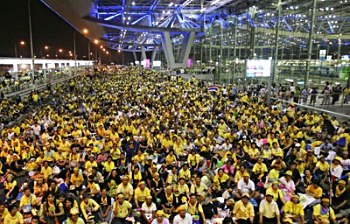
Photo of PAD protesters at Bangkok airport

Thailand’s long-simmering political crisis finally made it onto Western TVs this week when protesters closed Bangkok’s international airport, disrupting [shock horror] Western tourists.

The essence is that the People’s Alliance for Democracy, the guys in the yellow shirts who’ve shut down the airport, want prime minister Somchai Wongsawat (สมชาย วงศ์สวัสดิ์) to resign. They reckon he’s the puppet of a former corrupt prime minister, Thaksin Shinawatra.

You could argue that Somchai’s election, while controversial, was constitutionally valid. But PAD has run out of patience with the string of corrupt and presumed-corrupt politicians. Even the army chief reckons it might be time to call fresh elections to clear the air. But Somchai won’t budge.

This isn’t a simple story of The People versus the Evil Politician though. The roots of conflict go deep into Thai history and culture.

Continue reading “Thailand’s political crisis: an introduction”

Live Blog: Internet censorship forum

Australia’s controversial plans to “filter” (i.e. censor) the Internet are being discussed in a major forum tomorrow — and I’ll be blogging it live on this very page. Bookmark it for reference!

The forum is at the UNSW Cyberspace Law and Policy Centre from 10am Sydney time on Thursday 27 November, through to 2.30pm, and there’s a fantastic array of speakers.

There’s three sessions: technical and social/legal to set the bounds of what’s actually possible, and then one focussing on how we actually protect the interests of children given this background — both preventing children seeing “inappropriate material” and stamping out child pornography.

Continue reading “Live Blog: Internet censorship forum”

Journalism in a hyperconnected world

[This essay was written for the Media Entertainment & Arts Alliance‘s report Life in the Clickstream: The Future of Journalism [PDF], to be launched in Melbourne today. It was published under the title “Smart brains find ways to spread the message” and trimmed to fit the space available. This version includes all of the extracts from @smartbrain’s Twitter stream which I’d originally supplied.]

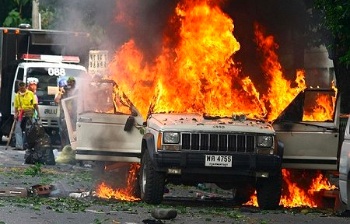
Photo of burning Jeep Cherokee after it exploded in Bangkok

Bangkok, 7 October 2008. A Jeep explodes near parliament, killing a man. Body parts are thrown up to 20 metres.

Meanwhile, 5,000 members of the royalist People’s Alliance for Democracy are occupying the Government building grounds — well-organised but largely peaceful. Thailand’s Constitutional Court forced Prime Minister Samak Sundaravej to resign a month earlier, but his successor Somchai Wongsawat is seen as a corrupt puppet. PAD has given him until 6pm to resign. He does not. The car bomb detonates. The ultimatum expires. The demonstration explodes into riot.

Tear gas. Gunfire. 381 injured. Another death. It’s the worst violence in 16 years.

Meanwhile, in Sydney, my ex-pat Thai partner and I are sinking beers. We take our laptops online but not even Thai news outlets say what’s happening now.

Then, using Twitter, we find @smartbrain.

Continue reading “Journalism in a hyperconnected world”