
Australia 2020 Summit website (finally) online

The guv’mint has finally gotten up a website for the Australia 2020 Summit. The main new pieces of information are a little more about each topic area and the nomination process.

Key points:

  • Nominations close 25 February. There’s a nomination form, and you’ll have to include an explanation of “why you want to participate as a delegate in the Australia 2020 Summit in 100 words or less.” A bit like a TV Week competition.
  • You can nominate for up to three subject areas.
  • If you don’t get selected, you can still make a submission. Submissions close 9 April.

And that’s about it, apart from a photo of Chairman Rudd. Not even an RSS feed.
Topic 9 to discuss Australia 2020 Summit’s government topic

I’ve just registered the Internet domain topic9.com.au, where I’ll set up a blog to discuss topic number 9 of the Australia 2020 Summit: “The future of Australian governance: renewed democracy, a more open government (including the role of the media), the structure of the Federation and the rights and responsibilities of citizens.”

I won’t have time to do anything with it until (probably) tomorrow evening. Meanwhile, can you suggest people who might be interesting contributors?

The Four Stages of the Internet of Things

Further to comments in my piece about that Web 2.0 session, I’ve stumbled across Kevin Kelly’s explanation of The Four Stages in the Internet of Things, riffing of an essay by Tim Berners-Lee (i.e. the bloke what invented the web).

I can summarise the four stages like this:

  1. Connect all the computers together (i.e. the Internet)
  2. Connect and share pages of data (i.e. the World Wide Web)
  3. Connect and share individual data elements (Web 2.0 through Web 3.0?)
  4. Connect and share things themselves, not just the data about things

So where are we now?

Continue reading “The Four Stages of the Internet of Things”

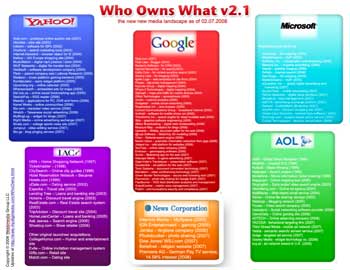
Who owns what on the Internet

Thumbnail of Who Owns What diagram

Amy Webb (now there’s an aptonym!) has updated her diagram of who owns the new media landscape. It’s also available as a PDF file.

Coming soon, a widget and RSS feed to help you track acquisitions and mergers in media.

I must admit, I’d much rather see this sort of data presented as a directed graph of ownership relationships, rather than simple lists — something like this diagram. The size of the nodes could represent the companies’ market capitalisation, and width of the lines the percentage ownership or something.

Still, it’s a handy-enough reference.

Hat-Tip to Lee Hopkins.

No, there is no cable-cutter conspiracy

In my previous post about the four communications cables being cut in one week, I suggested that something odd might be happening. Well, no actually. According to an article in The Register, around 100 cables get cut every year, enough to keep a fleet of 25 cable repair ships fully occupied. Most are caused by fishing mishaps, but ship anchors and geological causes such as earth quakes also play a role. Hat-tip to Bernard Robertson-Dunn.

Australia’s unwired politicians

In October 2007 I wrote: “The next time someone says we’re experiencing Australia’s ‘first internet election’ or our ‘first YouTube election’, slap them. Slap them very hard.” Now UTS research into the 2007 federal election further illustrates the point.

As ZDNet News reports, only two-thirds of the sitting federal members and senators had a personal website, and only 1 in 10 had a MySpace page — though personally I object to MySpace being the touchstone.

The study also revealed only 6.6 percent had a blog, 5.75 percent had posted one or more videos on YouTube, 3.5 percent had a Facebook site and only 3.1 percent had a podcast, as at 20 November 2007.

But of those that did find their way online a large percentage failed to go beyond traditional one-way communication.

Much more in the full story. Hat-tip to Peter Black.