
Just a quick reminder that in a few hours I’ll be winging my way to San Francisco for NetSuite’s SuiteWorld event. If you’ll be there, do get in touch. If there’s something you reckon I should cover, do let me know.
The 9pm Edict #13
 Westpac forgets that banks are meant to be about trust, and just bullshits us during a major outage. Sony too. Snake-oil salesfolk tell us gamification will solve all our needs. Bugger the morals. And idiots imagine that Twitter is like CNN, somehow.
Yes The 9pm Edict podcast has returned after an hiatus of nine months. Just like pregnancy. But let’s not go there. Where I do go is gamification, and I refer to the video Gamifying Education and my op-ed at Technology Spectator.
You can listen below. But if you want all of the episodes, now and in the future, subscribe to the podcast feed, or even subscribe automatically in iTunes.
Podcast: Play in new window | Download (Duration: 12:38 — 4.3MB)
If you’d like to comment on this episode, please add your comment below, or Skype to stilgherrian or phone Sydney +61 2 8011 3733.
[Credits: The 9pm Edict theme by mansardian, Edict fanfare by neonaeon, all from The Freesound Project. Photograph of Stilgherrian taken 29 March 2009 by misswired, used by permission.]
Weekly Wrap 48
A weekly summary of what I’ve been doing elsewhere on the internets. This week was very much a calm — sort of — before the storm.
Podcasts
- Patch Monday episode 86, “Apple: Big Brother or just misunderstood?”. When news broke that Apple’s iOS-based devices were logging location-based information, the media went wild. I speak with information security engineer Alex Levinson from Katana Forensics and Professor Roger Clarke, chair of the Australian Privacy Foundation.
Articles
- APF urges criminal penalties for smartphone privacy breaches, for ZDNet Australia, based on Professor Clarke’s comments on Patch Monday.
- Gamification: Hot, new, unethical? for the new site Technology Spectator. I’ll say it straight up: the mindset behind the gamification trend disgusts me. And, despite what the first two commenters on that op-ed imagine, it’s not because I haven’t heard or read enough about it. The more I hear and read from gamification’s buzzword-addled cheer squad the more disgusted I become.
Media Appearances
- On Monday I spoke with Perth radio RTRfm about the Sony PlayStation Network hack.
- On Friday I spoke with Kate O’Toole on ABC 105.7 Darwin about the surge of spam and malware following the killing of Osama bin Laden.
I haven’t posted the audio files of those radio interviews, even though I have them. Should I? Part of me says I should do so, because it helps create a proper archive of what I do. But another part of me reckons that radio in particular is ephemeral, and that my conversations about these issues really haven’t added much new to the vast global pool of media on these subjects. What do you think?
Corporate Largesse
None. But that will seriously change next week. Stand by.
Elsewhere
Most of my day-to-day observations are on my high-volume Twitter stream, and random photos and other observations turn up on my Posterous stream. The photos also appear on Flickr, where I eventually add geolocation data and tags.
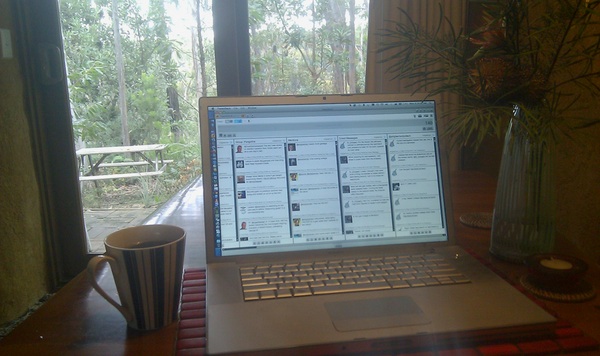
[Photo: Victory is mine! The view from the dining table at Wattle Cottage, one of the Bunjaree Cottages where I’ve been living off and on for the last three months. The title is because this was the last in a sequence of photos documenting my battle with the forces of natural gas. I guess you had to be there…]
Fowler’s Assange biography not really so bad

A couple weeks ago I wrote that Andrew Fowler’s biography of WikiLeaks’ Julian Assange, The Most Dangerous Man in the World, was failing to impress. I persisted reading, however, and things got better.
My main gripe then was that just 41 pages into the narrative I was getting the distinct impression that Melbourne University Press hadn’t assigned an editor who had the faintest grasp of internet technology, history and culture. I listed a bunch of what, to me, were glaring errors.
However once we get past Assange’s earlier hacker life and into more recent material, which is more about interpersonal relationships and international politics, the book is significantly stronger. Indeed, The Most Dangerous Man in the World does a good job of tying together the various threads of the Assange and WikiLeaks stories, and even buries on page 217 an important revelation — if it is a revelation.
I have been reliably told that ASIO played an active part in the investigation into Assange, trawling through his life and activities in Australia. But what must be just as worrying for him, and has also never been revealed before, is the fact that the inquiry also included officers from ASIS, Australia’s overseas intelligence agency, which has strong links with the US.
Personally I’m not surprised by that news one bit. That’s just the intelligence organisations doing their jobs of investigating perceived threats to national security, as should be expected. But given how some folks get all frothed up whenever they discover that spooks are involved, I’m wondering why this wasn’t given more prominence.
The book still has some curious wording, such as on page 147 where WikiLeaks is described as “a child of the anarchic blogosphere”. I’m not sure that’s the right heritage to stress and, as I wrote before, Robert Manne’s free-to-read essay in The Monthly does a much better job of capturing Assange’s and WikiLeaks’ cypherpunk roots. On page 165 there’s a reference to “what’s known as the DefCon conference”, as if there’s some doubt as to the name of one of the longest-running and most-respected hacker events on the planet. And there’s still plenty of that sloppy editing I referred to, such as the Chaos Computer Club being explained twice.
Nevertheless, reading The Most Dangerous Man in the World will give you the core narratives. Just be aware that the technical and cultural descriptions are wobbly, and use it to get the timelines straight in your head.
Weekly Wrap 47
A weekly summary of what I’ve been doing elsewhere on the internets. Thanks to the collision of Easter and Anzac Day to create a very long weekend indeed, there were only three official workings days.
Podcasts
There was no Patch Monday podcast because Monday was a public holiday. However I did record the key interviews for the next two episodes. That’s the furthest ahead I’ve ever been.
Articles
- Tired Microsoft delivers solid profits, for now, for Crikey, which as you might imagine is a commentary on the company’s quarterly results.
- I also wrote a piece for ZDNet Australia that should be published tomorrow, and my first two opinion pieces for an outlet that… well… I’ll tell you about that next week.
Media Appearances
- On Wednesday I was interviewed by Carol Duncan on ABC Radio 1233 Newcastle about the security breach of Sony’s PlayStation Network. The audio is available at the ABC website.
- I was interviewed on the same subject by the OzSpot gaming podcast, a production of CBS Interactive’s GameSpot.
- On Thursday I was interviewed by John Kenneally and Jane Doyle on Adelaide radio FIVEaa about… the Sony PlayStation Network hack. There’s no audio published at their website. Should I post my copy, do you think?
[Update 8 May 2011: The direct link to the podcast doesn’t work. You’ll have to scroll down the list of episodes in the “archive” section on the right to find the one for 26 April.]
Corporate Largesse
None.
Elsewhere
Most of my day-to-day observations are on my high-volume Twitter stream, and random photos and other observations turn up on my Posterous stream. The photos also appear on Flickr, where I eventually add geolocation data and tags.
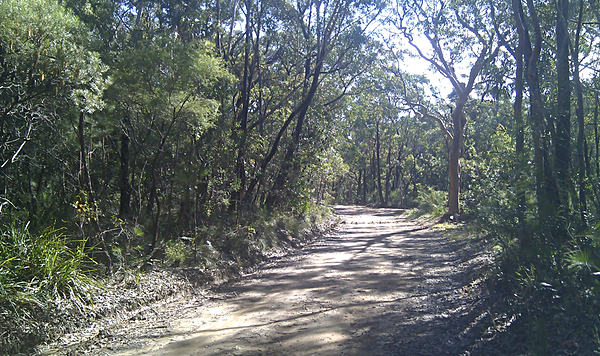
[Photo: Road to Bunjaree Cottages, taken earlier today. This is one of the dirt roads leading to Bunjaree Cottages, which is where I’ve been staying off and on for the last three months. This isn’t the official road to take, as for a short distance it crosses through private property, but it’s the way I usually take when walking into Wentworth Falls.]
Follow Politics & Technology Forum people on Twitter
Further to my post about the forthcoming Microsoft Politics & Technology Forum in Canberra on 1 June, I’ve created a Twitter list through which you can follow all of the presenters at once.
And in the lead-up and especially on the day, you’ll be able to follow everyone’s tweets using the hashtag #poltech.