Zombie Generation: The spreading infection

ZDNet Australia logo: click for the Zombie Generation article

“If you had to identify the biggest single issue confronting the security and safety and the confidence of the internet these days, particularly in the commercial space, you could only point to zombie botnets as the major concern,” says Peter Coroneos, chief executive of the Internet Industry Association (IIA).

On Wednesday, ZDNet.com.au published my feature story Zombie Generation: The spreading infection, which kicks off with a backgrounder on zombie botnets and then some worrying trends.

  • The malware used to create botnets is getting more sophisticated. Traditional stay-safe-online messages are no longer adequate — if they ever were.
  • Young people’s eagerness to share cool new things amongst their peers is natural human behaviour, but it runs counter to the “don’t share” messages.
  • It’s easy for kids to break out of the security restrictions of the laptops supplied under the Australian Government’s Digital Education Revolution program — something we also spoke about on Patch Monday.

Australian ISPs are now developing a more formal code of practice to detect and deal with their customers’ zombie computers.

I also posted a lengthy rebuttal to some fool trying to over-simplify this as “a Microsoft problem”.

Patch Monday: CCTV surveillance and Rudd laptops

ZDNet Australia logo: click for Patch Monday episode 28

A double-headed Patch Monday podcast this week. Are multitudes of video surveillance cameras value for money? And do teenagers with free Rudd government laptops represent a security risk?

Security consultant Crispin Harris is co-author of the soon-to-be-published paper Information overload: CCTV, your networks, communities and crime [PDF], and he’s been digging into the numbers.

Meanwhile, a 15-year-old Sydney lad reckons he’s broken out of the security restrictions on the Lenovo netbook he got as part of the Digital Education Revolution and could install games and browse the school’s file server.

You can listen below. But it’s probably better for my stats if you listen at ZDNet Australia or subscribe to the RSS feed or subscribe in iTunes.

Please, let me know what you think. We now accept audio comments too. Either Skype to “stilgherrian” or phone Sydney 02 8011 3733.

[Update 11 February 2010: The paper Information overload: CCTV, your networks, communities and crime [PDF] is now online.]

Yes, I wrote about iPad, but not here

Not posting here for a week makes it look like I’ve vanished. But increasingly, more of my work is elsewhere. Like my Crikey piece It’s called iPad, and the Kindle is rooted. Like the 2000-word feature I’m slaving to finish today for ZDNet.com.au. Look in the sidebar under “More Stilgherrian”. My online presence is now scattered amongst so many streams of data!

There’s an essay here about the meaning of all this fragmentation. But if I write that essay, I’ll end up having to admit this is precisely why Facebook has been so successful. So much of your life can happen through Facebook and its myriad third-party data-sucking privacy-perverting applications, from organising a BBQ to marketing a business.

The ease with which Facebook can become your all-encompassing social portal means Facebook will win.

That means I’ll probably never write that essay. I don’t want to admit Facebook will win. Because it’s ugly. And because they’re cunts.

Patch Monday: Online industrial espionage

ZDNet Australia logo: click for Patch Monday episode 27

Following the allegedly-Chinese attacks on Google (and 33 other corporations), and following Hillary Clinton’s assertive speech on Internet Freedom, online espionage is in the news — and it’s my topic on the Patch Monday podcast this week.

My guests are Mark Goudie, who heads the forensics practice at Verizon Business in Melbourne; and Ajoy Ghosh, security executive with Logica in Sydney.

You can listen below. But it’s probably better for my stats if you listen at ZDNet Australia or subscribe to the RSS feed or subscribe in iTunes.

Please, let me know what you think. We now accept audio comments too. Either Skype to “stilgherrian” or phone Sydney 02 8011 3733.

No, Stilgherrian’s financial projections are bullshit

OK, so I was wrong. Very wrong. And Citi was right, perhaps even conservative with their estimates of Google’s revenue turnaround.

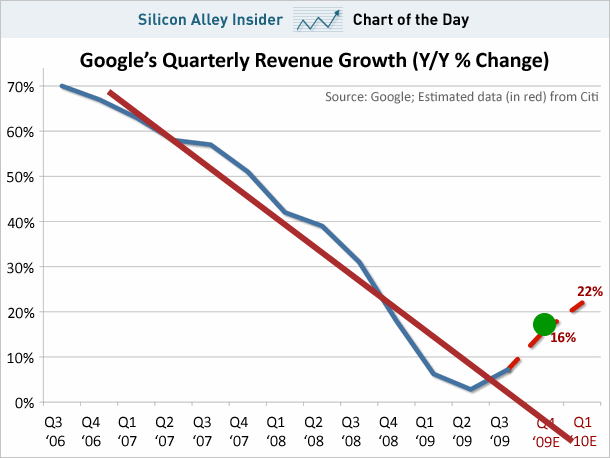
The other day I was sceptical that Citi’s analysis showed Google suddenly reversing three years of declining revenue growth. They predicted that the revenue growth for 2009 Q4 would be 16%.

I scoffed. I figured the fat red line (right) was a more appropriate projection of the data in the graph.

Well, Google’s actual Q4 revenue growth was 17%. That’s the green dot.

Bastards.

Now Bob Bain, who actually knows how to read these numbers, has found a more detailed review. He points out that while net profit was allegedly up fivefold, Google did write off a billion dollars as “impairment of equity investments” last year. I don’t know what that means, but it sure sounds like it’d make last year look a bit wobbly.

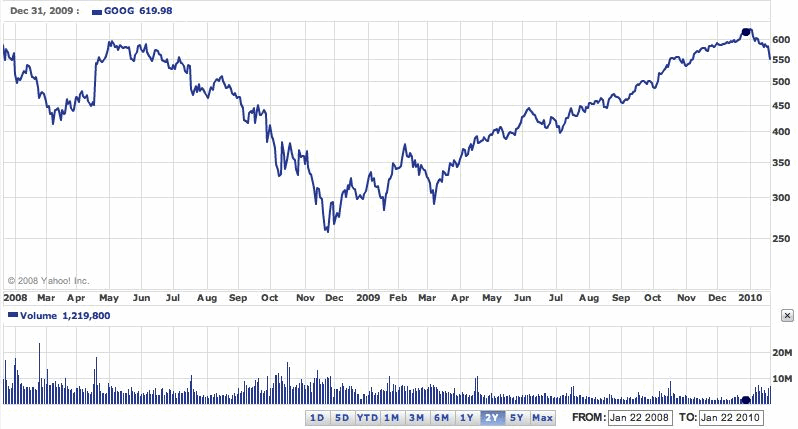
Now, check this chart of Google’s share price for the last two years.

Broadly speaking, it shows the share price dropping as the global financial crisis kicked in, and then recovering. Apart from that tiny little downturn in the last week or two, Google’s share price is back up to where it was two years ago.

Lessons?

  1. The stock market is a long term investment, unless you really want to immerse yourself in the crazy world of the day traders.
  2. When it comes to the stock market, I haven’t the faintest fucking idea what I’m talking about, and you should ignore me.

Any questions?

Internet financial projections are bullshit

It’s no secret that the high-growth venture-capital-driven Internet industry is a hype-laden circus of misinformation. But today’s Chart of the Day from Silicon Alley Insider (right) really takes the biscuit.

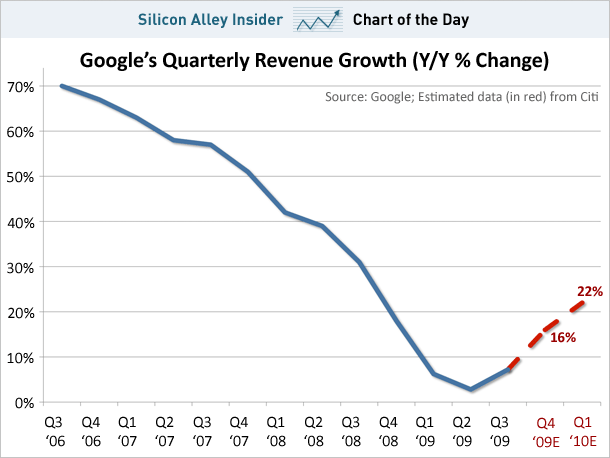
Here we see that since Q3 of 2006, Google’s quarterly revenue growth has steadily declined from a cancerous 70% year-on-year to under 10% for the last three quarters.

Now there’s nothing wrong with an 8% growth rate. That’s pretty much up there with China, for instance. And the only countries growing faster than China are starting from a very low base. Think of such economic powerhouses as Angola, Bhutan, Rwanda and Timor-Leste.

OK, I know countries and companies aren’t the same thing, but that’s not my point.

Look at the bottom right of that first graph.

Citi reckons that Google’s growth in the next two quarters will increase in a more-or-less straight line that’s even steeper than that most recent quarter-on-quarter increase. Based on fucking what, Citi? That’s the only quarter showing growth in the entire chart!
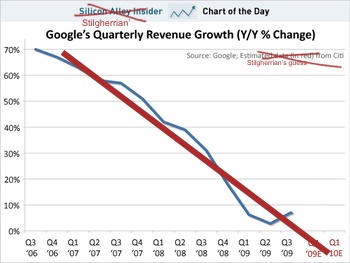
Surely this second graph is a more realistic projection based on the data available.

There’s precisely zero science here. I just grabbed the straight-line tool in my graphics program and drew in a red line by eye. I certainly couldn’t be arsed doing this properly with, you know, mathematics. But…

Honestly, which of these “projections” looks more realistic to you?

As I say, there’s no science here. Perhaps we can add some analysis.

What factors might be affecting Google’s potential for increased revenue growth?

On the plus side:

  • Google is operating in a marketplace which is still growing, and perhaps even growing faster than last year as we emerge from the global financial crisis. Then again, so is everyone else.
  • Google’s got a new product line coming out, those Android phone thingamabobs, and people are wetting themselves to get one. Well, at least until Apple reveals their new toy next week.
  • Google pwns the Internet.
  • What else?

But working against that:

  • Google is subject to increased competition, especially from Microsoft’s Bing and related products and services.
  • Rupert Murdoch is up to something, although admittedly he might not have the faintest idea what he’s doing.
  • Every market eventually reaches a plateau. The key bullshit image of the first dot.com boom was the classic revenue projection of a start-up: exponential growth continuing forever. Well, here in rich white Western countries, all the folks who are using the Internet are pretty much there already. There might be more volume of data, but the amount of attention span you can sell to advertisers ain’t going to rise so much.
  • What else?

We also need to remember that these are revenue figures, not profit. And that’s my core point. Simplistic “Oooh, aah!” gawking over one numerical measure without context is wankery. Why do we let analysts get away with it?

All that said, I’m no financial analyst. What would I know? So if you know better, set me straight. There’s a “Reply” box below…

Oh, and Google’s Q4 revenue figures will be announced tomorrow. So we’ll have one more real data point then. Stand by.