Club Escape Perfect Lists, updated

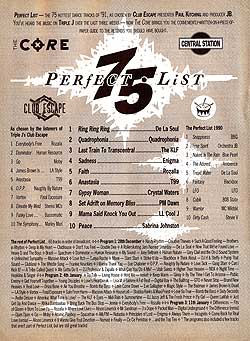
Triple J Club Escape Perfect List 1991: click for the list

Back in 1990 and 1991, the Adelaide-based Triple J radio program Club Escape did episodes at the end of the year called “Perfect List”, featuring its choice of the best dance music released for the year. I’ve just updated my copies of those lists with links to the tunes.

For your listening and nostalgic pleasure, here are the Perfect Lists for 1990 and 1991.

Those old blog posts explain the story, but the short version is that I was one of the program’s presenters in 1990. It was a great time.

Two things come to mind as I look back at these lists…

First, I’m amazed at how few of the links I’d originally set up still worked. Linkrot is a problem for every website manager, but it’s not made easier when people delete their account or when the music distribution companies insist that you have to link to their version and all the others get deleted. I don ‘t know why they think this helps.

And second, well, I’m really hit by the feeling that time has moved on. Those programs were two decades ago. And yet some people want to wallow in their past. I listened to a few of the songs as I repaired the links, but I felt no urge to spend a lot of time “reminiscing”.

Perhaps I’m unusual in that I prefer to live in the present. Or even the future.
Tufte books for sale

[Update 10 January 2011: These books have now been sold.]

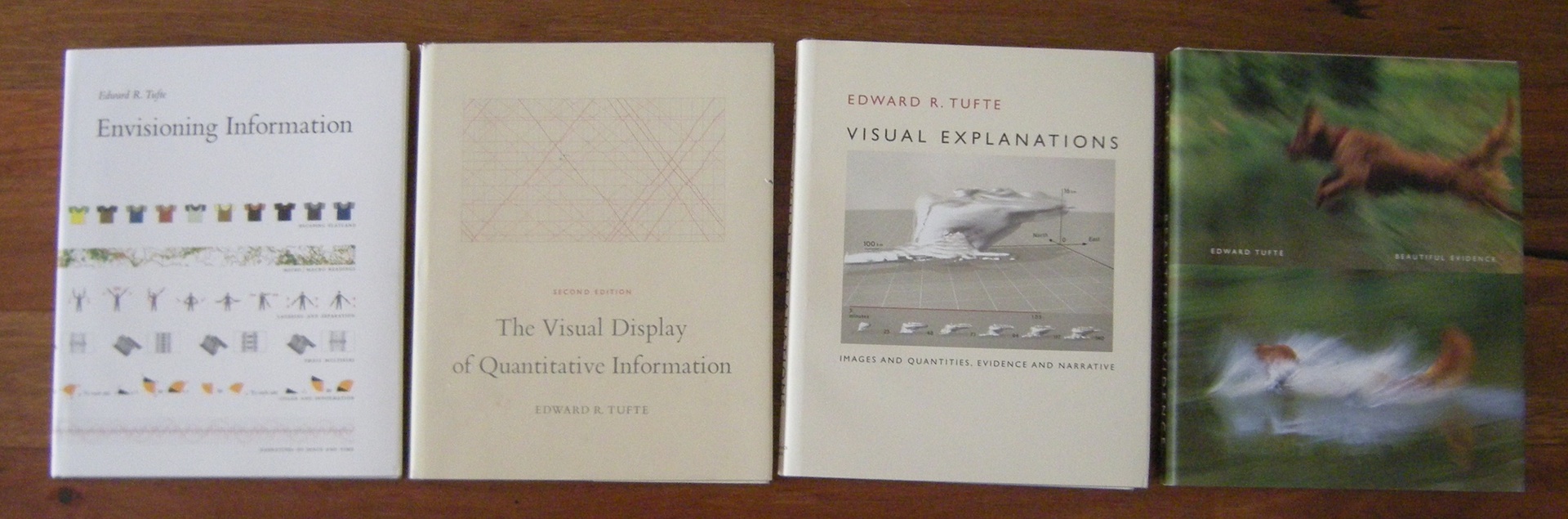
For sale right now on eBay: my copies of Edward Tufte’s first four books on data visualisation: The Visual Display of Quantitative Information, Envisioning Information, Visual Explanations: Images and Quantities, Evidence and Narrative and Beautiful Evidence.

This is the first of a whole bunch of things I’ll be selling over the next few weeks. Yes, partially it’s because I have to move house. But it’s also because I’ve decided to make good on the comment I made at a lunch with the people from Blurb — that books I haven’t even opened in six months are simply wasting space on my shelves and are of no use to anyone. They’re an asset in a coma.

This also relates to a point I’ve been trying to make for the last couple of years, with varying degrees of success: that digital media allows us to separate to creative content — a novel, say — from the container it was traditionally published in, i.e. a book. One version was a Crikey article, Literature? What’s that got to do with the price of books? The core issue is that the pleasure people enjoy from reading the novel, with its characters, settings and plot, is a separate pleasure from the tactile sense of turning pages and feeling the paper, or the satisfaction of collecting objects. I don’t deny anyone any of these pleasures, but they’re no longer necessarily interlinked.

But I digress…

Having read Tufte’s books and absorbed their message, there’s no need for them to sit idly on bookshelves. They’re not something I refer back to. And I have no need to reinforce my sense of self-worth by displaying them as tribal markers either.

You can bid for these books directly at eBay.

Problematising the discourse: clear communication fail

I’ve just read an article which used “problematised” as a verb. Apart from causing me to stumble and have to re-read the whole sentence, this uncommon word illustrates perfectly the problem with so much “educated” writing. And with journalism.

Discussing this on Twitter earlier this afternoon, I said I’d save the writer from further embarrassment. And the editor. But I’ve changed my mind, because I’m going to pull them into this conversation.

The author is Jeff Sparrow. The editing is by newmatilda.com. And the article is certainly something I’m interested in understanding: The Golden Age Of Publishing is an essay on the challenges facing publishers as we move into the digital era.

Here’s the whole paragraph:

That’s why the glory days of the press coincided with the long boom after the Second World War, a time of relative economic and social stability, in which Keynesianism explicitly validated public works and the public sphere. Since then, however, the turn back to marketisation that reached its zenith with neo-liberalism has problematised, more and more explicitly, the very notion of a public. In the idealised free market, there is, as Margaret Thatcher famously explained, no such thing as society — there’s simply an aggregation of competing individuals. In the midst of that fragmentation, the old newspaper model no longer makes sense.

“Problematised”? I’d never seen the word before! I thought it might mean “position as a problem” or something like “assert it’s a problem rather than a benefit”. But no.

So what the hell is this about?

Continue reading “Problematising the discourse: clear communication fail”

Senate to re-open Bloggers versus Journalists

That tired “bloggers are not journalists” debate looks like it’ll surface in Australia’s Senate soon, thanks to The Greens. It’ll be annoying. But it’ll be a Good Thing.
At the end of October the House of Representatives passed the Evidence Amendment (Journalists’ Privilege) Bill 2010, which is all about protecting the confidentiality of journalists’ sources. In the usual jargon, it’s a “journalist shield law”.

Australia was apparently the only major democracy without such a law in place or in progress, so it’s welcome. And, in the words of the new Greens MP for Melbourne, Adam Bandt, “this bill is a good example of how all parties can collaborate on a worthwhile initiative in a way that would not have happened without the currently composed parliament.”

Bandt continued:

To facilitate its passage, the Greens will support the bill in its current form in the House, but I indicate now that we will seek minor amendments to it in the Senate. In particular, we believe that it should be made explicit that the bill covers bloggers, citizen journalists and documentary filmmakers, and that the privileges provided by the bill cover anyone engaged in the process of journalism, no matter who they are or in what medium they publish.

Well I reckon it’s great that the new law might cover more people, not just those who work as employee-journalists in the industrial media factories. It’s great that it might be technology- and medium-neutral. But…

What the heck is a “blogger” or a “citizen journalist”?

Continue reading “Senate to re-open Bloggers versus Journalists”

Weekly Wrap 22

A weekly summary of what I’ve been doing elsewhere on the internets and in the media and so on and so forth — and this week I’ve done a lot of writing.

Articles

Podcasts

  • Patch Monday episode 63, “The govt’s data retention dreams revealed”. If you’d prefer to listen to the edited highlights of that Senate hearing rather than read about it, this is the go.

Media Appearances

  • Parity Bit episode 1. A new IT-related video podcast produced and presented by Owen Kelly. I was chatting with him and the other panellists about #ozlog and other news stories. I didn’t swear once.

Geekery

Not a sausage.

Corporate Largesse

Elsewhere

Most of my day-to-day observations are on my high-volume Twitter stream, and random photos and other observations turn up on my Posterous stream. The photos also appear on Flickr, where I eventually add geolocation data and tags.

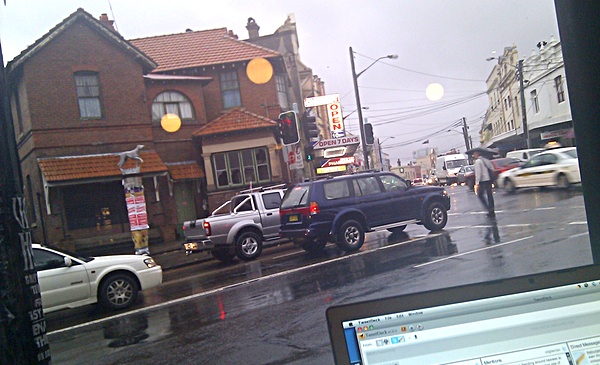
[Photo: Enmore village in the spring rain, taken from the Warren View Hotel. Compare this with the similar view from a few weeks ago.]