Crikey: Internet filtering isnt compulsory, but…

Over at Crikey I’ve written a summary of what’s happening with Australia’s internet filter.

Australia’s mandatory internet filtering by internet service providers (ISPs) won’t happen for at least two years. But we’re getting filtering anyway. Voluntarily. By ISPs. Next month…

Telstra and Optus are expected to have their filters ready within weeks, although the situation with Primus is unclear…

The Internet Industry Association (IIA) is also about to release a voluntary industry code that would see an estimated 80% to 90% of Australian internet connections filtered by the Interpol blacklist over the next year. Attempts to access domains on the list would be redirected to an Interpol block page.

Overall, I reckon the process that’s now unfolding could well result in the gvernment’s planned mandatory ISP-level filtering disappearing off the table entirely.

As a bonus link, here’s Interpol’s explanation of their “worst-of” blacklist of child exploitation material.

Respect, please, NSW Police!

Respecting someone’s religious beliefs is something I though was basic etiquette. But apparently not so, according to NSW Police Commissioner Andrew Scipione and Police and Emergency Services Minister Michael Gallacher.

I have no idea who the women in the photo are. I cannot identify them. But I know that if I wanted to identify them, asking them to remove their burqas would cause offence.

If I needed to identify them, I know that in 2011 there are methods other than demanding they show their faces. They’re Muslim women, so I’m fairly sure that I could arrange for another Muslim woman to view their faces in private, without men present.

But this is how those aforementioned gentlemen’s views were explained in a NSW Police media release headed Police Commissioner meets Minister to close Burqa loophole earlier this evening:

Mr Scipione made the meeting a priority today, declaring the Carnita Matthews Appeal decision [my linkage] raised “real concerns” for police officers.

“The Minister and I are in total agreement that we need to take action to close this potential loophole and strengthen police powers to demand identification where necessary,” Mr Scipione said.

“We are working together to fix this issue and legislative change may be the answer,” the Commissioner added.

As I said on Twitter, I thought it might have been nice if the Commissioner and Minister had even just hinted that respect for people’s religious beliefs might enter into their thinking.

But apparently someone’s sincerely-held religious beliefs are a “real concern” and a “loophole”. We must change the laws so the police can ignore them. At least that’s what it sounds like.

I would like to think that this is simply a poorly-worded media release. After all, I respect the NSW Police for doing a difficult job that I wouldn’t touch with a barge pole and, looking at the world scale, I know they’re mostly on my side. Unlike some countries we could all name.

I would like to think that the police minister, being an experienced politician, knew how to balance the different factors at play in the community.

But this is the same police minister who reckons we shouldn’t worry that people are illegally arrested because police computer information is out of date. This doesn’t exactly fill me with confidence.

[Photo: Afghan women wearing their traditional burqas when going outside in northern Afghanistan, by Steve Evans. This image is licensed under the Creative Commons Attribution 2.0 Generic license.]

Patch Monday: ISP filtering goes ‘voluntary’, plus updates

Australia’s mandatory internet filter is at least two years away, but Telstra and Optus are only weeks from implementing their “voluntary” equivalents. Where are we up to with this controversial issue?

That’s what I covered in yesterday’s Patch Monday podcast for ZDNet Australia. And as I explained on the weekend, I’m returning to my habit of doing a blog post here for each episode.

For this internet filtering update, I spoke with Peter Black, who teaches internet and media law at the Queensland University of Technology; network engineer Mark Newton; and Lyle Shelton, chief of staff for the Australian Christian Lobby.

You can listen below. But it’s probably better for my stats if you listen at ZDNet Australia or subscribe to the RSS feed or subscribe in iTunes.

Since this podcast was recorded, we’ve discovered that Primus isn’t so sure about voluntary filtering any more. They were the third ISP to commit to the plan last year. However the Internet Industry Association (IIA) has said most Australian ISPs will filter via the Interpol list this year.

Previous podcast on this issue covered the meaning of the Refused Classification content category, Senator Conroy’s announcement of the strategy in July 2010, and the apparent fact that parents don’t act on their cybersafety fears.

Please let me know what you think. Comments below. We accept audio comments too. Either Skype to stilgherrian or phone Sydney +61 2 8011 3733.

ABC: The only NBN monopoly seems to be on ignorance

Over at ABC’s The Drum opinion website, I’ve written a piece that argues the National Broadband Network won’t kill competition in the telco industry.

They did the headline, not me, but I do like it.

The article explains the structure of the telco industry before getting to the key points.

In most parts of Australia, the only CAN [customer access network] has been Telstra’s copper network. The NBN will replace that with NBN Co’s optical fibre CAN — at least for 93% of the population, roughly any location with a population of 1000 or more. In other words, the NBN replaces an ageing CAN that’s reaching the limits of its capacity technically, with a new one that provides vastly increased capacity for the future.

What doesn’t change is the fact that customers, both domestic and business, can still choose whichever retail telco offers the best deal for them. That is, there’s still the same capacity for competition between telcos. The only difference is that those retail telcos are provisioning their services via NBN Co fibre rather than Telstra copper.

[I give a few examples and then…]

[T]o claim that telco competition will end because of an “NBN monopoly” is as silly as claiming there’s no competition in the road transport industry because everyone has to use the same monopoly public-funded roads. Different freight companies use those same roads to deliver different styles of service at different prices, and competition seems healthy enough.

The Australian Communications Consumers Action Network just described it as the most factually accurate piece they’ve seen in weeks. That’s flattering but seems over the top. But I will say that I’m happy the article — particularly as this morning broadcast radio arsehole Alan Jones is claiming the exact opposite. And we know what he’s like with facts.

There’s also an article by Alan Kohler that analyses the Telstra-NBN deal from a financial perspective. Well worth a read.

Weekly Wrap 55

A weekly summary of what I’ve been doing elsewhere on the internets. If last week was a bit thin, this week more than made up for it — and as I noted yesterday, I’m knackered.

Podcasts

  • Patch Monday episode 93, “Are we missing the bus on Gov 2.0 data?” A popular Sydney Buses app died when Sydney Transit cut off the data feed after just a few weeks, citing lack of server capacity. Developer Ben Hosken is disappointed, but he’s more concerned that developers aren’t making enough use of the government data on offer. I also speak with developers Benno Rice and Adrian Chadd.

Articles

In addition to these, I wrote a fifth piece for ABC’s The Drum, but that hasn’t been published yet. And there’s a couple of pieces I’ve been working on that I must finish and file tomorrow.

Media Appearances

I did five radio spots this week, which is a record I think. Well, except for when I worked full time in radio, obviously.

  • On Tuesday I spoke with Louise Maher on ABC 666 Canberra about the photographic project Everyday Photographs, Extraordinary Journeys, which I inspired. Well, partly inspired.
  • On Thursday morning I spoke with Adelaide radio 1395 FIVEaa about the National Broadband Network. I’ve already posted the audio.
  • A little later on Thursday morning I spoke on ABC Radio National’s Life Matters about the current state of play in information security. I’ve already posted about that.
  • While I was talking live on Radio National, ABC North Coast NSW broadcast an interview with be about Facebook and Social Media that has been pre-recorded. Alas, I don’t have a copy.
  • On Thursday afternoon I spoke with ABC 774 Melbourne about Bitcoin a digital currency. And I’ve posted that audio too.

Corporate Largesse

None. We’ll have to fix that. Dear PR Operatives, my junket calendar for July is empty. You know what to do. I prefer an aisle seat.

Elsewhere

Most of my day-to-day observations are on my high-volume Twitter stream, and random photos and other observations turn up on my Posterous stream. The photos also appear on Flickr, where I eventually add geolocation data and tags.

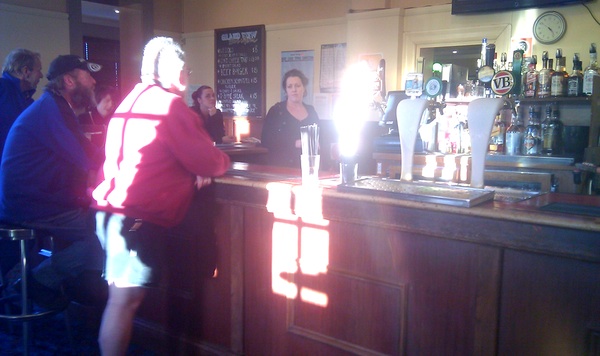
[Photo: The afternoon sunlight can be fierce at The Grand View, an image taken in The Grand View Hotel, Wentworth Falls, yesterday.]

Talking Bitcoin and digital currency on ABC 774 Melbourne

Bitcoin hit the news this week when it was alleged that an ABC employee had been using their computers to generate the digital currency.

On Thursday I gave this backgrounder to the ABC’s Lindy Burns. And yes, she did pronounce my name incorrectly. Her producer has had words.

The audio is ©2011 Australian Broadcasting Corporation, but it hasn’t been posted on their website so here it is. In return, I reckon you might choose to listen to Lindy Burns’ drive program next week.