NSW Sphere: Government 2.0 for NSW

I should’ve written more about this earlier, but today I’m speaking at NSW Sphere, a discussion event on Government 2.0 organised by Penny Sharpe MLC.

It’s being run along the style of Senator Kate Lundy’s Public Sphere events, and interest is so high that all places are booked out.

As I write this, some early-bird participants are watching the movie Us Now, and I’m figuring out exactly what I’ll say in my 10-minute presentation, Risk, Fear, Paranoia: Perspective, People!

You can participate live wherever you are, and I’ll post my presentation and thoughts later. The Twitter hashtag is #nswsphere.

“Influence is the future of media”, eh?

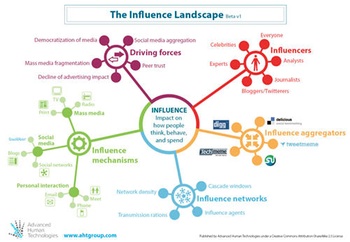
The Influence Landscape: click for a more details

This year, the Future of Media Summit has been replaced by the Future of Influence Summit. It’s next Tuesday 1 September, Sydney time. I’ll be going, and I can offer you a discount.

Summit-master Ross Dawson has changed the name because he reckons that influence is the future of media.

Ross writes:

We have already begun to discover this through the now-dominant concept of “social media”. In the Future of Media Strategic Framework that was launched for our Future of Media Summit 2006 we described the (symbiotic) relationship between Mainstream Media and Social Media.

Social media is all about human relationships, about how we shape our view of the world based on our peer communication. The extraordinary breadth of information and opinion that we are exposed to today, combined with the ability to converse, means our own opinions are often driven more by peers than traditional sources.

In fact this shift to the social means that media is becoming far more about peer influence than information and reporting.

This year companies globally will spend US$450 billion on advertising. The composition of advertising spend has changed dramatically over the last decade. That pace of change will rapidly accelerate in coming years. Total marketing spend is hardly set to reduce in an increasingly crowded marketplace, but it will be allocated to those activities that truly make a difference. Influence — based on conversations and aggregated opinion — will be at the centre of how companies seek to drive sales and customer engagement.

Today, people find content such as movies, music, news, books and so on primarily through aggregated channels. Instead of buying the New York Times and reading it cover to cover, people are pointed to the most relevant articles in the New York Times and elsewhere, based on what people find interesting. It is hardly new that people buy music or books because of recommendations — but now adding to their friends’ opinions and magazine reviews are a universe of influencers who provide guidance on what to buy. Influence is driving the world of content and publishing as never before, and this is just the beginning.

Last year’s Future of Media Summit was full of old media journalists and managers in denial.

It triggered my controversial essay Note to “old media” journalists: adapt, or stfu! (parts of which were even translated into French in Le Monde), a wonderful response from the MEAA’s Jonathan Este, and furthers writing from me including the essays “Trouble at t’paper” and Sunday Thoughts about Journalism.

A year later, a lot has changed — although my liveblog from Media 09 still reads as pessimistic. I’ll be interested to see what emerges, and to prepare myself I’ll be reading more of Ross’ blog over the next couple of days. Expect further posts.

Meanwhile if you want to register for the Future of Influence Summit, you’ll get 20% 25% off if you use the discount code TIESTIL.

Irrational hatred of the Internet

“Hating the Internet because of child pornography is a bit like hating the roads because of drug trafficking. If you had no roads there would be much less of it.” A great observation from a friend today.

Yes, “bad things” happen online, just as “bad things” happen anywhere. But when Clive Hamilton screeches about all the naughty things he’s found online, it looks to me like a deliberate attempt to press our emotional buttons and avoid rational debate. And he does it repeatedly.

The police don’t try to stop drug trafficking by putting a road block in everyone’s street and searching every vehicle. No, they use intelligence — in both senses of the word — to work out where best to deploy their finite resources for maximum results.

They also allocate their resources between conflicting demands so society as a whole is best protected. Their risk assessments tell them to worry more about the suspected rapists, serial killers or violent thugs in their community than some kid with a few grams of weed.

The people who actually understand child protection continually remind us that the greatest threats to children are the same as they always have been — abuse in their own home by family and close family friends, poverty, and bullying by their peers. Why oh why do we have to keep repeating that, Senator Conroy?

1939: So, is it war then, George?

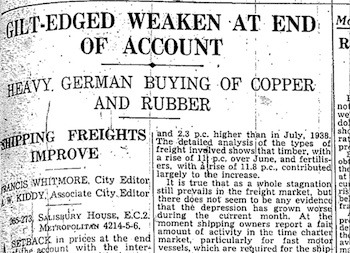
Daily Telegraph (UK), 19 August 1939, page 3 (part): click for a closer view

If the world was about to explode into a Total War lasting six years, would you know?

As I wrote back in 2007, TV documentaries about World War II cover the rise of Adolf Hitler in a few minutes. We forget that Hitler was head of the National Socialist Party from 1921, fully 12 years before he became Chancellor in 1933. It was another 6 years before the invasion of Poland.

What did it look like for people living it in real-time?

My guess is that for the vast majority of people the rise of Hitler had very little impact on day-to-day life — just as today the distant wars in Afghanistan and Iraq have virtually no discernible impact on my life in Sydney. Nor do the many minor changes to our laws which increase the powers of central government without any balancing increases in our own ability to hold that government accountable.

In the summer of 1932, a few politically-aware people sitting in sunny cafes might have discussed that odd Mr Hitler’s failed run for the presidency, but I doubt anyone would have seen it as heralding global war.

This is why I’m starting to find George Orwell’s diary intriguing.

Initially, as the Orwell Prize published the entries exactly 60 years after they were first written it was, to be honest, boring. Laughably so, in fact, as the meticulous journalist documented the day-to-day activities in his garden. On 30 November 1938, it was nothing more than: Two eggs.

But now, we’re only eleven days out from the German invasion of Poland. Thirteen days from Britain and France declaring war on Germany.

Orwell notes a Daily Telegraph report (pictured): “Germans are buying heavily in copper & rubber for immediate delivery, & price of rubber rising rapidly.”

Orwell’s journalistic eye could see the signs. Could ordinary citizens? Sure, gas masks were being distributed and air raid drills held, but did people believe them?

In 2007, did we believe John Howard’s “alert but not alarmed” scaremongering? Or didn’t we? And if not, but they did in 1939, what’s the difference?

I reckon Orwell’s diary will be an interesting read over the next 13 days.

The bad guys pwn the Internet

Crikey logo

“Be afraid. Be very afraid. Online criminals are after your personal data. They’re smart. They’re professional. They’re efficient. Meanwhile, those guarding your data are overloaded, under-coordinated and, often, under-trained.”

That’s how I started a piece in Crikey on Tuesday, written after the general manager of AusCERT had given his scary presentation.

UK banks are now seeing criminals correlating data captured from different malware runs, compiling detailed personal profiles. That information is then used to target specific individuals in corporations with an email that looks so legitimate they can’t help but click through  – targeting, say the CFO who knows about planned company mergers or the discover of a new oil field. The aim? Advantage on the stock market.

The article is free to read, so off you go!