

More Thoughts on Twitter

Twitter cartoon image by Hugh MacLeod

Weird. I was thinking that today I might write about how I’ve been using Twitter recently, and I’ve just found myself writing in its defence.

Over on the Link mailing list were talking about Microsoft’s new Live Mesh when I noted:

It’s been interesting to watch the vastly different reaction here on Link with the (mostly) very positive reaction amongst the alpha geeks in my circle of friends on Twitter.

There, the reaction is all “When can I get a Mac version?” and “How can I hook this into X technology?” and about exploring the possibilities — what can be achieved. Here on Link, the reaction is often negative, “How can it go wrong?”, “Where do you sue?”.

Both reactions are necessary to provide a balanced response to a new technology. How to we get them to meet?

Systems administrator Craig Sanders was quick to respond, and I must admit I found his response to be almost a stereotype — something I later dubbed “old man syndrome”.
Continue reading “More Thoughts on Twitter”

Note to Harvey Norman

Dear Harvey Norman: When you sell someone a new computer and tell them that “everything’s on there”, please explain that you’ve only dumped a copy of their old hard drive onto it, and that it’s still a few hours’ work to download and install software, put data in the right place and generally configure things. You might also like to explain that the “student and teacher” editions of Microsoft Office you’re trying to push aren’t actually able to be used by people running a commercial business.

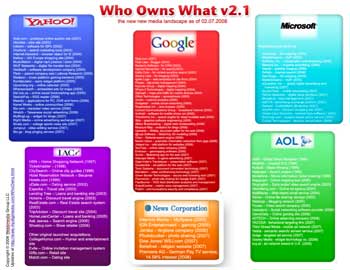
Who owns what on the Internet

Thumbnail of Who Owns What diagram

Amy Webb (now there’s an aptonym!) has updated her diagram of who owns the new media landscape. It’s also available as a PDF file.

Coming soon, a widget and RSS feed to help you track acquisitions and mergers in media.

I must admit, I’d much rather see this sort of data presented as a directed graph of ownership relationships, rather than simple lists — something like this diagram. The size of the nodes could represent the companies’ market capitalisation, and width of the lines the percentage ownership or something.

Still, it’s a handy-enough reference.

Hat-Tip to Lee Hopkins.

Even better commentary on Microsoft/Yahoo! merger

My commentary on a Microsoft/Yahoo! merger was sarcastic, but Fake Steve Jobs has even better visual imagery. “The Borg-Yahoo merger won’t work. Here’s why. It’s like taking the two guys who finished second and third in a 100-yard dash and tying their legs together and asking for a rematch, believing that now they’ll run faster.” And “Imagine a circus act in which two enormous, clumsy, awkward elephants that don’t really like each other are supposed to mate while riding on skateboards.” Hat-tip to Mark Pesce.