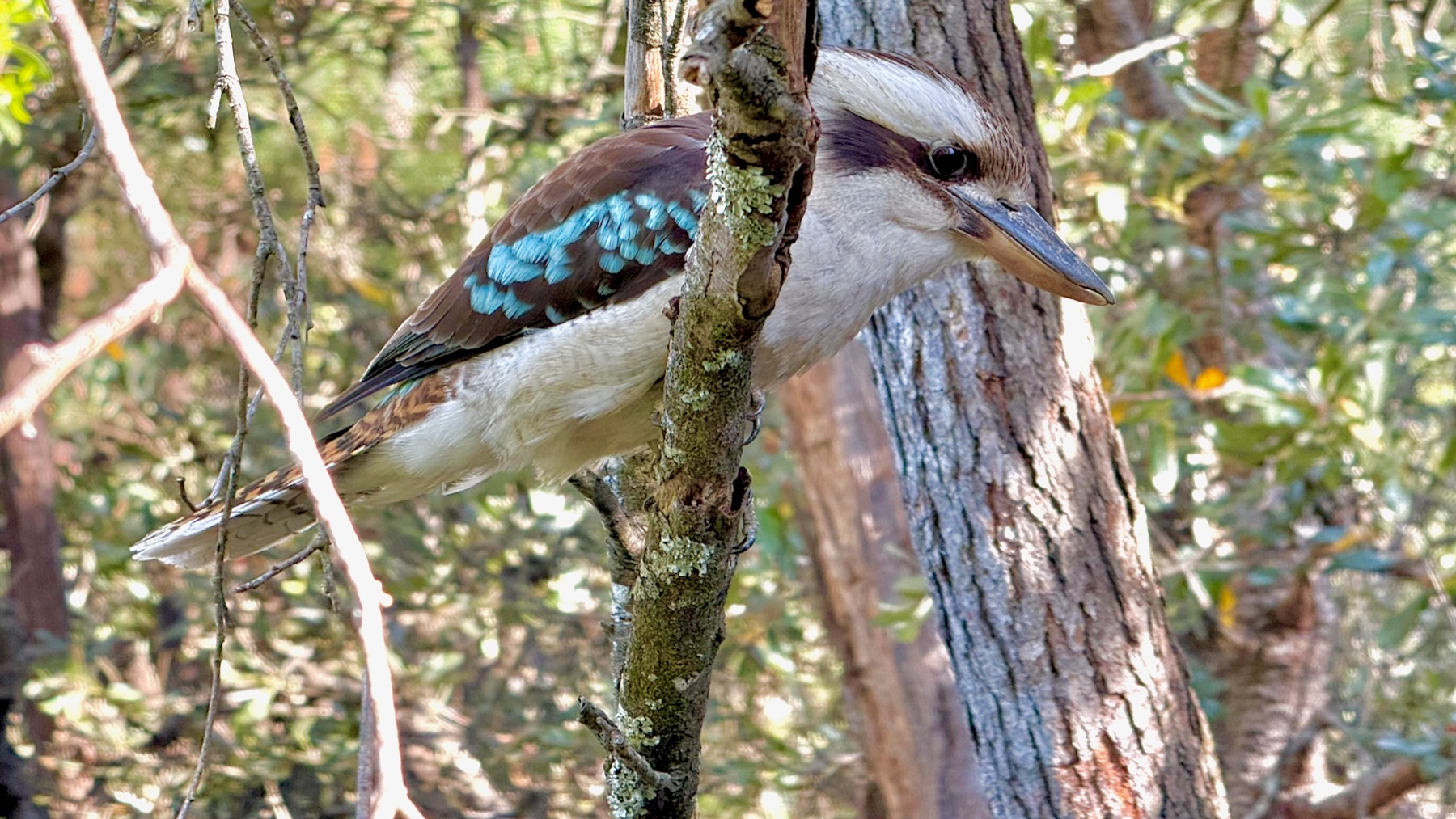
My week of Monday 3 to Sunday 9 November 2025 saw me invent a new podcast sub-project, and then manage not to post the two full podcasts I’d planned. For various reasons. Oh well. The rest of it was reasonably productive, so I’m happy with that.
Continue reading “Weekly Wrap 806: The Kookaburra of Consideration”Links for 08 November 2009 through 18 November 2009
Stilgherrian’s links for 08 November 2009 through 18 November 2009:
See what happens when you don’t curate your links for ten days, during which time there’s a conference which generates a bazillion things to link to? Sigh.
This is such a huge batch of links that I’ll start them over the fold. They’re not all about Media140 Sydney, trust me.
Continue reading “Links for 08 November 2009 through 18 November 2009”
Links for 22 October 2009 through 27 October 2009
Stilgherrian’s links for 22 October 2009 through 27 October 2009, published after far too long a break. I really, really do need to work out a better way of doing this…
- Nature Child | San Juan Islander: “According to family studies professor, Sandra Hofferth of the University of Maryland, there was a 50% decline between 1997 to 2003 in the proportion of children 9 to 12 who spent time in outdoor activities (hiking, walking, fishing, beach play and gardening).”
- FreeRangeKids: “At Free Range, we believe in safe kids. We believe in helmets, car seats and safety belts. We do NOT believe that every time school age children go outside, they need a security detail.”
- How far did you roam as a child? | Watershed: Educator John Larkin continues the thoughts about wrapping our kids in cotton wool.
- How children lost the right to roam in four generations | Mail Online: In 1919, an 8yo was allowed to walk six miles to go fishing. Today, an 8yo isn’t allowed past the end of the street without parental escort. This article from 2007 triggered many thoughts, and I’ve glad I found it again.
- Forget the young pretenders, Humans 1.0 can lead the way | The Observer: John Naughton riffs off the idea that teenagers don’t know everything and some parts of cyberspace (ugh!) are teenager-free. Although the article then says that “only” 11% of Twitter’s users are under 17 years old. And what proportion of the literate population is under 17yo? 11%? More? Less?
- Podcasting Equipment Guide (2009) | Hivelogic: A nice guide to the tools needed to podcast on a budget. Yes, there’s a reason I’m looking at this. Stay tuned, as they say.
- Senate Select Committee on the National Broadband Network | Parliament of Australia: Full transcripts of the Senate Select Committee on the National Broadband Network public hearings, which I’m tagging for my own reference later.
- What Information is “Personally Identifiable”? | Electronic Frontier Foundation: Gender, ZIP code and birth date are enough to uniquely identify about 87% of the US population. This has massive implications for publishing data sets, and for privacy policies that claim not to collect “personally identifiable” information.
- Nine News twittered by seagull | TV Tonight: It’s nothing to do with Twitter, but there is a seagull. A very big seagull.
- Apology for singing shop worker | BBC News: Shop assistant Sandra Burt, 56, from Clackmannanshire, was threatened with a fine for singing without a license by the Performing Right Society. However they’ve now apologised and sent flowers.
- Online Ads Not Working for You? Blame the Creative | Advertising Age: A study by Dynamic Logic says that obsession about optimisation and placement is less important.
- We can’t turn back the tide of internet piracy, says TV boss | Herald Scotland: “Internet piracy is merely demand where appropriate supply does not exist,” says the commissioning editor for education at the UK’s Channel 4.
- Court tweets sustained but paper still lurks | ZDNet Australia: Liam Tung, who tweeted from the AFACT v iiNet trial in the Federal Court of Australia in Sydney, reflects on the gaps in courtroom IT.
- Beats and Tweets: Journalistic Guidelines for the Facebook Era | NPR: Yet another exploration of ethics an journalism. One point in here I really do not like, though: “You must not advocate for political or other polarizing issues online. This extends to joining online groups or using social media in any form (including your Facebook page or a personal blog) to express personal views on a political or other controversial issue that you could not write for the air or post on NPR.org.” Sorry? Work for NPR and you lose your right to participate in democracy?
- Poles, Politeness and Politics in the age of Twitter | The New Adventures of Stephen Fry: Another fine if perhaps rambling essay from Mr Fry about the meaning of “influence” and accidentally gaining same. Worth a leisurely read.
- Why journalism's all a-Twitter | The Walkley Foundation: The editorial chief of Sydney’s forthcoming Media140 conference goes beyond the obvious “Is Twitter journalism?” and mechanical how-to issues and explores the ethical issues of journalists using Twitter.
- Twitter in the court: Federal judge gets it | CNET News: Another article about using Twitter in courtrooms, from the US an from March 2009.
- Call For Opinions | Blackbeard Blog: Tom Ewing’s collection of opinions on market research and social media, “quite unsupported by anything other than grumpiness and prejudice”. The first is that “insights” aren’t Zen koans. “If you can express something that briefly, it’s probably banal.”
- The internet doesn’t exist | Business Spectator: Ah, Alan Kohler! I do so love your commentaries! Here’s more of his sensible thoughts on the matter of paying for “content” on the Internet.
- How Safe is the HPV vaccine? | Information Is Beautiful: A brilliantly simple infographic showing the incredibly low risk of associated with the Human Papillomavirus compared with various everyday activities.
- Ultimate Goat Fansite: Do I need to explain? I thought not.
Links for 30 September 2009 through 13 October 2009
Stilgherrian’s links for 30 September 2009 through 13 October 2009, gathered automatically but then left to languish for two weeks before publication.
There’s so many of these links this time that I’ll publish them over the fold. I think I need to get over my fear of the link being published automatically without my checking them first, and my concern that my website won’t look nice if the first post is just a list of links.
Maybe I should just stick these Delicious-generated links in a sidebar? Or do you like having them in the main stream and RSS feed?
Continue reading “Links for 30 September 2009 through 13 October 2009”
Links for 28 August 2009 through 09 September 2009
Stilgherrian’s links for 28 August 2009 through 09 September 2009, gathered automatically and then forgotten until today:
- REAPER | Audio Production Without Limits: I haven’t encountered this audio/music production tool before. It’s perhaps worth a look.
- Experts look to Australia’s Aborigines for weather help: As it happens, the Aboriginal tribes of the Sydney basin recognised six season, not the European four.
- The 2009 Edelman Trust Barometer: This was published back in March, but it’ll show you how trust in various things has changed over time.
- Salvage Techniques for Wet Electronics | Andy Ihnatko’s Celestial Waste of Bandwidth (BETA): The title says what it is. Yes, I have wet electronics. I dropped my phone in a “moist environment” and it’s now sitting with silica gel and probably never working again. Read this guide now so you know the drill for the future.
- For SEC, tech-savvy fans might be biggest threats to media exclusivity | St Petersburg Times: The US Southeastern Conference of college sports is trying to stop fans communicating about the game in the most stringent restrictions ever seem. A pity they can’t possibly work.
- User driven service bingo | Doc Searls Weblog: A checklist of activities to see whether some web service or other is truly “user driven”. Does this apply to organisations too?
- Electronic Warfare: Airborne electronic attack – a new offensive role for the RAAF | ADM: Someone took me to task for suggesting the RAAF buying F/A-18 Super Hornets was a waste. He suggested the electronic warfare capability of the “Growler” model was a worthwhile addition to Australia’s defence capability.
- Stop Using the Word “We” | Ted Dziuba: A plea for more direct communication within the corporation. Yes please.
- Economics is not a Natural Science by Douglas Rushkoff | Edge: “Some of us analyzing digital culture and its impact on business must reveal economics as the artificial construction it really is. Although it may be subjected to the scientific method and mathematical scrutiny, it is not a natural science; it is game theory, with a set of underlying assumptions that have little to do with anything resembling genetics, neurology, evolution, or natural systems.”
- Impatient CEOs are all of a Twitter, but it doesn’t work like that | The Observer: John Naughton points out a real dilemma: CEOs have to generate profits to a quarterly cycle, but the business benefits of “social media” (or whatever it’s called next month) will take decades to emerge.
- Draft Open Access and Licensing Framework released | In Development: The New Zealand government’s draft policy recommends that government agencies use the most liberal Creative Commons licensing possible.
- Stark realisation: I no longer depend on Google to find stuff | Alex J Campbell: Alex differentiates between “finding” and “locating”, and along the way observes that the changes in the way we do these things has profound implications for businesses trying to get customers online.
- Words for Webstock – Bruce Sterling: Bruce Sterling sees the Future, and it’s banal. Just like today.
- Last Year’s Model: “It’s totally normal to lust after the hottest new geeky gadgets. It’s also cool to put some thought into what we buy, and what we throw away. So this is a place to show the world that a lot of us are choosing to use Last Year’s Model.” Their slogan is “Saving the planet through sheer laziness”, but it’s also a call for a more informed choice about consuming less.
- OSX Timemachine and Samba/Windows share | Hupio’s Weblog: How to use Apple’s OS X 10.5.2 Time Machine backup software with a Linux server, Windows server or Windows network share. It presumably works just as well with later versions.
- The next 100 years | New Statesman: An extract from Stratfor founder George Friedman’s book of the same name. Can you imagine a war between a Japan-Turkey alliance and US-Poland?
- Depression’s Evolutionary Roots | Scientific American: New research seems to indicate that depression isn’t something “broken”, but rather the brain going into an altered state so that “deep rumination” can be uninterrupted, leading to better analysis of a complex problem. If so, doesn’t that mean anti-depressant medications are preventing the problem being solved?
- John Thompson-Mills: John was the producer of Club Escape, the dance music program I presented with Scott Thompson on Triple J back in 1990 or whenever it was. Happy to have stumbled across this.
- CHART OF THE DAY: Actually, Kids Don’t Hate Twitter Anymore! | Silicon Valley Insider: “While Twitter’s user base historically favored older users, people between ages 12-24 have been Twitter’s fastest growing age group of late. And now that age group is actually disproportionately visiting Twitter, according to comScore.”
Links for 10 August 2009
Here are the web links I’ve found for 10 August 2009 and some days beforehand, posted automatically, kinda.
- Teens Don’t Tweet… Or Do They? | apophenia: Mashable reported some new statistics on Twitter usage with the headline “Teens Don’t Tweet”;. This article debunks that idiocy.
- Why I believe in the link economy | MediaFile: Chris Ahearn, who’s President, Media at Thomson Reuters, provides an interesting counterpoint to Associated Press’ aggressive anti-linking views.
- What’s a Big City Without a Newspaper? | NYTimes.com: This feature starts off with a long nostalgic waffle about newspapers, but towards the end it has some excellent points about how journalism may adapt to the new world.
- Hunter S Thompson Motivational Posters | Sloshspot Blog: Yes, the world needs Hunter S Thompson motivational posters. It truly does.
- The Communications Market 2009 (August) | Ofcom: The UK communications regulatory authority’s latest industry statistics.
- TVS – Television Sydney: Community TV station TVS has a website — which is nothing new, except that I just discovered that their program are streamed live as well as being broadcast on UHF analog.
- eCrime Symposium panel discussion | Risky Business: One of the panel discussions from last week’s eCrime Symposium in Sydney, featuring: Rachel Dixon, who’s a technology executive for online media group Viocorp, as well as being the deputy chair of consumer group CHOICE; Phil Argy, head of the Technology Dispute Centre, and Sean Richmond from Sophos. The panel was hosted by Nigel Phair, and there’s a question from me.
- Mission control | SomaFM: Apollo mission radio feeds from NASA mixed with ambient electronica. Suitably excellent listening.
- Rupert and the death of hubris – Alan Kohler | Business Spectator: A solid analysis of Rupert Murdoch’s announcement that News Corporation will pull its content behind paywalls.
- Watch the Ebb and Flow of Melbourne Trains | FlowingData: From Australian data visualisation team Flink Labs, a fascinating overview of Melbourne’s railway network in action.
- Internet Filter Plan From Stephen Conroy Won’t Work: DPP | theage.com.au: Earlier this week, the NSW Director of Public Prosecutions, Nicholas Cowdery QC, was rather sceptical of the Rudd government’s plans to “filter” the Internet.
- Canberra Players League’s All Star Game 2009 | Dnosauria: Not bookmarked because I’m interested in basketball, but because Dean trialled using Livestream.com to put the video online. Live. Seems it’s a batter choice than Ustream, which is what I’d been using until now. I may check it out.