
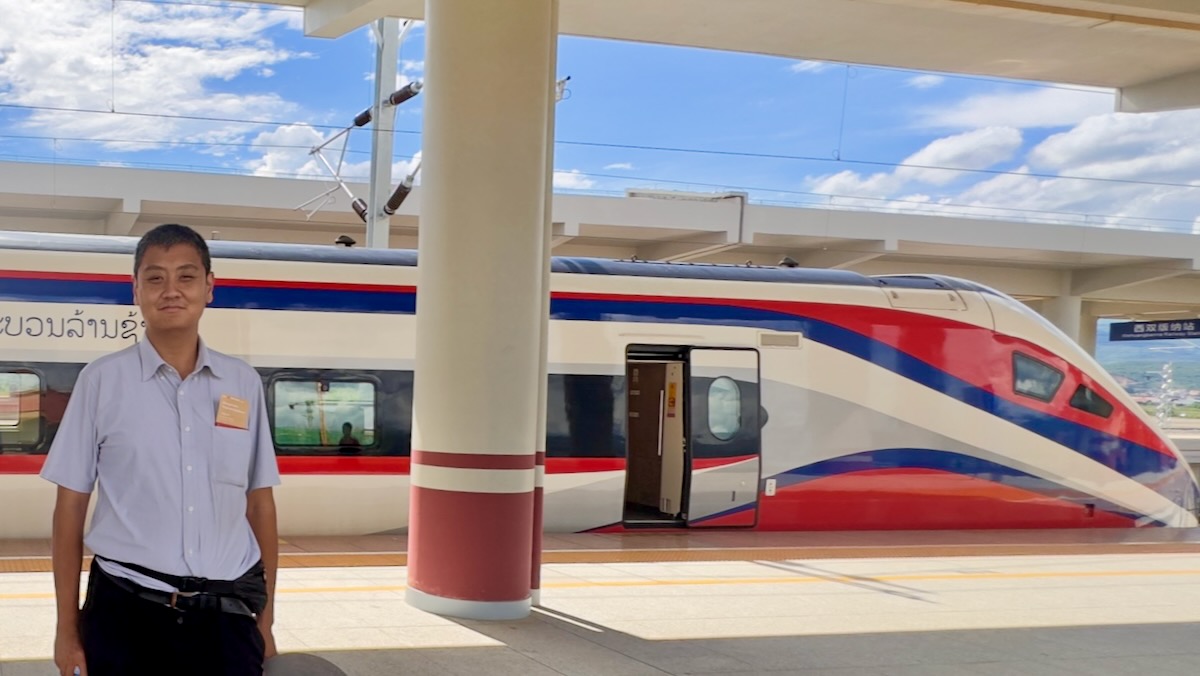
I like trains. Do you like trains? I hope so, because today we’re talking about trains. There’s a strong focus on China and on high-speed trains, and our guest on the internet from Beijing is Chinese-Swiss international rail visionary, it says on his YouTube channel, David Feng.
In this episode we discuss China’s high-speed rail network and some of the country’s metros. But we also cover high-speed rail in other countries, why Australia doesn’t have any (yet), signalling, food, and more.
If you’re interested in maybe meeting up with David and me in Sydney on 14 June, please indicate your interest by Wednesday 8 July.
This podcast is available on Amazon Music, Apple Podcasts, Castbox, Deezer, Google Podcasts, iHeartRadio, JioSaavn, Pocket Casts, Podcast Addict, Podchaser, Spotify, and Speaker.
You can also subscribe to the generic podcast feed.
Episode Links
-
This is the official website of David Feng. Perhaps you know him from one of these things?
-
Come on mate, hop along!... with David Feng on Trains across the entire world across all permanently inhabited continents (600'000+ km globally). But that doesn't even begin to tell the story.
-
Trains, Urbanology, Green mobility, Sustainability, Infrastructure | Switzerland, China | 500'000+ km Trains globally on all continents. Never stop believing in your microphone foam covers. Swiss.
-
The high-speed rail (HSR, Chinese: ??; pinyin: G?oti?) network in the People's Republic of China (PRC) is almost entirely owned and operated by the China State Railway Group Co. under the brand China Railway High-speed (CRH), including HSR trains, tracks, and services. China's high-speed rail network is the world's longest and has the highest ridership, as it accounts for roughly two-thirds of the world's total and has expanded to more than 50,000 km in operational length.
-
The XPT service runs two return trips each day between Melbourne and Sydney... All four daily XPT services take about 11 hours.
-
[21 January 2022] This video shows how the SL900 is used to construct 350km/h high-speed railway in China.
-
Canberra station is the terminus for a three-daily Xplorer service operated by NSW TrainLink from Sydney. The journey takes about four hours.
-
Amfleet is a fleet of single-level intercity railroad passenger cars built by the Budd Company for American company Amtrak in the late 1970s and early 1980s. Budd based the Amfleet design on its earlier Metroliner electric multiple unit.
-
The New South Wales R sets are a type of bi-mode multiple units (EDMUs) being built to replace NSW TrainLink's Xplorer and XPT fleets for long-distance services, as well as Sydney Trains' Endeavour fleet for diesel intercity services. The fleet is being built by CAF as part of their Civity family of trains.
-
The Chongqing Rail Transit (branded as CRT; also known as Chongqing Metro) is the rapid transit system in the city of Chongqing, China. Opened in 2004, it is the world's 6th-largest metro system by length, at 574.12 km (357 mi), the largest monorail system, and holds the world records for the highest and deepest metro stations, both on the same line.
-
Wuhan Metro trains come in two sizes, Type-B cars and larger Type-A cars, both of which are commonly used by other rapid transit system in China.
-
[1 June 2026] Hong Kong is betting its economic future on a megadevelopment spanning one-third of its territory. The multibillion-dollar Northern Metropolis project aims to turn a rural frontier of fish ponds, farmland and villages into a tech hub of cutting-edge labs and startups. The effort also will serve as a concrete-and-steel connection to Mainland China, and eventually ten other nearby cities that make up the Greater Bay Area.
-
[1 April 2026] The question everyone wants answered… is China over-building its High Speed Railway network? Whilst the Beijing-Shanghai example can’t hope to be representative, the case is clear: fears about over-building don’t quite seem to… be what they think it may be…
-
The Trans-Asian Railway Network Agreement is an agreement signed on 10 November 2006, by seventeen Asian nations as part of a United Nations Economic and Social Commission for Asia and the Pacific (UNESCAP) effort to build a transcontinental railway network between Europe and Pacific ports in China. The plan has sometimes been called the "Iron Silk Road" in reference to the historical Silk Road trade routes... [One] corridor to be included will connect China to Korea, Mongolia, Russia and Kazakhstan. In 2003, the president of Kazakhstan proposed building a standard gauge link from Dostyk (on the Chinese border) to Gorgan in Iran; it has not yet been built.
-
[24 April 2026] David’s currently based in Central China in a big city right on the Eurasian rail and road corridor… it’s a very intriguing thought to drive, or travel by rail, or do both — from the East China Sea to Europe! He’s thinking of doing this once-in-a-lifetime journey… across many goes…
-
[3 May 2026] Australia is pursuing its most ambitious high-speed rail project yet, with plans to connect Newcastle and Sydney in one hour at a cost of at least $90 billion.
-
The Australian Government is planning a high speed rail network to connect Brisbane, Sydney, Canberra, Melbourne and regional communities across the east coast of Australia. A High Speed Rail connection between Newcastle and Sydney is now in the Development Phase.
-
High Speed Rail will connect Australian regions, cities and communities - delivering generations of opportunities.
-
Al Boraq (Arabic: ???????, romanized: al-bur?q) is a 323-kilometre (201 mi) high-speed rail service between Casablanca and Tangier in Morocco. The first of its kind on the African continent, it opened on 15 November 2018 after a decade of planning and construction by ONCF, Morocco's national railway company.
-
Indonesia operates a single high-speed rail service between the country's de facto capital and largest metropolitan area (Jakarta), and third largest metropolitan area (Bandung). It is branded as Whoosh (short for Waktu Hemat, Operasi Optimal, Sistem Hebat, 'Time Saving, Optimal Operation, Outstanding System').
-
The NBA investigate the feasibility of a very fast train connecting Melbourne, Sydney & Brisbane.
-
The NBA investigate the feasibility of a very fast train connecting Melbourne, Sydney & Brisbane.
-
A lexeme (/?l?ksi?m/ ) is a unit of lexical meaning that underlies a set of words that are related through inflection. It is a basic abstract unit of meaning, a unit of morphological analysis in linguistics that roughly corresponds to a set of forms taken by a single root word. For example, in the English language, run, runs, ran and running are forms of the same lexeme, which can be represented as run.
-
The hard sleeper (Chinese: ??; pinyin: yìng wò, abbreviated YW) is a passenger railway compartment class in the People's Republic of China. Hard sleeper is a class on most Z-series, T-series express trains and K-series rapid trains. It is usually the cheapest type of sleeper on Chinese trains.
-
Chicken feet are used in several regional Chinese cuisines; they can be served as a beer snack, cold dish, soup or main dish. They are interchangeably called fèng zh?o (??, phoenix claws), j? zh?o (??, chicken claws), and j? ji?o (??, chicken feet).
-
Australian Chinese cuisine is a style of cooking developed by Australians of Chinese descent, who adapted dishes to satisfy local Anglo-Celtic tastes. Its roots can be traced to indentured Chinese who were brought to work as cooks in country pubs and sheep stations.
-
[24 September 2025] The diverse and colourful Inner West suburb of Burwood has ranked 16th coolest neighbourhood in the whole world for 2025.
-
The Spirit of Queensland is a long-distance passenger rail service in Queensland, Australia, operated by Queensland Rail's Traveltrain division. It operates between Brisbane and Cairns.
-
[12 August 2019] Over 90 per cent of Australia’s sugar cane is grown in Queensland. Although some is transported by road, the vast majority reaches sugar mills by rail. Queensland has extensive sugar cane railways, most of which use 610 mm (2 feet) gauge.
-
[24 September 2024] Railway enthusiast Brad Peadon is convinced time is running out to preserve remnants from the glory years of Australia's cane trains.
-
The safety distance (safe-braking distance) between trains in fixed block and moving block signalling systems In railway signalling, a moving block is a signalling block system under which the "blocks", or safe zones around trains, are defined in real time by computers. That requires both the knowledge of the exact location and the speed of all trains at any given time, as well as continual communication between the central signalling system and the signalling system in the train cab.
-
[26 December 2024] Move away from Krung Thep Maha Nakhon/Bangkok and way up into the north of the country — Nong Lom station, unknown to many, is one of the quieter stations in northern Thailand. It's small, but beautiful; a bit of peace and quiet right by the railway. The station has just two trains a day, and is compact and pretty much the right size for that — 713 km away from the Thai capital.
-
In railway signalling, a token is a physical object which a train driver is required to have or see before entering onto a particular section of single track. The token is clearly endorsed with the names of the section to which it belongs. A token system is more commonly used for single lines because of the greater risk of collision in the event of a mistake being made by a signaller or traincrew than on double lines.
-
The Laos-China Railway is a 414-kilometer railway line that connects the capital city of Laos, Vientiane, to the Chinese border.
-
[29 September 2023] A look at the newest international rail link from China. From Kunming, China, to Vientiane, Laos; part of a route from Europe to Singapore. Less travelled, but intriguing, and full of great views and places off the beaten track.
-
The Belt and Road Initiative (BRI or B&R), also known as the One Belt One Road (Chinese: ????; pinyin: Y?dài Y?lù) and sometimes called the New Silk Road, is a global infrastructure and economic development strategy of the government of China since 2013. Projects in over 150 countries include ports, railways, highways, power stations, aviation, and telecommunications.
-
The Budapest–Belgrade railway connects the capital cities of Budapest, Hungary and Belgrade, Serbia, linking the Budapest Keleti railway station with Belgrade Centre railway station. Valued at $2.89 billion, the 350 km (220 mi) high-speed rail line is part of the planned Budapest–Belgrade–Skopje–Athens railway, an international route across Central and Southeast Europe. It is a flagship China-CEEC project under Beijing's Belt and Road Initiative, aimed at connecting the Chinese-operated Port of Piraeus in Greece with Central Europe.
-
The Stadler KISS is a family of bilevel electric multiple unit commuter trains developed and built since 2008 by Stadler Rail of Switzerland. As of 2025, around 700 KISS trainsets have been sold to operators in 14 countries.
-
Dorval station (French: Gare de Dorval, IATA: XAX) is an inter-city train station in the city of Dorval, Quebec, Canada operated by Via Rail. It is located 2 kilometres (1.2 mi) south of Montréal–Pierre Elliott Trudeau International Airport near the intersection of Quebec Autoroute 20 (Boulevard Bouchard) and Quebec Autoroute 520. It is a stop for all Corridor trains between Toronto, Ottawa and Montreal.
-
The Amtrak Cascades is a passenger train route in the Pacific Northwest, operated by Amtrak in partnership with the U.S. states of Washington and Oregon. It is named after the Cascade mountain range that the route parallels. The 460-mile (740 km) corridor runs from Vancouver, British Columbia, through Seattle, Washington, and Portland, Oregon, to Eugene, Oregon.
-
41. BONUS LINK: Keynote Speaker Reel | David Feng (02 July 2026; Featuring TEDxFengdongSq) - YouTube[2 June 2026] David Feng has been talking about trains to audiences the world over. This collage of some of his "best of" talks includes presentations done in China, the UK, and Switzerland, with keynotes at TEDx and regional rail events, talks to locals and expats alike, trade shows, transport museums, and more.
If the links aren’t showing up, try here.
Thank you, Media Freedom Citizenry
The 9pm Edict is supported by the generosity of its listeners. You can always throw a few coins into the tip jar or subscribe for special benefits. Please consider.
For this episode it’s thanks to Simon Harris, as well as one person who renewed their Edict 01 Flat White Annual subscription but who would prefer to remain anonymous.
And it’s thanks once again to everyone who supported The 9pm Stilgherrian’s Dramatic Decamp to Campsie crowdfunding campaign: Adam Kent, Ashley Walsh, Benno Rice, Bernard Walsh, Briana Bowmer, Craig Crompton, Damian Maclennan, Dave Gaukroger, Donna Benjamin, Evan Hughes, Frank Filippone, Garth Kidd, Geoffrey Brent, Jim Campbell, Keith Duddy, Lucas James, Maria Conidaris, Mark Newton, Martin English, Matt Arkel, Michael Cowley, Michael Harris, Michael Lines, Mindy Johnson, Miriam Mulcahy, Mitch Jeffers, Oliver Townshend, Paris Lord, Paul Williams, Peter Blakely, Peter Blakely again, Peter Hopkins, Peter McCrudden, Peter Wickins, Regina Huntington, Ric Hayman, Sally Ruth, Sam Spackman, Sonia Cuff, Steven Kambouris, and Tom Carding.
Thanks also to another 22 people who chose to remain anonymous. You know who you are.
Series Credits
- The 9pm Edict theme by mansardian via The Freesound Project.
- Edict fanfare by neonaeon, via The Freesound Project.
- Elephant Stamp theme by Joshua Mehlman.
