
Internet hosting: the cost of support

[This is the first in a series of three articles to help people understand how internet hosting services work from a business perspective. They’re written for my small business clients over at Prussia.Net as part of a review of our own internet hosting service, but I’m hoping they’ll be of general interest. Enjoy.]

Prussia.Net logo

Internet hosting prices are usually explained in terms of the amount of storage space you get and the amount of data transfers (“bandwidth”) per month. However the real cost factor is paying the humans who provide support.

Some technical factors do affect the price of hosting, and I’ll address those tomorrow in Internet hosting: the cost of reliability. But with storage and bandwidth prices always dropping, particularly when set up on a large scale, hosting is now so cheap that Google, say, or WordPress.com and many others can provide free hosting in exchange for advertising. Or in Google’s case with Gmail, monitoring your email to build a profile so they can target advertising at you.

No, the humans are the expensive bit, and the cost can vary dramatically depending on how that support is provided. Here’s just a few of the factors.

Continue reading “Internet hosting: the cost of support”

Without civil liberties…

“The only difference between a Nation State and a Mafioso protection racket is the letterhead and the rituals — and the series of concessions, hard-won over eight centuries, that we call ‘civil liberties’.”

That’s the start of my guest post today for Electronic Frontiers Australia, entitled Without civil liberties, government is just a criminal racket.

It’s an essay that combines some thoughts about the constant battle for civil liberties with my reaction to the video posted by Wikileaks at Collateral Murder. It’s footage from 2007 showing a Reuters photojournalist and his driver and others being killed by US helicopter gunfire in Baghdad. It’s footage the US Department of Defence didn’t want you to see. It’s challenging to watch.

This is one of a series of guest posts for the EFA as part of their current fundraising campaign.

Patch Monday: Refused Classification means what, exactly?

ZDNet Australia logo: click for Patch Monday episode 36Australia’s planned mandatory ISP-level internet filter will block Refused Classification (RC) material. Communications Minister Senator Stephen Conroy says that’s “child pornography, pro-bestiality sites, pro-rape websites and material like that”. But it’s actually more than that.

I covered this in the most recent episode of the Patch Monday podcast, back on 29 March, but I forgot to re-post it here. Consider that fixed.

My guest is Professor Catharine Lumby, one of the authors of Untangling the Net: The Scope of Content caught by Mandatory Internet Filtering.

You can listen below. But it’s probably better for my stats if you listen at ZDNet Australia or subscribe to the RSS feed or subscribe in iTunes.

Please let me know what you think. Comments below. We accept audio comments too. Either Skype to stilgherrian or phone Sydney +61 2 8011 3733.

50 to 50 #5: Dangerous play

[This post is part of the series 50 to 50, fifty posts in the lead-up to my 50th birthday in May. Originally intended to be one per day, with the final one on the birthday itself, it’s been disrupted by my work schedule. There will still be fifty posts, just not one per day.]

The great thing about growing up on a farm is that there’s about eleventy hundred ways of killing yourself and you get to try them all.

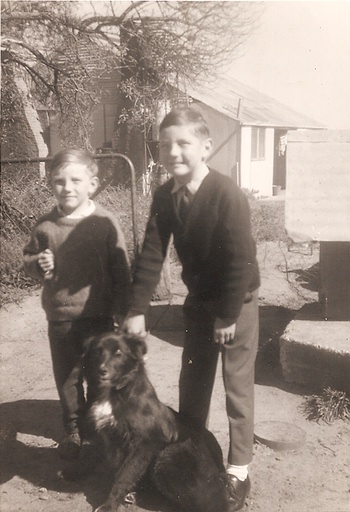
In the photo, there’s a pine tree on the right behind me and my brother. Yes, a brother. He was born in 1963, so there’s a three year gap. I’ll get to the pine tree in a moment.

On the left is the cement-brick milking shed. Immediately to its right, off in the distance so you might want to look on the embiggened photo, is the pumphouse. And then the truck, well, that’s just a truck — although my father built it like Dr Frankenstein from bits of other, dead, trucks.

Just behind the truck’s engine compartment is dad’s shed, a crumpled heap of corrugated iron that’s no longer there. It was poorly lit and full of tools and wood scraps and junk and half a dozen unfinished projects. I didn’t like going in there, it was creepy. Strange creatures lived in the dark corners and would kill small children, I know that for sure.

Even if they were good children.

Mum and dad were pretty busy most of the time. My brother and I were left to our own devices. The huge open spaces of the farm, the sheds, the random bits of equipment all meant I could invent my own imaginary world.

Every trip out with the dogs — and the dogs went everywhere with us and took care of us, so we couldn’t possibly get into any trouble — became some sort of combat patrol.

But watch out for the snakes!

Continue reading “50 to 50 #5: Dangerous play”

50 to 50 #4: Poor, with cheap holidays

One core issue affected everything while we were living on our farm at Mount Compass: we were poor.

I suspect my father’s enthusiasm to have his own patch of land blinded him to the economic realities of trying to run this property as a dairy farm. He presumably bought it cheap after the drought of 1961, but I’m told the bank manager was sceptical — even though he still approved the loan.

The facilities were basic. The milking shed was a simple cement brick rectangle with a corrugated iron roof. The dams and concrete water tank were only constructed later, and initially the sole water source was the bore and its unreliable pump.

One image that stays with me is my father in the middle distance, striding through the overgrown bracken over to the pumphouse, often in heavy rain or even a storm, to get that damn pump working again.

The house was basic too, but more about that another time. And I’ll talk about the effects of being poor later too.

Today, though, the three factors that caused the farm’s continual financial struggles, and an explanation of that photo.

Continue reading “50 to 50 #4: Poor, with cheap holidays”

50 to 50 #3: Mount Compass dairy farm

My father hated working for other people. He always wanted to be his own man. So some time in 1962, when I was about two years old, he took me and my mother to live on a dairy farm at Mount Compass.

Sure, as I mentioned last time, in 1961 we lived on a farm near Kersbrook. But dad was just a labourer there, living in a worker’s cottage. His dream was to create a home for his wife and family. So to Mount Compass it was, and a 120-acre dairy farm on Lanacoona Road, Pages Flat, where we lived until 1971.

The boundary of the farm is still the same today. It’s even marked in Google Maps so, as usual, there’s a map over the jump.

The photo above was taken some time around 1962 or 1963. That’s Fern, one of the cows. I’ve marked the spot on the map where this photo was taken from.

Yes, the farm was so small that each cow was known by name. There were 25 to 30 cows “in milk” at any one time, plus perhaps four to six heifers, half a dozen calves and a bull. Plus two dogs and four cats.

Every cow gets pregnant every year — that’s how come they’re always lactating. But why aren’t there as many calves as cows? Well, some of the the female calves are kept, to grow into milking cows. Others are sold to other farmers. But you really only need one or two bulls to keep all the cows pregnant — yeah, dairy bulls have a pretty good life. So the other male calves are what we call “veal”.

The farmhouse is barely visible between the trees immediate above the cow’s head. I’ll post some more photos of that soon. Then from right to left we’ve got: a small shed where we kept the car; a high-roofed sideless shed where we kept the tractor and stored hay; the milking shed immediately above the cow’s tail; and finally a small run-down structure which was “dad’s shed”, full of tools and scraps of wood and a workbench where he was always at work on something that was probably never going to be finished.

I must say, I’m a little overwhelmed looking at the map and the photos and trying to decide what to write about.

Continue reading “50 to 50 #3: Mount Compass dairy farm”