50 to 50 #5: Dangerous play

[This post is part of the series 50 to 50, fifty posts in the lead-up to my 50th birthday in May. Originally intended to be one per day, with the final one on the birthday itself, it’s been disrupted by my work schedule. There will still be fifty posts, just not one per day.]
The great thing about growing up on a farm is that there’s about eleventy hundred ways of killing yourself and you get to try them all.

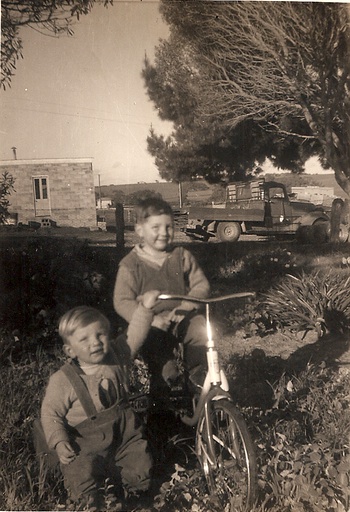
In the photo, there’s a pine tree on the right behind me and my brother. Yes, a brother. He was born in 1963, so there’s a three year gap. I’ll get to the pine tree in a moment.

On the left is the cement-brick milking shed. Immediately to its right, off in the distance so you might want to look on the embiggened photo, is the pumphouse. And then the truck, well, that’s just a truck — although my father built it like Dr Frankenstein from bits of other, dead, trucks.

Just behind the truck’s engine compartment is dad’s shed, a crumpled heap of corrugated iron that’s no longer there. It was poorly lit and full of tools and wood scraps and junk and half a dozen unfinished projects. I didn’t like going in there, it was creepy. Strange creatures lived in the dark corners and would kill small children, I know that for sure.

Even if they were good children.

Mum and dad were pretty busy most of the time. My brother and I were left to our own devices. The huge open spaces of the farm, the sheds, the random bits of equipment all meant I could invent my own imaginary world.

Every trip out with the dogs — and the dogs went everywhere with us and took care of us, so we couldn’t possibly get into any trouble — became some sort of combat patrol.

But watch out for the snakes!
Continue reading “50 to 50 #5: Dangerous play”

50 to 50 #4: Poor, with cheap holidays

One core issue affected everything while we were living on our farm at Mount Compass: we were poor.

I suspect my father’s enthusiasm to have his own patch of land blinded him to the economic realities of trying to run this property as a dairy farm. He presumably bought it cheap after the drought of 1961, but I’m told the bank manager was sceptical — even though he still approved the loan.

The facilities were basic. The milking shed was a simple cement brick rectangle with a corrugated iron roof. The dams and concrete water tank were only constructed later, and initially the sole water source was the bore and its unreliable pump.

One image that stays with me is my father in the middle distance, striding through the overgrown bracken over to the pumphouse, often in heavy rain or even a storm, to get that damn pump working again.

The house was basic too, but more about that another time. And I’ll talk about the effects of being poor later too.

Today, though, the three factors that caused the farm’s continual financial struggles, and an explanation of that photo.

Continue reading “50 to 50 #4: Poor, with cheap holidays”

50 to 50 #3: Mount Compass dairy farm

My father hated working for other people. He always wanted to be his own man. So some time in 1962, when I was about two years old, he took me and my mother to live on a dairy farm at Mount Compass.

Sure, as I mentioned last time, in 1961 we lived on a farm near Kersbrook. But dad was just a labourer there, living in a worker’s cottage. His dream was to create a home for his wife and family. So to Mount Compass it was, and a 120-acre dairy farm on Lanacoona Road, Pages Flat, where we lived until 1971.

The boundary of the farm is still the same today. It’s even marked in Google Maps so, as usual, there’s a map over the jump.

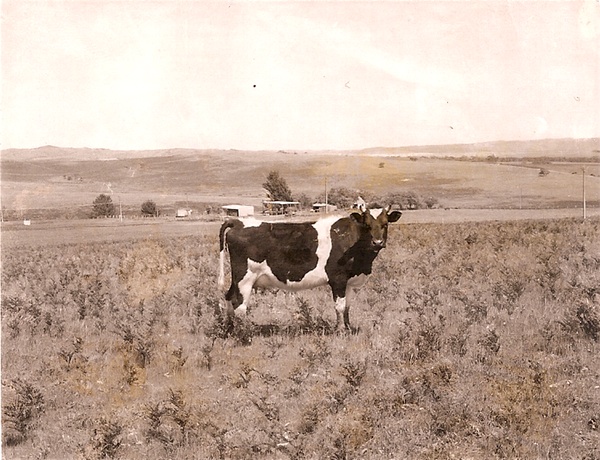
The photo above was taken some time around 1962 or 1963. That’s Fern, one of the cows. I’ve marked the spot on the map where this photo was taken from.

Yes, the farm was so small that each cow was known by name. There were 25 to 30 cows “in milk” at any one time, plus perhaps four to six heifers, half a dozen calves and a bull. Plus two dogs and four cats.

Every cow gets pregnant every year — that’s how come they’re always lactating. But why aren’t there as many calves as cows? Well, some of the the female calves are kept, to grow into milking cows. Others are sold to other farmers. But you really only need one or two bulls to keep all the cows pregnant — yeah, dairy bulls have a pretty good life. So the other male calves are what we call “veal”.

The farmhouse is barely visible between the trees immediate above the cow’s head. I’ll post some more photos of that soon. Then from right to left we’ve got: a small shed where we kept the car; a high-roofed sideless shed where we kept the tractor and stored hay; the milking shed immediately above the cow’s tail; and finally a small run-down structure which was “dad’s shed”, full of tools and scraps of wood and a workbench where he was always at work on something that was probably never going to be finished.

I must say, I’m a little overwhelmed looking at the map and the photos and trying to decide what to write about.

Continue reading “50 to 50 #3: Mount Compass dairy farm”

50 to 50 #2: Photos from 1 year old

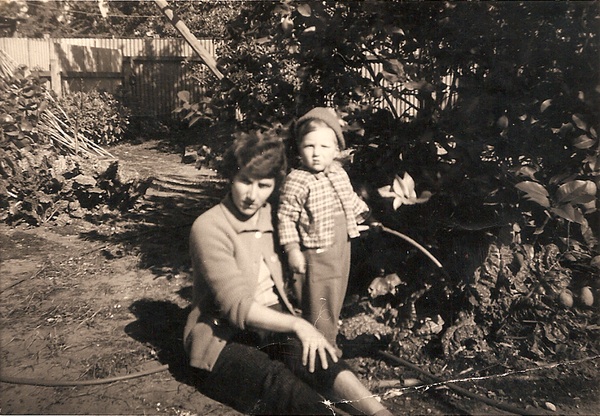
Since the first post in this series included a photo of me and my father, it’s only sensible that today you see my mother.

I’m fairly sure this photo was taken at the same home at 43 Adelaide Road, Gawler that I mentioned last time. There’s other photos from that time too, and I’ve just now posted them on Flickr.

However I’m told that in 1961 we moved to live on a farm near the village of Kersbrook in the Adelaide Hills — although I have no memory of this at all. As shall now be usual, there’s a map over the jump.

I do have memories of the Gawler house, though. Fuzzy ones. Lying in a pram looking at the plaster mouldings in a white ceiling. The green leaves of the nasturtium plants in the back garden contrasting with the reddish brown of the corrugated iron fence. The yellow of the pumpkins.

Continue reading “50 to 50 #2: Photos from 1 year old”

50 to 50 #1: Born in Gawler

Fifty days from today is my 50th birthday. Yes, Five Zero. This is the first in a series of blog posts to celebrate that milestone.

I’m not quite sure how this will unfold, except that each day I’ll find a photo or object or concept that relates to the year of my life in question — in this case that’s, erm, gulp, 1960 — and see what emerges.

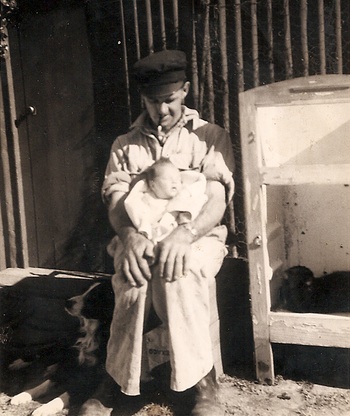
Today’s photo was taken when I was just six weeks old.

That’s my father holding me. He was 35 years old. Yes, rather old for that era, but he’d been married before and had a daughter. The fact that he divorced and re-married was so scandalous in rural South Australia that the daughter was taken away to live with her grandparents and they cut off all contact with him. The first time I met anyone from my father’s side of the family was at his funeral a decade later.

And yes, dad is smoking around the baby. Different times, eh? Not the ever-present pipe I remember him for, but a black Bakelite cigarette holder.

The dog’s name was Toby.

The photo would have been taken by my mother using a Kodak Box Brownie camera in the back yard of our house at 43 Adelaide Road, Gawler. The house is still there, but with what looks like a really low-grade renovation.

I’ll also be posting photos at Flickr (there’s another 6-weeks-old image there already) and mapping locations at Google Maps (see over the jump).

Continue reading “50 to 50 #1: Born in Gawler”

Notes on Obama’s election campaign

[Last week, Australia’s Finance Minister Lindsay Tanner wrote about Government 2.0 in The government wants to blog. Later today ABC Radio wants me to talk about how Barack Obama’s presidential election campaign used social media and social networking, so I’ve been reviewing my liveblog of the presentations made by Ben Self at Media 09 and Joe Trippi at the Microsoft Politics and Technology Forum. Trippi has worked on various Democrat campaigns including as campaign manager for Howard Dean‘s 2004 unsuccessful presidential nomination campaign. Self’s company Blue State Digital managed Obama’s online fundraising, constituency-building, issue advocacy, and peer-to-peer online networking during the primaries. I figured I might as well share my notes. Enjoy.]

More than two years since Barack Obama’s presidential election campaign, the numbers are still staggering. $770 million was raised, roughly 65% of that online. There were 3.2 million individual donors, with the average donation under $100.

This is completely different from traditional political fundraising, which revolved about dinners and other events costing $2300 a ticket — the maximum unreportable donation donation allowable from a couple at that time under US electoral laws. Obama’s campaign really did reach out and mobilise millions of ordinary Americans.

Yes, millions. The progressive Democratic Party network is now 15 million people online.

Online social networking tools made all this possible, sure, but the success came through the clever application of those tools. The key word here is “personal”.

Continue reading “Notes on Obama’s election campaign”