Govt Internet filtering plan “quarter-baked, at best”

Photograph of Irene Graham

Free speech campaigner Irene Graham (pictured) has updated her page on the Australian government’s Internet filtering plan.

Very little detail has been made publicly available, although the Labor Party (ALP) announced a mandatory ISP filtering policy in 20 March 2006. Two years later, all indications are that their “plan” is still quarter-baked at best.

A good non-technical summary, opening with a great quote:

“[P]reventing information flow, communication or the exchange of art, film and writing on the internet is a task only King Canute would attempt.”
— Bob Debus, (then) NSW Attorney General, Speech at the OFLC International Ratings Conference 2003.

Ms Graham also has a quick world tour of Internet blocking. For a good technical summary, Electronic Frontiers Australia’s paper is still one of the best.


How clean is Labor’s “clean feed” Internet?

Crikey logo

The ALP’s grand vision of a “clean feed” Internet safe for Aussie kids is meant to filter out — what, exactly? Labor’s pre-election policy [PDF file] seemed to give the proposed ISP-level filters wide scope indeed, blocking content “inappropriate” or “harmful” for children — however that’s defined. But evidence given to Senate estimates last night suggests it’s little more than what’s already in place.

As I’ve written in Crikey before [1, 2] debate is clouded because sometimes people talk about Internet filtering in terms of child pornography and other very-illegal “prohibited content”, and other times it’s about material as wide-ranging as websites promoting anorexia as a lifestyle choice.

Communications minister Stephen Conroy hasn’t helped by labelling free speech advocates watchers of kiddie porn.

Last night Senator Conroy confirmed that the trial of ISP-level filtering is on schedule. The contract has been issued; the report’s due back on 30 June. But what’s actually being filtered, beyond ACMA’s existing blacklist of about 800 URLs of “prohibited content”? No-one knows. A Ms O’Loughlin from ACMA told us they “haven’t completed discussions” with the Minister’s office about that.

Continue reading “How clean is Labor’s “clean feed” Internet?”

Lessons from tacky Heath Ledger jokes, final edition

It’s nearly a month since I posted my tacky Heath Ledger joke page. What have we learned? Truth be told, not a lot more than I wrote in the Day 1 lessons and the items tagged “heath ledger”.

But let’s look at the total traffic anyway, this time using a graph from Google Analytics which shows visits only visitors to the jokes page.

Graph of one month of Heath Ledger-related traffic

As of just now, there’s been 11,717 page views in total, representing 8,798 unique visitors who stayed on average for 3 mins 44 secs per visit — quite respectable!

Traffic took a couple of days to peak — the first day being fuelled by Google Adwords — with a secondary peak the following week when Ledger’s funeral arrangements hit the news. Google rates the peaks as about 1000 visits a day and even now, a month later, we’re still seeing 60 to 80 visits a day.

As for the jokes themselves, well… to be honest I really don’t want to read them again. Most of them were crap. If you’ve got any astounding sociological observations, feel free to post a comment.

BitTorrent vs the Supreme Court of Victoria

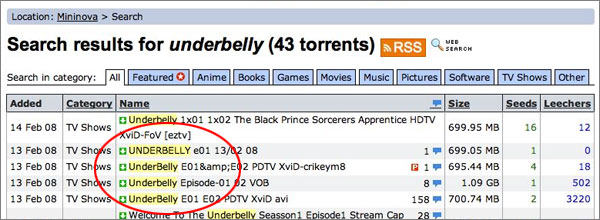
Last night Channel Nine screened the crime drama Underbelly everywhere across Australia — except Victoria, where it was banned following a Supreme Court order. But thanks to the joys of BitTorrent, thousands of people have already downloaded it from the Internet. The law cannot cope in this new era.

As the screenshot shows, Underbelly was online within two hours of broadcast. By mid-morning today, 6500+ people had downloaded it from Mininova alone.

Screenshot of Underbelly downloads available on Mininova

As with the Corey Delaney episode before it, this highlights the stupidity of the law in the bold new age of the Internet. I have no complaint with Justice Betty King’s decision. She’s just upholding the law as it stands. The law, alas, is hopelessly inadequate.

Who, I wonder, has this kind of law reform on their agenda. Anyone?

Bonus links: