
PodCamp Perth 2007: Social Media and the Federal Election

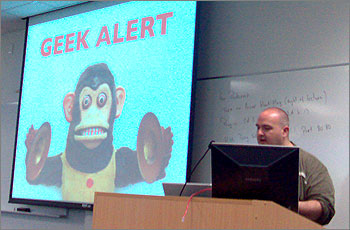
Here’s a video of my presentation from PodCamp Perth 2007.

Thanks to Stewart Greenhill for the video work. As Stephen says:

I’ve put them on Viddler because it supports long videos and has some nifty tagging and commenting features. Feel free to be social: if you see something fun or interesting just click on the green “+” button and add a comment. That way, if people don’t have time to watch the whole thing at least we can check out the highlights. If you see the word “PROGRESSIVE” in the bottom left, click on it to switch to STREAMING mode. You can skip to any point in the movie by clicking in the seek bar, or on a comment point.

Alas, the very end is missing thanks to a flat camera battery. Mind you, Stephen wasn’t the only one to “experience technical difficulties”.

[Update 15 January 2007: I believe I have a complete audio recording of the session. If there’s enough interest I’ll combine it with my slides and this video, and/or generate a transcript.]
2007: The (Second) Last TV Election

The next time someone says we’re experiencing Australia’s “first Internet election” or our “first YouTube election”, slap them. Slap them very hard.

Our politicians only see the Internet and the emerging social media as a different kind of TV. YouTube is a place to post commercials, MySpace and Facebook for media releases. Their use of social media is so clueless that geeks attending PodCamp in Perth this Saturday were laughing.

Far from this being the “first Internet election”, it’s more like the The Last Television Election. Maybe the second-last.

Continue reading “2007: The (Second) Last TV Election”

PodCamp Perth 2007: first comments

Photograph of Leslie Nassar presenting at PodCamp Perth 2007

Beer. Yes, it needs to be said. Beer. More precisely, beer and geeks. Many of both. This is my clearest memory of yesterday’s PodCamp in Perth. Other memories may return shortly, once coffee and udon work their magic. Many brain cells will not. I bid them a fond farewell.

Nick Hodge has posted a much better lead photo for PodCamp Perth, showing Cameron Reilly’s passionate opening keynote, replete with a vast image of Che Guevara. It helped me feel more comfortable using an image of Joseph Goebbels in my own session.

I’ll explain the Goebbels reference when I post a version of my presentation. I’d prefer to post something of lasting value, not a raw dump, so it might take a couple of days. Plus I want to continue the dialogue I started about social media and the federal election.

I’m also writing a piece for Crikey tomorrow, and I’ll post a version here too.

I won’t bother listing the sessions. Nick and others have already written their initial impressions, including Cameron Reilly and Simone van Hattem and Michael Minutillo… I’ll complete all the linkage later too.

But for now, a rest and a read before catching up with people at the Belgian Beer Cafe. Yes, beer. Again.

NetAlert filter is crap, as expected

The government’s claim they can “protect the kiddies from teh Internet” with a magic filter is bound to be crap, because every review of said filters has revealed flaws. Many, many flaws. But perhaps this time things are different because, y’know, technology advances?

No.

Peter Bowditch downloaded Integard, one of the filters us taxpayers are paying for through the government’s NetAlert program, and was unimpressed.

Continue reading “NetAlert filter is crap, as expected”

Political advertising “blackout” loophole. Or not.

There’s a “blackout” on political advertising in electronic media the last three days before an election — but not on the Internet. Is this a loophole which needs closing? Or is the blackout a pointless relic from the past?

The rules on electoral advertising include this blackout…

…to ‘provide a “cooling off period” for electors to consider their stance on the issues without the influences of electronic media advertising’. This provision had been in place for about 50 years before being deemed unnecessary in 1991 when a complete election advertising ban was imposed. However, it was re-enacted in 1992 after a High Court decision declared the complete ban invalid. The ‘blackout’ can also be seen to prevent parties making claims late in election campaigns that cannot be scrutinised before election day.

But political parties will be able to continue broadcast-style advertising over the Web.

Continue reading “Political advertising “blackout” loophole. Or not.”

MP3 spam

Is this a new kind of spam? MP3 spam! An email I received overnight had no content apart from an MP3 audio file — which was a voice-synthesized announcement of whatever it was they were selling.