Talking about DDoS attacks on ABC TV’s “The Business”

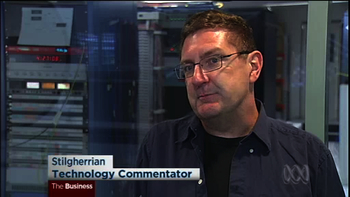
Screenshot from ABC TV's The BusinessA strange thing happened yesterday. A distributed denial service (DDoS) attack, a big one, got reported in the mainstream media as having somehow all but crippled the internet — despite all the journalists presumably continuing to use the internet as usual.

“The internet around the world has been slowed down,” reported the BBC. Um, no.

Now I won’t go through all the details here, because eventually they were properly reported elsewhere and I’m writing it up for Technology Spectator in a piece to be published Tuesday morning. The short version is that a nuanced report on Kaspersky Lab’s Threatpost lost its nuance in the mainstream media, a process helped along by a data-plotting error in early reports. People like Gizmodo hosed down the bulldust.

However I was interviewed by ABC TV’s The Business yesterday, along with Patrick Gray of the Risky Business information security podcast and Ty Miller from penetration testing firm Pure Hacking.

If the embedded video doesn’t work, try the version at the ABC’s website. In both cases the video is ©2013 Australian Broadcasting Corporation.

I’ll also be talking about this DDoS attack on ABC News24 tomorrow morning at 1010 AEDT — and after both of those I’ll ponder the way the media handled this whole thing.

Talking Yahoo!, Summly and more on ABC Local Radio

ABC logoThe $30 million purchase of internet startup Summly by Yahoo!, the fourth most-visited online service, certainly attracted media attention today — thanks to founder Nick D’Aloisio being just 17 years old. So yeah, I did some radio.

I’ve just finished talking about that — and a whole bunch of semi-related issues like robot journalists and data mining — on ABC Local Radio around NSW with Rosie Beaton, who’s filling in for regular presenter Dom Knight.

I thought we’d talk for maybe five minutes, but it ended up being a 20-minute chat. Here’s the entire audio.

The audio is of course ©2013 Australian Broadcasting Corporation, archived here because it isn’t being archived anywhere else.

Algorithms and the Filter Bubble: UTS guest lecture

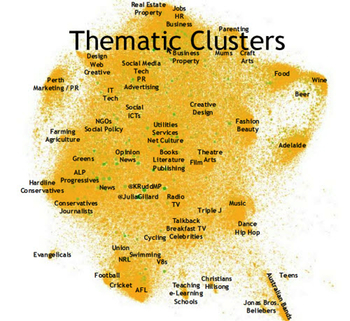
Diagram of the Australian political Twitterverse: click for article "Twitter mapping and how we choose our own adventure"On Monday I’m delivering a guest lecture at the University of Technology Sydney. “Algorithms and the Filter Bubble” is the supplied title, and in theory I’ll be looking at Google (and friends), big data and personalised news filtering.

The students — who are, I’m told, “first and second year students who are at the beginning of their media studies degrees” — have been given some pre-reading: Eli Pariser’s book The filter bubble: what the Internet is hiding from you (specifically the chapter “The User is the Content”, pages 47-76 in the edition I’ve seen; check the Wikipedia summary), and David Beer’s paper “Power through the algorithm? Participatory web cultures and the technological unconscious”. I’m about to read them myself.

But I reckon the bleeding-edge action here is in advertising, not news, and especially the comprehensive data mining that allows, for example, Target in the US to figure out that a woman is pregnant just by her shopping list.

After I discussed these topics with the lecturer, I sent her a list of related material I’d written. I believe this has been sent to the students.

I also linked to my presentation at Consilium 2012: Social media is destroying society? Good!

Since then, ProPublica has posted an excellent article, Everything We Know About What Data Brokers Know About You.

I don’t know if non-students are allowed in, but the lecture is on Monday 25 March at 1300 AEDT in Room 56, Level 3, Building 6 (Peter Johnson Building), University of Technology Sydney, 702-730 Harris Street, Ultimo. In any event, I’ll be recording it and will post the audio and transcript here in due course.

For now, though, I suppose I should write the damn thing.

Talking crimefighting smartphones on The Project

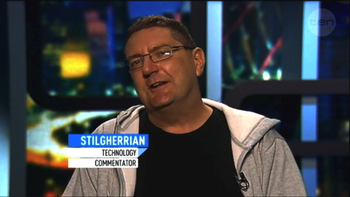
Screenshot of Stilgherrian on The Project, 14 March 2013The trial of the alleged murderer of Melbourne journalist Jill Meagher revealed (at least to those who were previously unaware) the importance of evidence gleaned from people’s smartphones.
Last Thursday 14 March I ended up talking about that on Channel TEN’s The Project, following a package that featured Gizmodo Australia editor Luke Hopewell.

Just like my previous appearance on The Project, which is produced in Melbourne, I was beamed in from Sydney while sitting in front of a green screen. This time I even managed to get a picture of what it looked like from my point of view.

The video of the four-minute segment is embedded over the jump — which is immediately below if you’ve come directly to this page.

Continue reading “Talking crimefighting smartphones on The Project”

Talking the ABC hack on “7.30”

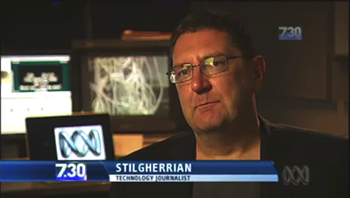
Screengrab of Stilgherrian on "7.30": click for storyI was interviewed by ABC TV’s current affairs program 7.30 on Wednesday about the hack of an ABC website, in a story called Hacker attacks ABC, private information released.

The hack was apparently in revenge for the Lateline interview with controversial Dutch politician Geert Wilders. The tweet claiming responsibility for the attack used the #OpWilders hashtag, the label for Anonymous’ ongoing protects against Wilders, but the operators of known Anonymous social media accounts are distancing themselves from this one.

Parts of the interview were also used in that night’s episide of Lateline, and a written story for ABC News Online.

It’s my third appearance on 7.30. I’ve previously spoken about the News of the World voicemail hacks and Anonymous’ hack of Stratfor.