
I’m in Crikey again today, this time with a piece called The Internet’s feral goldfish get it very wrong. It’s free for all to read and, yes, it introduces the world to my “feral goldfish” concept. Vive les poissons rouges sauvages!

Word-whore. I write 'em. I talk 'em. Information, politics, media, and the cybers. I drink. I use bad words. All publication is a political act. All communication is propaganda. All art is pornography. All business is personal. All hail Eris! Vive les poissons rouges sauvages!
I’m in Crikey again today, this time with a piece called The Internet’s feral goldfish get it very wrong. It’s free for all to read and, yes, it introduces the world to my “feral goldfish” concept. Vive les poissons rouges sauvages!
Crikey‘s Bernard Keane has written a magnificent 2000-word wrap of the year in Australian politics, 2008: Dashed dreams and mouldy political compromise. Every sentence is worth reading — but especially his observations about the links between politicians and the media.
Politics is more or less based around people of high principles and good will discovering that the obtaining and exercising of power involves doing bad things, distasteful things, amoral things, involves unpleasant trade-offs and not just the famous half-loaves of compromise but stale, mouldy crusts. And it’s all the more that way because its symbiotic partner, its Siamese twin the media, dislikes complexity and nuance, in favour of the same simple narratives, repeated with an ever-changing cast of characters but the same plots and moral lessons over and over again. That’s what sells. And what gets votes.
It’s the media’s job, or one of them, to make much of little and it has done that expertly for much of the year, as it does always. History suggests that, barring incompetence on an inordinate scale, Labor will be in power for several terms, but that’s not going to attract many eyeballs. Instead, the most minor political events are forensically analysed, with each tiny feature placed under the microscope so that it looms large to the viewer despite its irrelevance. Recall The Australian’s concerted push for Peter Costello mid-year, undoubtedly motivated not just by a sense of mischief-making but by the moderate inclinations of the obvious alternative to the failing Nelson. After more than a year on the backbench, not a scintilla of evidence has emerged that Peter Costello ever intended to do anything other than what he said, which was to remain on the backbench until he found a job outside politics. And yet we — as in all of us — devoted many pixels and column inches to his imminent ascension, or the unlikelihood thereof.
Afterwards, we forgot all about that, and probably hoped our readers did too.
Never forget the media has a vested interested in convincing you something is happening even when precisely nothing is happening — indeed, particularly when nothing is happening. It is thus wise – and I’m possibly not telling you anything you don’t already know here — to retain a strong scepticism about all political reportage and analysis, no matter the source. We’re all selling something.
OK, I’m biased. I write for Crikey every now and then. But this is why I’d buy it anyway.
If there’s a problem with some product which puts you at risk, you’d expect news bulletins to explain your safest options, yeah? But is that possible when the media outlet is a key business partner of the product’s manufacturer?
Yesterday’s zero-day exploit for Microsoft’s Internet Explorer is a real risk. But Channel Nine’s story last night didn’t include options like using a non-Microsoft web browser. Was this just the journalist’s ignorance of computers? Or is it because of Nine’s 50/50 business partnership with Microsoft in one of Australia’s busiest websites, NineMSN?
That’s what I ask in Crikey today. The article isn’t behind their paywall, so it’s free for all to read.
[This essay was written for the Media Entertainment & Arts Alliance‘s report Life in the Clickstream: The Future of Journalism [PDF], to be launched in Melbourne today. It was published under the title “Smart brains find ways to spread the message” and trimmed to fit the space available. This version includes all of the extracts from @smartbrain’s Twitter stream which I’d originally supplied.]
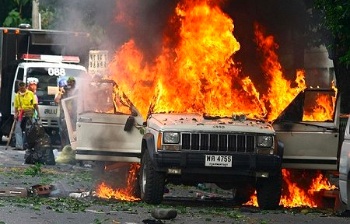
Bangkok, 7 October 2008. A Jeep explodes near parliament, killing a man. Body parts are thrown up to 20 metres.
Meanwhile, 5,000 members of the royalist People’s Alliance for Democracy are occupying the Government building grounds — well-organised but largely peaceful. Thailand’s Constitutional Court forced Prime Minister Samak Sundaravej to resign a month earlier, but his successor Somchai Wongsawat is seen as a corrupt puppet. PAD has given him until 6pm to resign. He does not. The car bomb detonates. The ultimatum expires. The demonstration explodes into riot.
Tear gas. Gunfire. 381 injured. Another death. It’s the worst violence in 16 years.
Meanwhile, in Sydney, my ex-pat Thai partner and I are sinking beers. We take our laptops online but not even Thai news outlets say what’s happening now.
Then, using Twitter, we find @smartbrain.
The Christmas decorations are in the shops, people are having Christmas parties, the current affairs programs are off TV, so the year has ended, right? What do you mean, your calendar has something called “December”? Bah! This is the 21st Century! One-twelfth of the year is just thrown away!
Back in January I made some Predictions for 2008. Since 2008 has already ended, let’s see how I went.
’Pong and I have returned home safely from Cowra, a 655km round trip, thanks to the wonders of Matthew Hall and the Success Whale. All hail the Success Whale! (Except Stephen Stockwell, unbeliever.)
The journey home was enlivened with an interesting experiment. Instead of me broadcasting Stilgherrian Live — bright TV lights in a moving car at night would be a plan full of FAIL — we created an inside-out radio station. Some of my followers on Twitter took up the offer to send us links to music — which we streamed live from YouTube. The audience chose the music and we listened to it.
This experiment in crowdsourcing a playlist was remarkably successful. I’ll publish the music later. But even more remarkable was the power of the hyperconnectivity. Even though we were driving through rural New South Wales, we were still in touch with our friends — wherever they were too — doing the usual things we do of an evening, like swap links and tell each other bad jokes.
I’ll have much more to say about this soon. But for now I must rest.