

The US has confirmed that it has weapons in space, although it hasn’t explained what kind. So let’s do an episode on space with space archaeologist Dr Alice Gorman aka Dr Space Junk and astrophysicist Rami Mandow. What a shallow excuse!
In this episode we also discuss how planets and asteroids and their features get their names, Millisecond Pulsar PSR J0437-4715, whether alien civilisations are hiding in Moon dust, the Bepicolombo mission to Mercury, and much more.
This podcast is available on Amazon Music, Apple Podcasts, Castbox, Deezer, Google Podcasts, iHeartRadio, JioSaavn, Pocket Casts, Podcast Addict, Podchaser, Spotify, and Speaker.
You can also subscribe to the generic podcast feed.
Bonus Photo
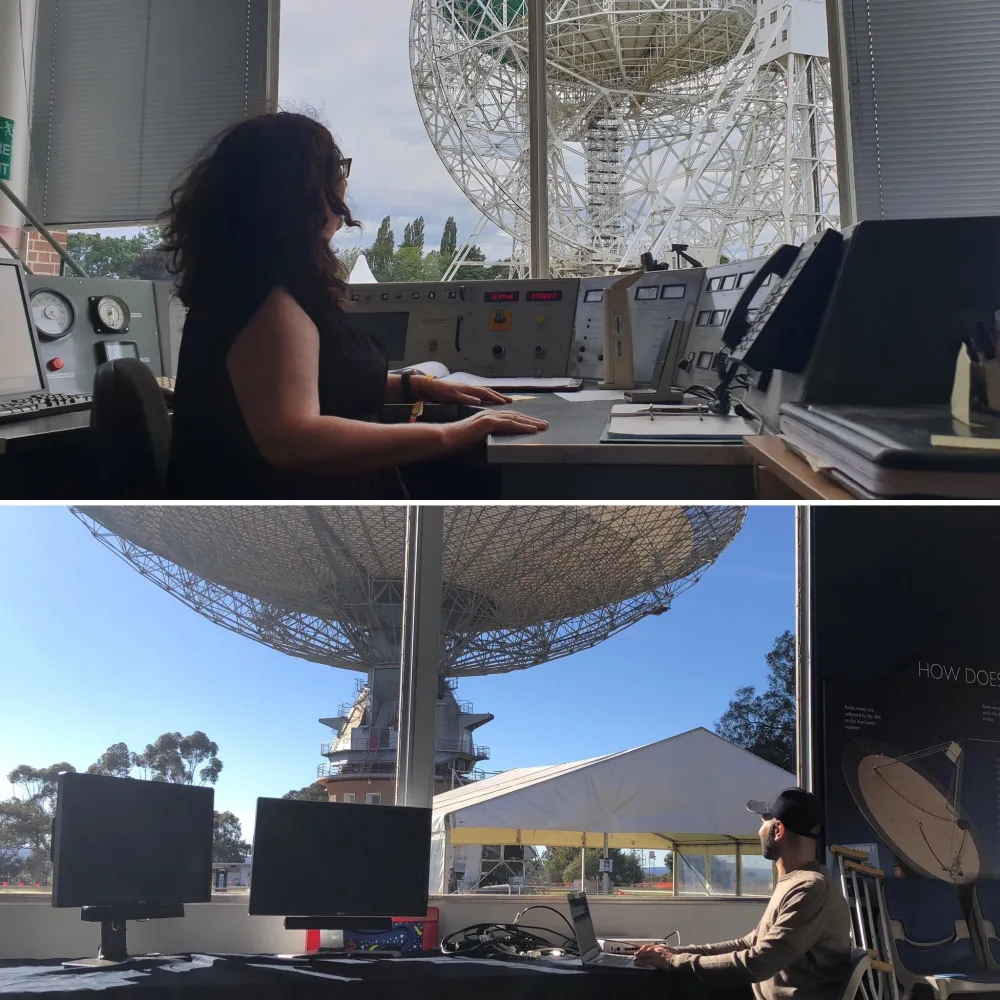
Episode Links
-
Alice Gorman (born 1964) FSA is an Australian archaeologist, heritage consultant, and lecturer, who is best known for pioneering work in the field of space archaeology and her Space Age Archaeology blog.
-
Astronomer, driving The Dish? to study pulsars in my PhD. Also, founded SpaceAustralia.com. Also, love a bit of astrophotography. Also, do everything with my little mate, Max. Also, Ultra-Gay. He/Him.
-
[15 September 2026] US Secretary of the Air Force Troy Meink said the "on orbit" weapon was necessary to safeguard US forces against hostile enemy action.
-
[15 September 2026] The announcement by the United States that it has deployed a space weapon in Earth's orbit has raised questions about what weaponry is actually in space, and what role it could play in efforts by great powers to dominate that arena.
-
[20 September 2026] Scott Bessent and He Lifeng meet in New York for US-China talks ahead of the Trump-Xi meeting later this week.
-
[9 September 2026] Trump shared the as-yet unconfirmed design on Truth Social on 7 September, showcasing dramatic flair of dark grey and black uniforms featuring high collars, matching trousers, belts, peaked caps, and high black boots. The concept is reportedly ‘inspired by the discipline and functionality of the Starship Trooper uniform, modernised for the Guardians of the space domain’, according to the statement. The post quickly attracted criticism because of its reference to the 1997 film Starship Troopers that deliberately uses fascist-inspired imagery as a satire of militarism and authoritarianism.
-
The Boeing X-37, also known as the Orbital Test Vehicle (OTV), is a reusable robotic spacecraft. It is boosted into space by a launch vehicle, re-enters Earth's atmosphere, and lands as a spaceplane. The X-37 is operated by the Department of the Air Force Rapid Capabilities Office, in collaboration with the United States Space Force,
-
The TP-82 (Russian: ??-82) is an out-of-service triple-barreled Soviet combination gun carried by cosmonauts on space missions. It was intended as a survival aid to be used after landings and before recovery in the Siberian wilderness.
-
The Polyus spacecraft (Russian: ?????, pole), also known as Polus, Skif-DM, GRAU index 17F19DM, was a prototype Soviet orbital weapons platform designed to destroy Strategic Defense Initiative satellites with a megawatt carbon-dioxide laser.
-
The Almaz (Russian: ?????, lit.?'Diamond') program was a highly secret Soviet military space station program, begun in the early 1960s... In addition to reconnaissance equipment, Almaz was equipped with a unique Rikhter R-23 23mm (factory index 261P or 225P) rapid-fire cannon mounted on the forward belly of the station. This revolver cannon was modified from the tail-gun of the Tupolev Tu-22 bomber... To aim the cannon, which was on a fixed mounting, the entire station would be turned to face the target.
-
The Salyut programme (Russian: ?????, IPA: [s??l?ut], meaning "salute" or "fireworks") was the first space station programme, undertaken by the Soviet Union. It involved a series of four crewed scientific research space stations and two crewed military reconnaissance space stations over a period of 15 years, from 1971 to 1986.
-
General Zod deploys the 'World Engine" that will destroy earth by transforming it into a 'Krypton-Like' planet.
-
Weaponry that appears in Alastair Reynolds' Revelation Space universe. From simple to highly advanced.
-
The Moon Is a Harsh Mistress is a 1966 science fiction novel by American writer Robert A. Heinlein about a lunar colony's revolt against absentee rule from Earth... Luna's government deploys its catapult weapon. When Mike launches rocks at sparsely populated locations on Earth, warnings are released to the press detailing the times and locations of the bombings, which deliver kinetic energy equivalent to atomic blasts. Scoffers, sightseers, and religious groups who travel to some of the sites die, turning Earth public opinion against the fledgling nation.
-
A kinetic bombardment or a kinetic orbital strike is the hypothetical act of attacking a planetary surface with an inert kinetic projectile from orbit (orbital bombardment), where the destructive power comes from the kinetic energy of the projectile impacting at very high speeds. The concept originated during the Cold War.
-
In various works of speculative fiction, a portable hole is a two-dimensional device that can be used to contravene the laws of physics by creating a passage through a solid surface, through which characters can move. Notable uses: The 1955 Looney Tunes cartoon, The Hole Idea, presents a fictional account in which Calvin Q. Calculus invents the device...
-
The Death Star is a fictional massive space station and superweapon featured in the Star Wars space-opera franchise. Constructed by the autocratic Galactic Empire, the Death Star is capable of obliterating entire planets, and serves to enforce the Empire's reign of terror.
-
[14 September 2026] Using approximately seven years of observations obtained with the Ultra-Wideband Low-Frequency receiver on Murriyang, CSIRO's Parkes radio telescope, we investigate the long-term spectro-polarimetric variability of PSR J0437-4715. We report the discovery of two consecutive discrete profile change events exhibiting the same phase-localised morphological variations, the first such behaviour reported in any MSP.
-
The radial pattern on the left of the plaque shows 15 lines emanating from the same origin. Fourteen of the lines have corresponding long binary numbers, which stand for the periods of pulsars, using the hydrogen spin-flip transition frequency as the unit. Since these periods will change over time, the epoch of the launch can be calculated from these values.
-
[28 January 2026] A kilometre beneath the surface of regional Victoria, scientists are preparing to switch on one of Australia’s most ambitious physics experiments. Nearing completion, the facility will soon host a sensitive dark matter detector designed to search for elusive particles thought to make up a quarter of the Universe’s mass. Dr Katie Mack and Rami Mandow visited the site to see the project taking shape.
-
[2 September 2026] Dark matter, an elusive substance that permeates the universe, has flummoxed scientists for decades. But a single flash of energy spotted by the world's most sensitive detector of its kind is the "most compelling hint reported to date", according to an international team of physicists.
-
In astronomy and cosmology, dark matter is an invisible and hypothetical form of matter that does not interact with electromagnetic radiation, including light... In the standard Lambda-CDM model of cosmology, the mass–energy content of the universe is 5% ordinary matter, 26.8% dark matter, and 68.2% a form of energy known as dark energy. Thus, dark matter constitutes 85% of the total mass, while dark energy and dark matter constitute 95% of the total mass–energy content.
-
Edwin Powell Hubble (November 20, 1889 – September 28, 1953) was an American astronomer. He played a crucial role in establishing the fields of extragalactic astronomy and observational cosmology. Hubble proved that many objects previously thought to be clouds of dust and gas and classified as "nebulae" were actually galaxies beyond the Milky Way.
-
Radio astronomy is a subfield of astronomy that studies celestial objects using radio waves. It started in 1933, when Karl Jansky at Bell Telephone Laboratories reported radiation coming from the Milky Way.
-
The first published recognition of the CMB [cosmic microwave background] radiation as a detectable phenomenon appeared in a brief paper by Soviet astrophysicists A. G. Doroshkevich and Igor Novikov, in the spring of 1964.
-
In cosmology, the steady-state model or steady-state theory was an alternative to the Big Bang theory... Influential papers on the topic of a steady-state cosmology were published by Hermann Bondi, Thomas Gold, and Fred Hoyle in 1948.
-
The Big Crunch is a hypothetical scenario for the ultimate fate of the universe, in which the expansion of the universe eventually reverses and the universe recollapses, ultimately causing the cosmic scale factor to reach absolute zero, an event potentially followed by a reformation of the universe starting with another Big Bang.
-
The idea that there was a detectable bubble of TV transmission forging out into the galaxy since Lucy’s first show in 1951 seemed completely wondrous.
-
I Love Lucy is an American sitcom that aired on CBS from October 15, 1951, to May 6, 1957, with 180 half-hour episodes across six seasons.
-
Mount Disappointment is an 800-metre (2,600 ft) mountain on the southern end of the Great Dividing Range, 9.5 kilometres (5.9 mi) north of Whittlesea and 60 kilometres (37 mi) north of Melbourne, the state capital of Victoria, Australia. It was named by explorers Hume and Hovell in 1824, and is now a popular hiking spot.
-
Comet 81P/Wild, also known as Wild 2 (pronounced "vilt two") (/?v?lt/ VILT), is a comet with a period of 6.4 years named after Swiss astronomer Paul Wild... On August 14, 2014, scientists announced the collection of possible interstellar dust particles from the Stardust spacecraft since returning to Earth in 2006.
-
[30 June 2001] It was planned that there would be an initial fleet of four Space Shuttles. Each would be launched like a traditional rocket into Earth orbit and after it had completed its mission would land like a conventional airplane on a runway. After it had landed, the Shuttle would be refueled and serviced and could be launched again within 10 days. In 1972, when Nixon announced the approval of the Shuttle programme, NASA expected that they would be launching 50 Shuttle missions a year by the time the it was fully operational
-
Volume up and get your groove on! A bit of weekend dancing on the @iss to start your week off right. A friend of mine was shocked when she realized that it was possible to dance in microgravity. Seems we can’t keep this from the world for any longer! The power of music transcends Earth and space.
-
[20 May 2026] At Bandsplaining, we often cover music from the 1960s-present, as this marks the beginning of the electrified, psychedelic era. But this music didn't come out of a vacuum. From the late 40s to the early 60s, many experimental innovations were introduced to pop music—not from wild-haired hippies—but from a series of unassuming easy listening records, known collectively as Space Age. We'll explore how this strange genre came to be, how it changed music, and enjoy some major bangers along the way.
-
[15 September 2077] According to a new paper available as a preprint on arXiv and submitted to the International Journal of Astrobiology by Lewis J. Pinault, an associate researcher at the SETI Institute, and his co-authors, we could take a completely different approach to trying to find alien civilizations—by looking for evidence of them in lunar dirt.
-
[18 August 2026] We examine the prospects for identifying micron-scale engineered particulate material within the lunar regolith... Particulate technosignatures [may] establish an experimentally accessible form of exo-archaeology, capable of placing meaningful constraints -- and, in favourable cases, yielding direct material evidence -- of the Galaxy's technological history.
-
The Solar System is traveling at an average speed of 230 km/s (828,000 km/h) or 143 mi/s (514,000 mph) within its trajectory around the Galactic Center.
-
The Poynting–Robertson effect, also known as Poynting–Robertson drag, named after John Henry Poynting and Howard P. Robertson, is a process by which solar radiation causes a dust grain orbiting a star to lose angular momentum relative to its orbit around the star.
-
The Fermi paradox is the seeming inconsistency between the lack of evidence of extraterrestrial civilizations and the apparently high likelihood of their existence.
-
The Nancy Grace Roman Space Telescope is a NASA infrared space telescope that was launched on a trajectory toward a Sun–Earth L2 orbit on 30 August 2026 by a Falcon Heavy launch vehicle. It is named after NASA's first chief of astronomy, Nancy Grace Roman.
-
Nancy Grace Roman (May 16, 1925 – December 25, 2018) was an American astronomer who made important contributions to stellar classification and stellar motions. The first female executive at NASA, Roman served as NASA's first chief of astronomy throughout the 1960s and 1970s.
-
[31 July 2026] On July 27, technicians at NASA’s Kennedy Space Center in Florida installed a memory card containing 1,350,144 names as part of a commemorative plaque on the Nancy Grace Roman Space Telescope.
-
Jodrell Bank Observatory (/?d??dr?l/ JOD-r?l) in Cheshire, England, hosts a number of radio telescopes as part of the Jodrell Bank Centre for Astrophysics at the University of Manchester. The observatory was established in 1945 by Bernard Lovell, a radio astronomer at the university, to investigate cosmic rays after his work on radar in the Second World War. It has since played an important role in the research of meteoroids, quasars, pulsars, masers, and gravitational lenses, and was heavily involved with the tracking of Soviet and US spacecraft of the Space Race.
-
[1 September 2026] Prime Minister Andy Burnham has vowed to save the UK's largest telescope at the Jodrell Bank Observatory. The Lovell telescope, which has stood in Cheshire since 1957, is the world's third-largest steerable radio telescope.
-
The Arecibo Observatory, also known as the National Astronomy and Ionosphere Center (NAIC) and formerly known as the Arecibo Ionosphere Observatory, is an observatory in Barrio Esperanza, Arecibo, Puerto Rico, owned by the US National Science Foundation (NSF). The observatory's main instrument was the Arecibo Telescope, a 305 m (1,000 ft) spherical reflector dish built into a natural sinkhole, with a cable-mount steerable receiver and several radar transmitters for emitting signals mounted 150 m (492 ft) above the dish... On August 10 and November 6, 2020, two of the receiver's support cables broke and the NSF announced that it would decommission the telescope. The telescope collapsed on December 1, 2020. In 2022, the NSF announced the telescope would not be rebuilt, with an educational facility to be established on the site.
-
Columbo's always got one last question up his sleeve.
-
BepiColombo is a joint mission of the European Space Agency (ESA) and the Japan Aerospace Exploration Agency (JAXA) to the planet Mercury.
-
After eight years of travelling through the inner Solar System, BepiColombo is arriving at Mercury. This page will show the latest updates throughout the mission's arrival.
-
Mariner 10 was an American robotic space probe launched by NASA on 3 November 1973, to fly by the planets Mercury and Venus. It was the first spacecraft to visit Mercury and the first to perform a flyby of multiple planets.
-
MESSENGER was a NASA robotic space probe that orbited the planet Mercury between 2011 and 2015, studying Mercury's chemical composition, geology, and magnetic field.
-
Albert Namatjira (pronounced [namac?ra]; born Elea Namatjira; 28 July 1902 – 8 August 1959) was an Arrernte painter from the MacDonnell Ranges in Central Australia, widely considered one of the most notable Australian artists. As a pioneer of contemporary Indigenous Australian art, he was arguably one of the most famous Indigenous Australians of his generation. He was the first Aboriginal artist to receive popularity from a wide Australian audience.
-
CSIRAC (/?sa?ræk/; Commonwealth Scientific and Industrial Research Automatic Computer), originally known as CSIR Mk 1, was Australia's first digital computer, and is the fifth stored-program computer in the world. It is the oldest surviving first-generation electronic computer (the Zuse Z4 at the Deutsches Museum is older, but was electro-mechanical, not electronic). It was the first computer to play digital music.
-
A re-creation of CSIRO's CSIRAC computer playing "Colonel Bogey".
-
The Science Fiction comedy that dares ask the question: what if Martians were all Australian? When Space Commodore Shazza of the Martian Space Navy gets given an ultimatum - shape up or cop a demotion - she does the only thing a hung over Martian can think do to: mounts a plan to invade Earth!
If the links aren’t showing up, try here.
Thank you, Media Freedom Citizenry
The 9pm Edict is supported by the generosity of its listeners. Please check out the current season’s crowdfunder, The 9pm Spring Series 2026, this time on Ko-Fi rather than Pozible like previous campaigns.
If you miss the deadline, which I haven’t set yet, you can always throw a few coins into the tip jar or subscribe for special benefits. Please consider.
For this episode it’s thanks again to everyone who’s supported The 9pm Spring Series 2026 crowdfunder so far: Buddha Williams, Buddha Williams again, Frank Filippone, Gavin Costello, Jojoeffe, Julia D, Julia D again, Just Jim, Mark Newton, Mark Newton again, Michael, Michael again, Mimbles, Mindy, Oberon’s Ghost, Oliver Townshend, Peter Blakeley, Rick Hayman, and six generous people who’ve chosen to remain anonymous. Thank you.
Series Credits
- The 9pm Edict theme by mansardian via The Freesound Project.
- Edict fanfare by neonaeon, via The Freesound Project.
- Elephant Stamp theme by Joshua Mehlman.