Further to my post about today’s Future of Influence Summit, there’s a liveblog over at getSocialAdvice. I’ll be concentrating on a piece for Crikey, so I may or may not be taking part there much.
“Influence is the future of media”, eh?
This year, the Future of Media Summit has been replaced by the Future of Influence Summit. It’s next Tuesday 1 September, Sydney time. I’ll be going, and I can offer you a discount.
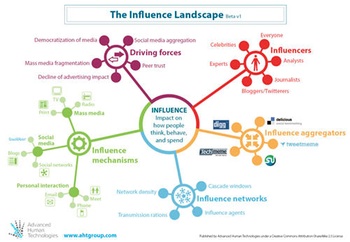
Summit-master Ross Dawson has changed the name because he reckons that influence is the future of media.
Ross writes:
We have already begun to discover this through the now-dominant concept of “social mediaâ€. In the Future of Media Strategic Framework that was launched for our Future of Media Summit 2006 we described the (symbiotic) relationship between Mainstream Media and Social Media.
Social media is all about human relationships, about how we shape our view of the world based on our peer communication. The extraordinary breadth of information and opinion that we are exposed to today, combined with the ability to converse, means our own opinions are often driven more by peers than traditional sources.
In fact this shift to the social means that media is becoming far more about peer influence than information and reporting.
This year companies globally will spend US$450 billion on advertising. The composition of advertising spend has changed dramatically over the last decade. That pace of change will rapidly accelerate in coming years. Total marketing spend is hardly set to reduce in an increasingly crowded marketplace, but it will be allocated to those activities that truly make a difference. Influence — based on conversations and aggregated opinion — will be at the centre of how companies seek to drive sales and customer engagement.
Today, people find content such as movies, music, news, books and so on primarily through aggregated channels. Instead of buying the New York Times and reading it cover to cover, people are pointed to the most relevant articles in the New York Times and elsewhere, based on what people find interesting. It is hardly new that people buy music or books because of recommendations — but now adding to their friends’ opinions and magazine reviews are a universe of influencers who provide guidance on what to buy. Influence is driving the world of content and publishing as never before, and this is just the beginning.
Last year’s Future of Media Summit was full of old media journalists and managers in denial.
It triggered my controversial essay Note to “old media” journalists: adapt, or stfu! (parts of which were even translated into French in Le Monde), a wonderful response from the MEAA’s Jonathan Este, and furthers writing from me including the essays “Trouble at t’paper” and Sunday Thoughts about Journalism.
A year later, a lot has changed — although my liveblog from Media 09 still reads as pessimistic. I’ll be interested to see what emerges, and to prepare myself I’ll be reading more of Ross’ blog over the next couple of days. Expect further posts.
Meanwhile if you want to register for the Future of Influence Summit, you’ll get 20% 25% off if you use the discount code TIESTIL.
Links for 16 August 2009 through 26 August 2009
Stilgherrian’s links for 16 August 2009 through 26 August 2009:
- Academic Earth: “Video lectures from the world’s top scholars”, it says. Provided they’re American. The universities included so far are Berkeley, Harvard, MIT, Princeton, Stanford, UCLA and Yale.
- [Air-L] Trivial tweeting: Another viewpoint on the “Twitter is pointless babble” rubbish, this time from Cornelius Puschmann, PhD, in the Department of English Language and Linguistics at the University of Düsseldorf.
- Power of Information | UK Cabinet Office: The February 2009 report from the UK government’s taskforce on Government 2.0.
- My #blogpostfriday post | Scripting News: Dave Winer is worried about the cloud. “We pour so much passion into dynamic web apps hosted by companies we know very little about. We do it without retaining a copy of our data. We have no idea how much it costs them to keep hosting what we create, so even if they’re public companies, it’s very hard to form an opinion of how likely they are to continue hosting our work.”
- 8129.0 – Business Use of Information Technology, 2007-08 | Australian Bureau of Statistics: Detailed indicators on the incidence of use of information technology in Australian business, as collected by the 2007-08 Business Characteristics Survey (BCS).
- The Work of Art in the Age of Mechanical Reproduction | Wikipedia: Someone — I forget who — told me to read this 1935 essay by German cultural critic Walter Benjamin. It’s been influential in the fields of cultural studies and media theory. It was produced, Benjamin wrote, in the effort to describe a theory of art that would be “useful for the formulation of revolutionary demands in the politics of art&”. “In the absence of any traditional, ritualistic value, art in the age of mechanical reproduction would inherently be based on the practice of politics. It is the most frequently cited of Benjamin’s essays”, says Wikipedia. Sounds like I should indeed read it.
- How Tim O’Reilly Aims to Change Government | ReadWriteWeb: Tim O’Reilly posits “government as platform”, where the government would supply raw digital data and other forms of support for private sector innovators to build on top of. That’s the writer’s version. Does this fit with the Rudd government’s idea of the government as an enabler, as outlined in their Digital Economy Future Directions paper?
- CHART OF THE DAY: Smartphone Sales To Beat PC Sales By 2011 | Silican Valley Insider: This is based on worldwide sales figures, and it makes sense. The Third World could really use a low-power, rugged smartphone at a sensible price, rather than a laptop or even a netbook to lug around.
- News Corp pushing to create an online news consortium | latimes.com: By “consortium” they mean “cartel”, right? “Chief Digital Officer Jonathan Miller has positioned News Corp as a logical leader in the effort to start collecting fees from online readers because of its success with the Wall Street Journal Online, which boasts more than 1 million paying subscribers. He is believed to have met with major news publishers including New York Times Co, Washington Post Co, Hearst Corp and Tribune Co, publisher of the Los Angeles Times.”
- Us Now : watch the film: “In a world in which information is like air, what happens to power?” This entire film can be watched online.
- Morons with mobiles sour the tweet life | theage.com.au: Jacqui Bunting writes some of the dumbest words about Twitter which have ever been written. Note to editors: Anyone who starts from the premise that Twitter is meant to be a “commentary on life” needs to be taken out the back and slapped around a bit. It’s 2009. Please catch up.
- The Conversation | Now That I Have Your Attention: The creator of Father Ted and The IT Crowd, Graham Linehan, also has a few words on Pear Analytics’ cod research on Twitter. He makes the point that for the first time we’re truly having a global conversation.
- Pointless babble | The New Adventures of Stephen Fry: The redoubtable Stephen Fry rips into that Pear Analytics research on Twitter, with more brevity and wit than I did the other day. Well said, Sir!
- Top 100 Aussie Web Startups – August 09 | TechNation Australia: The latest league table of Australian web businesses, for those who like to have winners and losers in clearly-defined categories.
- Benjamin Franklin’s daily schedule | Flickr: Proof that you don’t need the Getting Things Done (GTD) methodology to be boringly anal-retentive about your scheduling.
- Bruce Schneier: Facebook should compete on privacy, not hide it away | The Guardian: Another thought-provoking essay by Bruce Schneier.
- Hype Cycle Book | Gartner: Mastering the Hype Cycle is the book explaining Gartner’s regular Hype Cycle reports.
- How It All Ends | YouTube: A follow-up to the video The Most Terrifying Video You’ll Ever See, which presented a risk analysis showing that we cannot afford to ignore the potential risk of climate change, even if it all turns out to be wrong. This version skips over the main argument and addresses the potential objections.
- Climate change cage match | Crikey: A delightful comment from a Crikey reader, Stephen Morris, who likens the tactics of climate change denialist Tamas Calderwood to the mating habits of the Satin Bowerbird, which is totally obsessed by the colour blue. “It will actively search through a wide variety of brightly coloured objects that might suitably decorate its bower, but the only colour that interests it and it wants to collect are those coloured blue. Tamas in his scientific objectivity (and unfortunately often his logic) is very Satin bowerbird like. It doesn’t matter what large amounts of available data says about global warming, the only titbits of data of interest to Tamas, are those that can be seen to indicate cooling. Once a data set loses its blueness (or coolness), it seems interest in it is lost and other blue data sets are sought.”
- Senator Lundy describes her Public Sphere initiative | Net Traveller: A ten minute video in which Senator Kate Lundy describes her Public Sphere initiative, made for students at ANU studying Information Technology in Electronic Commerce COMP3410.
- AP contradiction: Move forward but restore | Pursuing the Complete Community Connection: Steve Buttry points out the problem with Associated Press’ content protection plan: How can you “move forward” and “restore the past” at the same time?
Links for 27 July 2009 through 03 August 2009
Here are the web links I’ve found for 27 July 2009 through 03 August 2009, posted not-quite automatically, and very late.
- Viral Wedding Video’s 10M Views Drive Chris Brown Buzz and Sales | Nielsen Wire: That “viral” (by which they just mean “popular”) video of a wedding party dancing into the church [was it a church?] reminded everyone of Chris Brown’s tedious autotune’d song again, with the result that it ended up in iTunes’ Top 10. Yet another example of how something being given away increases its sales.
- Who needs newspapers when you have Twitter? | Salon News: A massive troll by Wired editor Chris Anderson, seeking attention for his new book Free, which is not free. He starts by saying he doesn’t use the words “media” or “news” or “journalism”, but doesn’t offer any alternatives. Wanker.
- Techfest 2009 | NICTA: On 12 August 2009, NICTA showcases some of the new ICT research and development they’ree working on at this most-of-the-day event in Sydney. Let me know if you’d like to join me.
- Women In Film | YouTube: A morph-montage of some of the most famous female faces in film. Note how the eyes are so similar.
- Men In Film | YouTube: A morph-montage of some of film’s most famous male faces. It’s a challenge to spot all of them. Note how similar most of the noses are.
- Ashes 09: Hughes’ Twitter drop – Gen Y meets the Baggy Green | Crikey: Twitter, Criket Australia style: “We get the Twitter from Phillip and I feed them into our IT guy.” Somehow I don’t think they get this “personal” and “spontaneous” stuff.
- æ 目(目录): China’s PLA Daily offers free downloads of (military) music, plus some cheesy animated GIFs.
- Real Black Hats Hack Security Experts on Eve of Conference | Wired.com: Infosec “expert” Dan Kaminsky has been pwn3d, and his lame choice for passwords exposed.
- Tesla_Downunder: Some amazing photos of electrical effects from an Australian who’s been building large Tesla coils.
- AdViews: A digital archive of thousands of vintage TV commercials from the 1950s to 1980s, created or collected by ad agency Benton & Bowles or its successor, D’Arcy Masius Benton & Bowles (DMB&B).
- Profile: Gary McKinnon | guardian.co.uk: 43yo Gary McKinnon, diagnosed last August with Asperger’s syndrome, admits to hacking US military computers to fuel his UFO obsession.
- Template Twitter strategy for Government Departments | UK Cabinet Office: The UK has developed a standard 20-page template which departments can use for their own Twitter strategy. I can’t help think that it’ll kill spontaneity before it starts. “All other tweets will be cleared by staff at Information Officer grade and above in the digital media team, consulting relevant colleagues in comms and private offices as necessary.” Gawd.
- The Mind Of A US Army Sniper | newmatilda.com: A fine article on what it means for a soldier, particularly a sniper, to kill a person. And then do it again. Not an easy read, but an important read.
- Reconceptualising “time” and “space” in the era of electronic media and communications | Australian Policy Online: “This paper examines to what extent electronic media and communications have contributed to currently changing concepts of time and space and how crucial their role is in experiencing temporality, spatiality and mobility.”
- Cutthroat Capitalism: An Economic Analysis of the Somali Pirate Business Model | Wired: “Like any business, Somali piracy can be explained in purely economic terms. It flourishes by exploiting the incentives that drive international maritime trade. The other parties involved — shippers, insurers, private security contractors, and numerous national navies — stand to gain more (or at least lose less) by tolerating it than by putting up a serious fight. As for the pirates, their escalating demands are a method of price discovery, a way of gauging how much the market will bear.”
- Mark Thomas Info: I first encountered Mark Thomas by reading his book As Used on the Famous Nelson Mandala: underground adventures in the arms & torture trade. The stand-up comedian and activist for human rights is worth paying attention to.
- The Arms Trade | A Stubborn Mule’s Perspective: Sean Carmody turns his data analysis skills to the Stockholm International Peace Research Institute’s Arms Transfer Database, which I mentioned the other day. This initial foray generates some nice maps.
- The Coming Upstream Revolution. And We Need It | Gigaom: Just as I thought, increasingly two-way communication on the web leads to increased demand for fast uplinks as well as downlinks.
- Metadata for news | BuzzMachine: Jeff Jarvis’ write-up of Associated Press and the Media Standards Trust proposal for a new standard for metadata for news, plus his own thoughts.
- SIPRI Arms Transfers Database | Stockholm International Peace Research Institute: A searchable database of all international transfers in seven categories of major conventional weapons from 1950 to the most recent full calendar year.
Conversations are not markets, people!
Ten years ago The Cluetrain Manifesto claimed, in the first of its 95 Theses, that “markets are conversations”. Unfortunately, this has led marketers to continue to believe that the reverse is also true — that all conversations are markets.
Or, more precisely, marketers believe that all places where humans gather to converse are places where they can and should take their marketing message.
Some marketers, anyway.
The marketers I want to slap.
This isn’t helped by some later theses of The Cluetrain Manifesto. Unless you read these next two very carefully…
38. Human communities are based on discourse — on human speech about human concerns.
39. The community of discourse is the market.
… you could end up believing that all human discourse is nothing but a market! That in turn leads to the “marketing everywhere” idea.
This. Belief. Is. Wrong.
Breakfast over Mogadishu: fear at (almost) 36,000 feet

Saturday 27 June 2009. This isn’t exactly the world’s newest Boeing 767-300ER, and there’s slightly too much pubic hair in the toilets. Breakfast is being served, and my stupidly-expensive Moleskine notebook is filling up with notes about the Parable of the Quartered Donkey.
That’s quartered as in hanged, drawn and quartered.
I’m the donkey.
The smiling Kenya Airways staff go about their business of bread rolls and bitter coffee en route from Bangkok to Nairobi, where I’ll change for my flight to Dar es Salaam. I wake from a brief period of something vaguely approximating sleep to the realisation that Project TOTO has one significant flaw: multiple goals, with conflicting requirements.
Something deep in my gut says this is going to be a problem.
Flash forward to today. It’s only two weeks since I arrived in Tanzania and a week since I left again, but the world is eager to analyse the project’s “success” or “failure”. We already have Laurel Papworth’s Stilgherrian: Wherefor art thou, bloggers? (which has triggered some excellent discussion) and Fi Bendall’s Sharing the knowledge: How NGOs can benefit from online consumer awareness.
Both articles are well worth reading. Both highlight what I think is a serious problem: short-term thinking.
Continue reading “Breakfast over Mogadishu: fear at (almost) 36,000 feet”