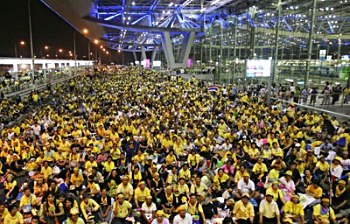
Thailand’s long-simmering political crisis finally made it onto Western TVs this week when protesters closed Bangkok’s international airport, disrupting [shock horror] Western tourists.
The essence is that the People’s Alliance for Democracy, the guys in the yellow shirts who’ve shut down the airport, want prime minister Somchai Wongsawat (สมชาย วงศ์สวัสดิ์) to resign. They reckon he’s the puppet of a former corrupt prime minister, Thaksin Shinawatra.
You could argue that Somchai’s election, while controversial, was constitutionally valid. But PAD has run out of patience with the string of corrupt and presumed-corrupt politicians. Even the army chief reckons it might be time to call fresh elections to clear the air. But Somchai won’t budge.
This isn’t a simple story of The People versus the Evil Politician though. The roots of conflict go deep into Thai history and culture.
Forget Western ideas of Left versus Right, monetary policy, industrial relations, or involvement in foreign oil wars. Thai voters don’t have that sophisticated a political education. Thai politics is about myriad factions, popular leaders who’ll solve your problems and “Who’s side are you on?”
We can trace one key theme from the 1960s when Bangkok, like so many Third World capitals, sucked in all the people and resources from the rural hinterland to create a modern metropolis. The 1980s and early 1990s saw massive growth too. But rural Thais, particularly in the heavily-populated farmlands of the north and north-west, felt left out.
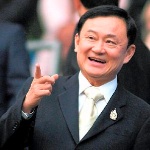
In 2001 Thaksin Shinawatra (à¸à¸©à¸´à¸“ ชินวัตร), a billionaire telco magnate, became that popular leader. He barraged poorly-educated rural voters with the best political marketing and pork-barrelling they’d ever seen.
In a landslide victory, Thaksin’s Thai Rak Thai party (ไทยรัà¸à¹„ทย, literally “Thais Love Thais”) became the first ever to achieve a clear majority in Thailand’s multi-party parliament. His policies helped alleviate rural poverty and claimed to provide universal health care. His re-election in 2005 had the highest voter turnout in Thai history.
However Thaksin’s government was plagued by allegations of corruption, conflicts of interest, tax evasion, lèse-majesté — even treason. This culminated with the January 2006 sale of his family’s remaining interest in Shin Corporation, the largest mobile phone operator in Thailand, Laos and Cambodia, to Singaporean interests. His family made US$1.88 billion — on which they paid precisely zero tax. Rural folk might perhaps see that as a canny business deal. Urban middle-class Thais were appalled.
In September 2006, amid continuing anti-corruption investigations and protests which had been running more than a year, Thaksin left the country for a meeting in New York. As soon as he was out of the country, tanks rolled onto Bangkok streets, the soldiers wearing yellow ribbons to denote their loyalty to the King, the much-loved Bhumibol Adulyadej.
Thailand knows how to do military coups. Well organised. Not a single shot was fired.
My Thai partner ’Pong once overheard a TV report about some other country which had experienced three military coups since the 1960s or whatever. He shouted back, “Is that all? You fucking amateurs!”
Thaksin’s TRT was declared an illegal political organisation. A new constitution was drawn up and fresh elections were held in December 2007.
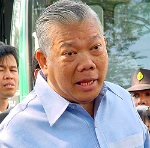
The leading party was People Power Party (PPP) headed by former deputy prime minister, Governor of Bangkok and Thaksin loyalist Samak Sundaravej (สมัคร สุนทรเวช).
On Australia’s SBS TV, Samak was asked about claims the PPP was just TRT re-formed, and he merely a front for Thaksin’s interests. “So what if I am?” he retorted.
PPP didn’t achieve a clear electoral majority. But a coalition with tiny minority parties pushed them over the line and Samak became Prime Minister. Resentment simmered.
Samak Sundaravej is a deeply controversial politician.
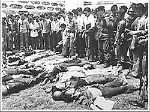
In 1976 there was a massacre at Thammasat University when police, army and other forces opened fire on students protesting the return of an ousted military dictator. Officially the death toll is 46, but it was probably much higher
Samak has been identified as the chief operator of the ultra-right Armoured Car radio program, which incited hatred against the students, calling them communists and claiming they were “committing suicide”. Only one Thai media outlet reported that the massacre had even happened, the leftish English-language newspaper The Nation.
To this day, though, Samak claims there was only ever one death.
Samak was even sentenced to two years in jail for defamation, having accused another politician of accepting accepting bribes. The case was still going through the Appeal Court at the time of the 2007 elections.
Samak was hounded by the People’s Alliance for Democracy (พันธมิตรประชาชนเพื่à¸à¸›à¸£à¸°à¸Šà¸²à¸˜à¸´à¸›à¹„ตย). Originally a coalition of protesters against Thaksin’s government, PAD consists of middle and upper-class people from Bangkok and the South, supported by the conservative elite and factions of the Thai Army, some leaders of Democrat Party, and leaders of state-enterprise labour unions. They disbanded when Thaksin was ousted, declaring their aims achieved, but re-formed when Samak was elected.
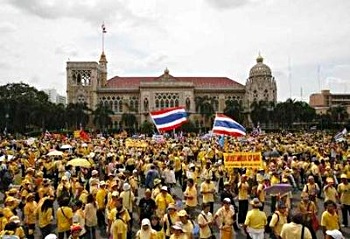
On 26 August 2008, PAD occupied the grounds of government buildings in Bangkok’s Old City in their tens of thousands, calling for Samak’s resignation.
Well-organised and well-funded, they barricaded themselves in with barbed wire, bamboo spikes and an impromptu electric fence, and were joined by their paramilitary force, the Srivichai Warriors. They resisted numerous police attempts to clear them away.
On 2 September, Samak declared a state of emergency. Army chief General Anupong Paochinda (à¸à¸™à¸¸à¸žà¸‡à¸©à¹Œ เผ่าจินดา), one of the leaders of the 2006 coup against Thaksin, declined to intervene, saying it was a civil matter.
The stalemate was resolved not on the streets of Bangkok but in the Constitutional Court.
Samak is also a celebrity chef, presenter of the popular TV program Tasting, Ranting.
On 9 September 2008, the Constitutional Court ruled that Samak’s paid TV gig was illegal moonlighting and ordered him to step down. He did. A short time later his appeal against his defamation sentence failed. 73-year-old Samak skipped bail and headed for the US, supposedly seeking treatment for his liver cancer.
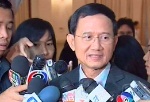
Parliament, after some confusion, chose a new prime minister: Somchai Wongsawat (สมชาย วงศ์สวัสดิ์). Thaksin’s brother-in-law.
Unsurprisingly, PAD sees him as a corrupt puppet.
Meanwhile, earlier in 2008, Thaksin and his wife Potjaman Shinawatra had returned to Bangkok to face their corruption charges. They were immediately arrested and charged, but released on bail. Potjaman was found guilty of illegal property dealings and sentenced to three years imprisonment, but released on bail pending appeal. Her adopted brother Bhanapot Damapong and her secretary were also found guilty. Thaksin himself awaited trial. However Thaksin and Potjaman were allowed to visit Beijing for the 2008 Olympic Games and did a runner, first to the UK, then east Asia.
Thaksin was tried in absentia, found guilty and sentenced to two years jail. He was last seen in Dubai, where he said he will not appeal the sentence and will make a statement on 14 December.
Which brings us to 7 October 2008… with both previous prime ministers Thaksin and Samak guilty of criminal offences, sentenced to jail and on the run.
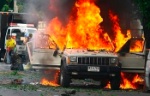
PAD, who’d now been occupying government house grounds for weeks, gave new prime minister Somchai until 6pm to resign. A car bomb killed a middle-aged man — possibly the bomber himself. The ultimatum expired. The demonstration exploded into riot. The prime minister was evacuated through the back fence and helicoptered to safety.
In the subsequent teargas attacks and gunfire, there was another death and at least 381 injured. It was Bangkok’s worst violence in 16 years. Finally, tanks rolled onto the streets of the Old City to restore order.
In the weeks since then, it’s been further stalemate.
PAD has continued its occupation and their demands for Somchai’s resignation. They’ve threatened that their union members will cut electricity and water services, and their wealthier backers will lead a bank run to destabilise the economy — though neither has happened yet. Meanwhile, red-shirted pro-Thaksin forces have been mobilising in opposition.
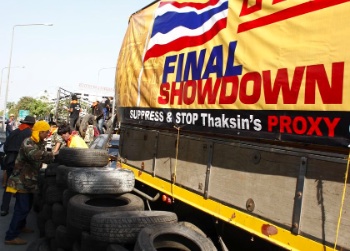
Monday this week, PAD announced it was time for the final showdown.
Violence has escalated, including PAD’s protest moving to Bangkok’s old airport at Don Mueang (DMK) in the northern suburbs, where prime minister Somchai had moved his cabinet, and then the new Suvarnabhumi international airport (BKK), which has been closed since Wednesday.
Prime minister Somchai, returning to Thailand after the APEC meeting in Peru, has chosen to stay out of harm’s way in the northern regional city of Chiang Mai.
And today…
As I write this, it’s Saturday morning Bangkok time. PAD has said it’ll keep the airport closed until Somchai resigns. Police say PAD has 4000 permanently encamped at Suvarnabhumi, which PAD has barricaded with razor wire, and a further 2500 at Don Mueang — though their hyperconnected mob could quickly summon many, many more.
PAD is openly calling for a military coup, but General Anupong continues to say a coup won’t solve the country’s problems. “If the people are one, we are with the people. But, if the people are divided, there is no place for us,” he’s been quoted as saying. “The way out through taking control over the country by the military is a closed door and no more… No one should try to take this way.”
However Somchai has sacked his police chief, declared emergency rule, and authorised police to storm the airports and other occupied sites. Former prime minister Thaksin is believed to be pulling the strings from Dubai.
PAD has vowed a fight to the death.
Thank you. Any questions?
Stil,
an excellent backgrounder mate – well put and balanced.
I’ve always found Thai’s to be such peaceful people that I felt there must be something behind all this to get them so riled.
The bigger question is why so many emerging countries struggle with democracy over tribal/ethnic loyalties. I think there needs to be a middle step to prepare the citizens for the responsibilities of citizenship.
Its no good a Dr telling a sick man to get better, you have to help and educate.
Preaching democracy and proving cash is a failed western world strategy.
Excellent. A comprehensive and readable summary of the situation.
Thank you, gentlemen. I’ve been getting some good feedback about this piece, so I’m glad I spent the time writing all 1600 words.
The latest news from Bangkok is that police fired some shots at Suvarnabhumi airport this morning, but their advance was repelled by PAD occupiers. I also heard that cellphones at the airport were cut off just before the police moved in.
The police have lost a checkpoint, and two trucks captured by PAD. One police officer was also captured and taken into the airport for “questioning”.
Night has just fallen in Bangkok…
Overnight, there seems to have been a slight escalation of violence in Bangkok, and the political options have become clearer — at least to me.
PAD protesters are still occupying Suvarnabhumi international airport, which is eerily quiet with operations shut down. CNN reporter Dan Rivers is surprised no-one has looted the duty-free plaza, but then he obviously doesn’t understand Thai politeness.
He does note that he could just walk around the airport. Customs and security checkpoints are unmanned, a risk to aviation security.
The police have been unsuccessful in their attempts to clear the airport — but then their actions have been amazingly restrained by Thai standards. ’Pong has previously said, “Oh they’re gassing the crowd, how polite.” He wasn’t being sarcastic: in the past, the police would have just opened fire. No-one was hurt in yesterday’s police advance and, as I said, the police lost control of one checkpoint and some vehicles.
One analysis I’ve read (not on the web) noted that police chief General Patcharawat Wongsuwanbut wasn’t exactly a fan of prime minister Somchai Wongsawat and was resisting carrying out his emergency-decree orders — but then he was sacked on Friday and there are still plenty of Thaksin loyalists in the Royal Thai Police.
There has been a grenade attack at Government House, wounding 46 — presumably pro-Thaksin forces attempting to scare off the PAD occupiers. However PAD leaders say their people are not afraid.
What happens next probably depends on PAD’s actions, and on how eager the police are to carry out orders to clear the airport. PAD have agreed to talk, but have said they will not vacate the airport unless Somchai resigns — that’s non-negotiable, they say. But every day the airport is closed costs Thailand big money.
The police will eventually be ordered to clear the airport by force — but will they obey? If not, then the PM has clearly lost control of all his security forces, as the army has clearly said it will not intervene.
Interesting follow up. My view was that the police went in to fail with the caveat that they could use it as an excuse when they use brute violence later. But if there is nobody to do that then indeed they may just have Thailand by the testicles and force a new election. An old friend always said that it was Thai Rak Thai, but TRB with B standing for the Baht.
Stil (and ‘pong)
Thanks for explaining the current state of affairs in Thailand to me in a simple manner. Excellent read: I was not aware that Thaksin was the puppeteer.
It seems to me that the power lies in the hands of the Royal family and the army. In the Thai constitution (for what its worth) — who controls the army?
Nick
@Charles Frith: I think I’m with you about the police intending to fail yesterday. Presumably they want to negotiate but will have been ordered to move in with force if negotiations fail. It would be interesting to know how many of the police officers on the ground sympathise with PAD and how many with the pro-Thaksin red-shirts.
Yes, the TRT is all about the money. Thaksin, with his personal lazy billion(s), could find persuasive campaigns. And, to his government’s credit, the rural village rejuvenation programs really do seem to have improved the lives of many rural poor. I remember seeing some of the results at a Thai trade fair here in Sydney — the new village-based industries were getting solid international promotion.
As I said before, rural Thais would still see bribery and kickbacks in those property development and telco deals as “normal business practice”. And they’d see PAD as spoiled, selfish rich folk from the city who can’t accept the election result.
@Nick Hodge: The King is the commander-in-chief of the Royal Thai Army.
Interestingly, AFP and other news agencies are saying that PAD is supported by “elements of the palace”. Not “possibly” or “assumed to be”, but a definite “are”.
In a totally unprecedented event, the Queen attended the funeral of a PAD demonstrator killed on 7 October. She also held a private conversation with one of the PAD leaders, who later said — alas, I can’t find the story just now — that they only spoke about “an unimportant personal matter”. Sure.
Stil (and ‘pong: the brains of this operation)
Next question that I hope doesn’t get you into trouble.
Recently an Australian was arrested for negative comments in regards to the Thai Royal Family (link not right at hand)
And you have stated that the Thai Royal Family is “much loved”. It seems that PAD are somehow involved; what about the large rural populace who voted in Thaksin? Are they traditionalist/royalist per se?
If this is a demonstration-by-proxy (ie: PAD forcing change, not Royal Family directly) … it sorta is obvious that the Army would go-gentle on the demonstrators. ie: polite use of Tear Gas vs. NATO-standard bullets.
The struggle for power is between the commercial/populist TRT (or Thaksin Rak Bhat LOL) and traditionalist/loyalist Royal Family … in broad terms …
… however, I will take into account ‘Pongs perspective that this is not a pure A-vs-B thing … so knowing some of the other grey areas would be great.
Nick
@Nick Hodge: Wow, yes, tough questions! I don’t know that it’s so much the palace operating by proxy through PAD, but that they see PAD as offering the best current hope for stability. That’s only my speculation as an ignorant farang, though. I would not be at all surprised if there were various factions within the Thai royal family too — after all, has any country’s monarchist politics been simple?
One of reasons Thailand’s King Bhumibol Adulyadej is so highly regarded is that he’s steered Thailand through such a tumultuous period since WWII without the country completely disintegrating — especially when compared with neighbouring Burma/Myanmar, Laos and Cambodia.
Nevertheless the King turns 81 this week, and his health is not the best. Will his son the Crown Prince follow with similarly subtle political skills?
Interestingly, the Wikipedia article on PAD says:
All is not as it seems…
For another interesting view on the situation, try Thailand: How will the airport chaos end?. The author is blatantly anti-PAD, saying, “PAD is vilified by almost everybody outside Thailand” and omitting to mention any of the criticisms of the Somchai government.
There’s a rumour doing the rounds that Thailand’s Constitutional Court will disband the People Power Party, which would give the army a more-or-less valid reason to take control and call fresh elections. I guess we’ll find out later today.
@Nick Hodge: Yes, an Australian write was charge for mentioning something in his book. In my opinion, Lese Majeste becomes more and more of a witch hunt.
The monarchy is way above political conflicts. Even though the Queen went to one of PAD protesters, the monarchy is still much loved in the rural.
I suspect that Thaksin uses the opportunity of the unhealthy King to speak up to get back in the politics because he’s the only one who could say stop, morally not legally.
I think it’s fair enough for the King not to get involved this time. Thais should learn to sort their problems. Court is working on it although they don’t have moral power as much as the King.
Do I answer your question?
Thanks for getting all the background information clear for me; I’d been getting confused by what was on the news.
Thanks for writing this Stil. Superbly done. It has all become clear to me now.