I’ll announce the broadcast time for His Benevolence Stilgherrian’s Christmas Message late this afternoon Sydney time. In a few hours, in other words. Meanwhile you can still nominate your preferred time in that previous post.
Gonzo Liveblog 2: Last Sunday before Christmas
I’m caving in to pressure. Following the success of my first experiment, Gonzo Twitter 1: Saturday Evening in Newtown, at 6.30pm or thereabouts I will liveblog from King Street, Newtown, or wherever the mood takes me on this fine Sunday evening.
Wow, that’s in just a few minutes! [Update 22 December: No, it was last night. But you can still see what happened in the CoveritLive tool immediately below the fold. The timestamps seem to be an hour early though.]
Continue reading “Gonzo Liveblog 2: Last Sunday before Christmas”
Fine posts for 2008
Given that mere popularity doesn’t reflect quality, here’s my personal selection of my best, timeless posts for 2008. Happy reading!
- Kruddiversary: The internet thanks you for 12 months of achieving nothing, my Crikey article looking at the first year of the Rudd government from an Internet geek’s perspective.
- Thailand’s political crisis: an introduction, though later pieces in The Economist are better than my amateur efforts.
- Journalism in a hyperconnected world.
- @KevinRuddPM stumbles into the Twitterverse, a Crikey article which includes links to the previous three essays I’d written about the PM’s entrance into modern social media.
- Gonzo Twitter 1: Saturday Evening in Newtown, my experiment in live-tweeting a descriptive essay and still one of the best things I’ve written all year.
- How Dell fixed my monitor order, which is being used by clever consultants as an example of how to use social media for quality customer service.
- Sunday Thoughts about Journalism, a rather lengthy essay with many links to background on the Death of Newspapers this year.
- Finally, The Shave, a rather wonderful film we made.
- The Great Firewall of China: how it works, how to bypass it.
- Note to “old media” journalists: adapt, or stfu! This piece triggered an entire wave of discussion and was quoted globally.
- Winter Solstice Meditation.
- Anzac Day Rememberings.
- ABC Playback: so this is the future of television…? Nope! A review of what’s now called ABC iView.
- There ain’t no shortcuts to professionally-managed IT.
- Remembering the Space Age: Arthur C Clarke dead at 90.
- Super Hornets are Go.
- Jason Calacanis and the Evil Cult of the Internet Start-up. I don’t really think Jason is evil, but I do worry about the self-centred anti-human attitude of many people connected with Internet start-ups.
- New national anthem: I am So an Aussie, when the Snarky Platypus and I created, yes, a new national anthem. Aussie! Aussie! Aussie! Oi! Oi! Oi!
- Is it really so wrong to mix business and politics (and religion)?
- Leaving room for elephants: a chat with David Attenborough, a personal fave since it harks back to an interesting time in my life. This is still one of the most enjoyable interviews I’ve done. Ever.
- Angry geeks: “Don’t waste money on internet filters”, one of many articles I posted about censorship, but which outlined the key issues way back in January.
- Post 801: Kill the Hallucinating Goldfish.
Most popular posts of 2008
Following established mainstream media tradition, my year-in-review pieces will start appearing well before Christmas. He’s a list of the most-read items on this website for (most of) 2008.
- Heath Ledger dead: jokes here please. It’s rather depressing to discover that my tasteless little experiment was this year’s highlight. Maybe I should’ve put advertising on this page.
- So this is human sexuality?
- How do you treat your staff? Like 37signals, or like this prick?
- Topic 9 to discuss Australia 2020 Summit’s government topic. This is actually spurious, as most hits are from link-following robots attempting to spam my blog at topic9.com.au (which has been since been abandoned).
- 67 Australian SAS captured airbase defended by 1000, though most of this traffic is to see the photo. The miltech fanboys are incapable of hosting their own photos, it seems, because most of their troll-filled forums don’t allow people to upload photos. Dark Ages.
- About Stilgherrian, which would seem to be a popular second page for people to visit once they’ve arrived here for other reasons.
- Corey Delaney, freedom fighter (for the right to party) — and increasingly I think Mr Corey Worthington Delaney is one of the true heroes of 2008. But not thereafter.
- Spaceport America, designed by Foster+Partners.
- Jason Calacanis and the Evil Cult of the Internet Start-up.
- Achtung! Die grosskapitalistischen Hühner kommen!
As with last year’s list, I’m somewhat disappointed with the results. I’ll therefore choose my own selection of “best” posts, just like I did last year.
When should I deliver my Christmas Message?
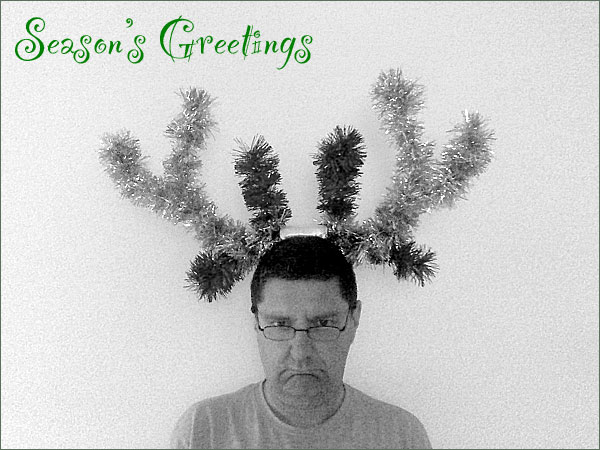
OK, the photo is from last year, but I couldn’t be bothered doing another one just yet. However, I have an important question for you!
Next Thursday is Christmas Day, and I’ve decided to do a special edition of Stilgherrian Live called His Excellency Stilgherrian’s Christmas Message His Benevolence Stilgherrian’s Christmas Message [see comments]. Something along the lines of Her Majesty’s little efforts from 2007 or 1957.
The question is: What time on Christmas Day should it be broadcast. In the afternoon at 3pm? Certainly not the usual 9.30pm, as everyone will have collapsed by then. But when? And what else should the program contain?
On political reporting

Crikey‘s Bernard Keane has written a magnificent 2000-word wrap of the year in Australian politics, 2008: Dashed dreams and mouldy political compromise. Every sentence is worth reading — but especially his observations about the links between politicians and the media.
Politics is more or less based around people of high principles and good will discovering that the obtaining and exercising of power involves doing bad things, distasteful things, amoral things, involves unpleasant trade-offs and not just the famous half-loaves of compromise but stale, mouldy crusts. And it’s all the more that way because its symbiotic partner, its Siamese twin the media, dislikes complexity and nuance, in favour of the same simple narratives, repeated with an ever-changing cast of characters but the same plots and moral lessons over and over again. That’s what sells. And what gets votes.
It’s the media’s job, or one of them, to make much of little and it has done that expertly for much of the year, as it does always. History suggests that, barring incompetence on an inordinate scale, Labor will be in power for several terms, but that’s not going to attract many eyeballs. Instead, the most minor political events are forensically analysed, with each tiny feature placed under the microscope so that it looms large to the viewer despite its irrelevance. Recall The Australian’s concerted push for Peter Costello mid-year, undoubtedly motivated not just by a sense of mischief-making but by the moderate inclinations of the obvious alternative to the failing Nelson. After more than a year on the backbench, not a scintilla of evidence has emerged that Peter Costello ever intended to do anything other than what he said, which was to remain on the backbench until he found a job outside politics. And yet we — as in all of us — devoted many pixels and column inches to his imminent ascension, or the unlikelihood thereof.
Afterwards, we forgot all about that, and probably hoped our readers did too.
Never forget the media has a vested interested in convincing you something is happening even when precisely nothing is happening — indeed, particularly when nothing is happening. It is thus wise – and I’m possibly not telling you anything you don’t already know here — to retain a strong scepticism about all political reportage and analysis, no matter the source. We’re all selling something.
OK, I’m biased. I write for Crikey every now and then. But this is why I’d buy it anyway.